Sales Compensation

What On-Target Earnings (OTE) Really Means and How to Calculate It

Ask ten sales reps what OTE means and you'll get ten different answers. Some think it's their salary. Some think it's guaranteed. Some think it's a number recruiters made up to make a job posting look better than it is.

On-Target Earnings, or OTE, is one of the most misunderstood terms in sales compensation, and that confusion costs people real money and real trust. Candidates accept offers they don't fully understand. Reps hit quota and still feel confused about their paycheck. Finance teams build comp plans that nobody on the floor can explain in one sentence.

This guide breaks down exactly what OTE means, how to calculate it, and how it's different from base salary and total compensation. You'll walk away knowing how to read an offer letter, build a comp plan, or explain your own earnings potential without the guesswork.

What Is On-Target Earnings (OTE)?

On-Target Earnings is the total amount a salesperson can expect to earn in a year if they hit 100% of their quota. It's not a bonus on top of salary. It's not a best-case fantasy number. It's the standard, expected outcome for someone doing the job at the level it was designed for.

Companies use OTE because it gives candidates and employees a complete picture of earning potential, not just the guaranteed piece. A $60,000 base salary sounds very different from a $60,000 base with a $120,000 OTE. Both numbers matter, and OTE tells the fuller story.

For sales professionals, OTE matters because it's usually the number you're actually being sold on. It shows up in job postings, offer letters, and recruiter pitches. If you don't understand how it's built, you can't judge whether it's realistic or whether you're being handed an inflated number to close the deal on you.

Why OTE Is Important in Sales Compensation

OTE isn't just a recruiting number. It does real work inside a sales organization.

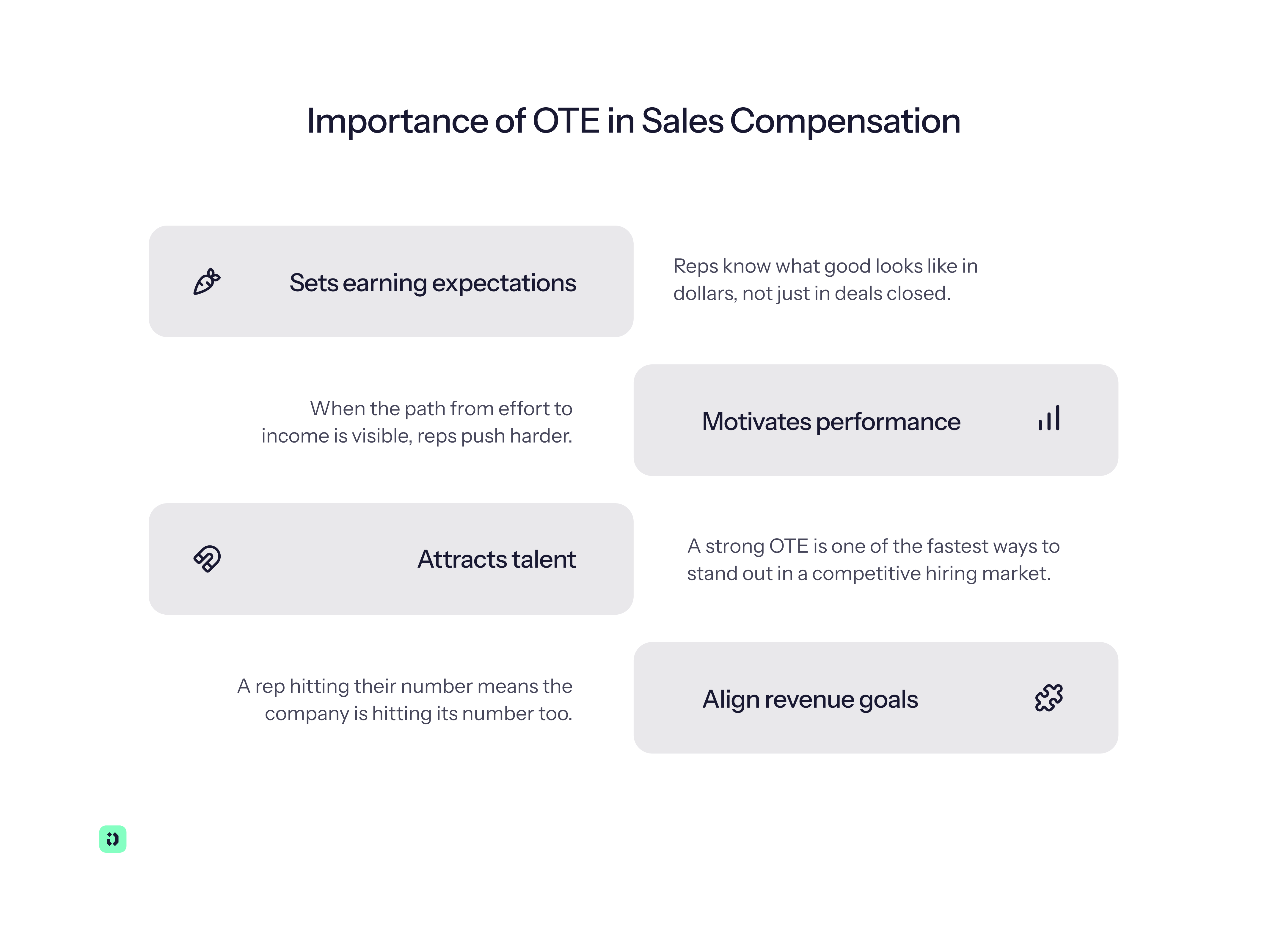
  • It sets earning expectations. Reps know what "good" looks like in dollars, not just in deals closed. That clarity matters more than most comp plans give it credit for.
  • It motivates performance. When the path from effort to income is visible, reps push harder. Vague comp plans do the opposite: they make people guess, and guessing kills motivation.
  • It helps companies attract talent. A strong OTE, backed by a realistic quota, is one of the fastest ways to stand out in a competitive hiring market. Candidates compare OTE numbers the same way they compare base salaries.
  • It aligns compensation with revenue goals. When OTE is built correctly, a rep hitting their number means the company is hitting its number too. That's the whole point of variable pay: everyone rows in the same direction.

Understanding why OTE matters is one thing. Knowing what actually builds the number is another, and that starts with two components.

What Makes Up OTE?

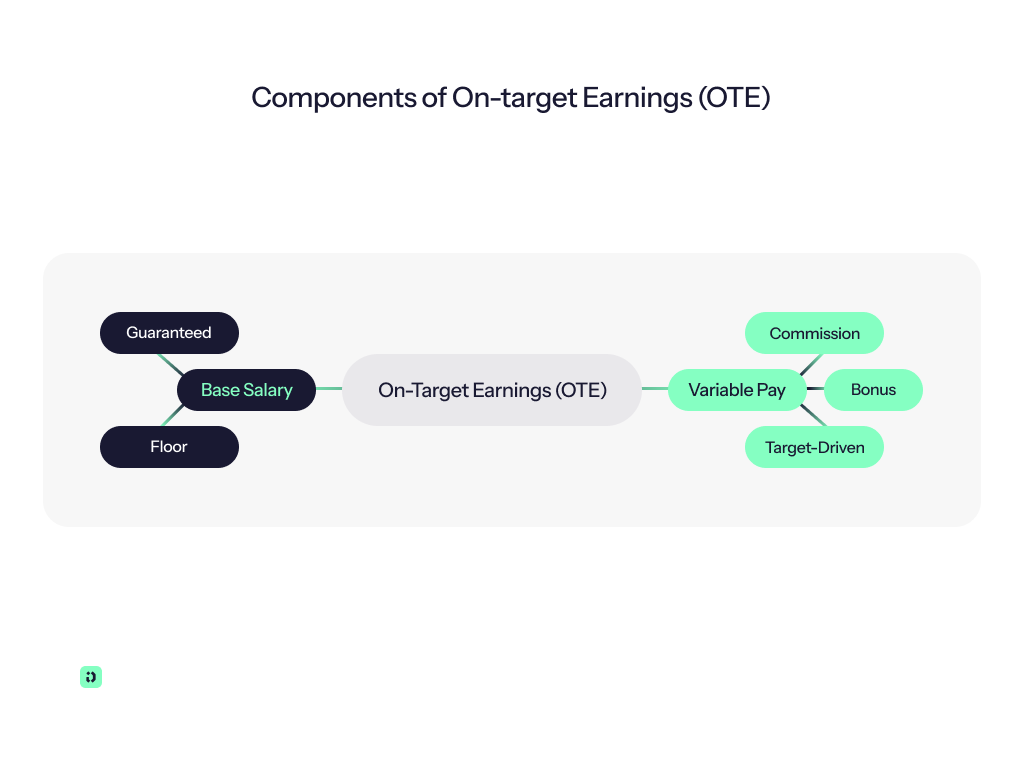
OTE has exactly two parts. No hidden third bucket, no equity folded in, no perks disguised as pay.

  • Base Salary is the guaranteed portion. It shows up in your paycheck whether you close zero deals or blow past quota. This is the floor.
  • Variable Pay is the commission or bonus tied to hitting targets, usually quota. This is the part that's earned, not given, and it's where OTE gets its name: On-Target Earnings assumes you hit the target. There's more than one way to structure this piece, so if you want the full breakdown, see our guide to variable incentive pay types.

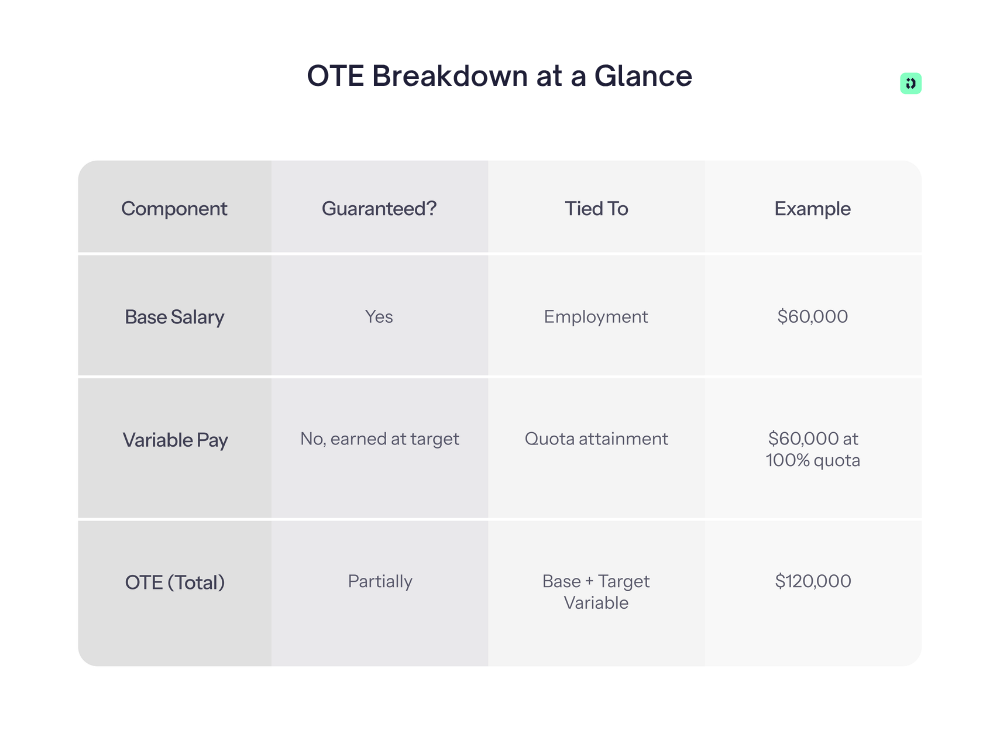
That table is the whole concept in one place. Once you see it broken out like that, the formula almost writes itself.

How to Calculate OTE

The OTE formula is simple:

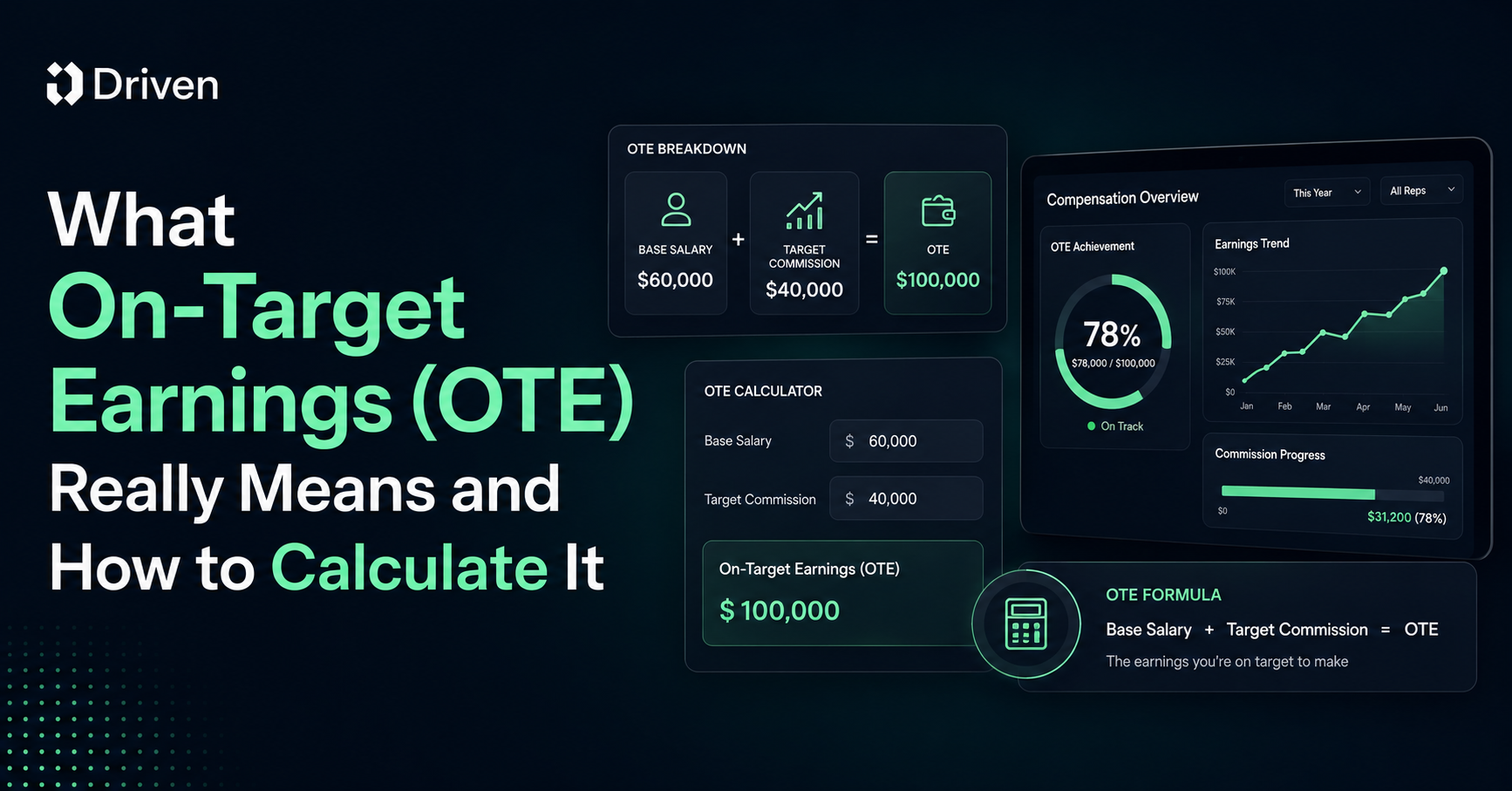
OTE = Base Salary + Target Variable Pay

Base Salary is fixed and stated in the offer. Target Variable Pay is the commission or bonus a rep earns specifically at 100% quota attainment, not at overachievement, not at some stretch scenario. Just the standard target.

The part people get wrong is assuming variable pay is a bonus on top of a "real" salary. It's not extra. It's earned income tied directly to hitting a number the company already decided was fair and achievable. If the quota isn't realistic, the whole OTE number becomes theoretical rather than practical, which is a problem we'll come back to later.

Once you know the two inputs, the math takes seconds. The real value is in seeing it applied across different sales roles, because OTE structure changes a lot depending on seniority and deal complexity.

OTE Calculation Examples

Here's how the formula plays out across three common sales roles.

Example 1: SDR (Sales Development Representative)

  • Base Salary: $50,000
  • Target Variable Pay: $20,000
  • OTE = $50,000 + $20,000 = $70,000

SDRs typically have a lower variable component because their role, booking qualified meetings, is closer to activity-based than revenue-based.

Example 2: Account Executive

  • Base Salary: $70,000
  • Target Variable Pay: $70,000
  • OTE = $70,000 + $70,000 = $140,000

A 50/50 split between base and variable is common at the AE level, where quota is tied directly to closed revenue.

Example 3: Enterprise Sales Rep

  • Base Salary: $110,000
  • Target Variable Pay: $110,000
  • OTE = $110,000 + $110,000 = $220,000

Enterprise reps carry bigger quotas and longer sales cycles, so OTE scales up, but the base-to-variable ratio often stays balanced to reflect both the deal size and the risk of a longer close.

Notice the pattern: as deal complexity and quota size grow, both halves of the equation grow with them. That's by design, not coincidence.

OTE vs Base Salary vs Total Compensation

These three terms get used interchangeably, and that's exactly where confusion starts. They're not the same thing.

Base salary is the floor. OTE is the target. Total compensation is the full picture, including anything OTE doesn't capture, like equity grants, signing bonuses, or benefits value. When you're evaluating a job offer, ask for all three. A recruiter who only gives you OTE isn't lying, but they're not giving you the whole story either.

OTE also isn't the only way to structure a plan. If you're comparing options, our breakdown of sales compensation structure types covers which model fits which kind of team.

Can You Earn More Than Your OTE?

Yes, and for a lot of reps, that's the whole point of being in sales.

  • Accelerators increase the commission rate once a rep passes 100% quota. Instead of earning the same rate on every dollar, reps earn more per dollar as they overperform.
  • Overachievement simply means closing more than target. If quota is $1M and a rep closes $1.3M, they're overachieving by 30%, and their pay should reflect that.
  • Uncapped commission removes the ceiling entirely. There's no maximum payout, so a huge quarter can mean a genuinely huge check.

Real-world example: An AE with a $140,000 OTE and a 1.5x accelerator above 100% quota closes at 130% attainment. Instead of earning a flat $140,000, their variable pay above target gets multiplied, pushing total earnings closer to $161,000 for the year. That gap is the entire incentive behind variable compensation: the better you perform, the more the plan pays you back.

This only works, though, if the underlying comp plan is built well. And a lot of them aren't.

Common OTE Mistakes Companies Make

Most OTE problems aren't about the formula. They're about execution.

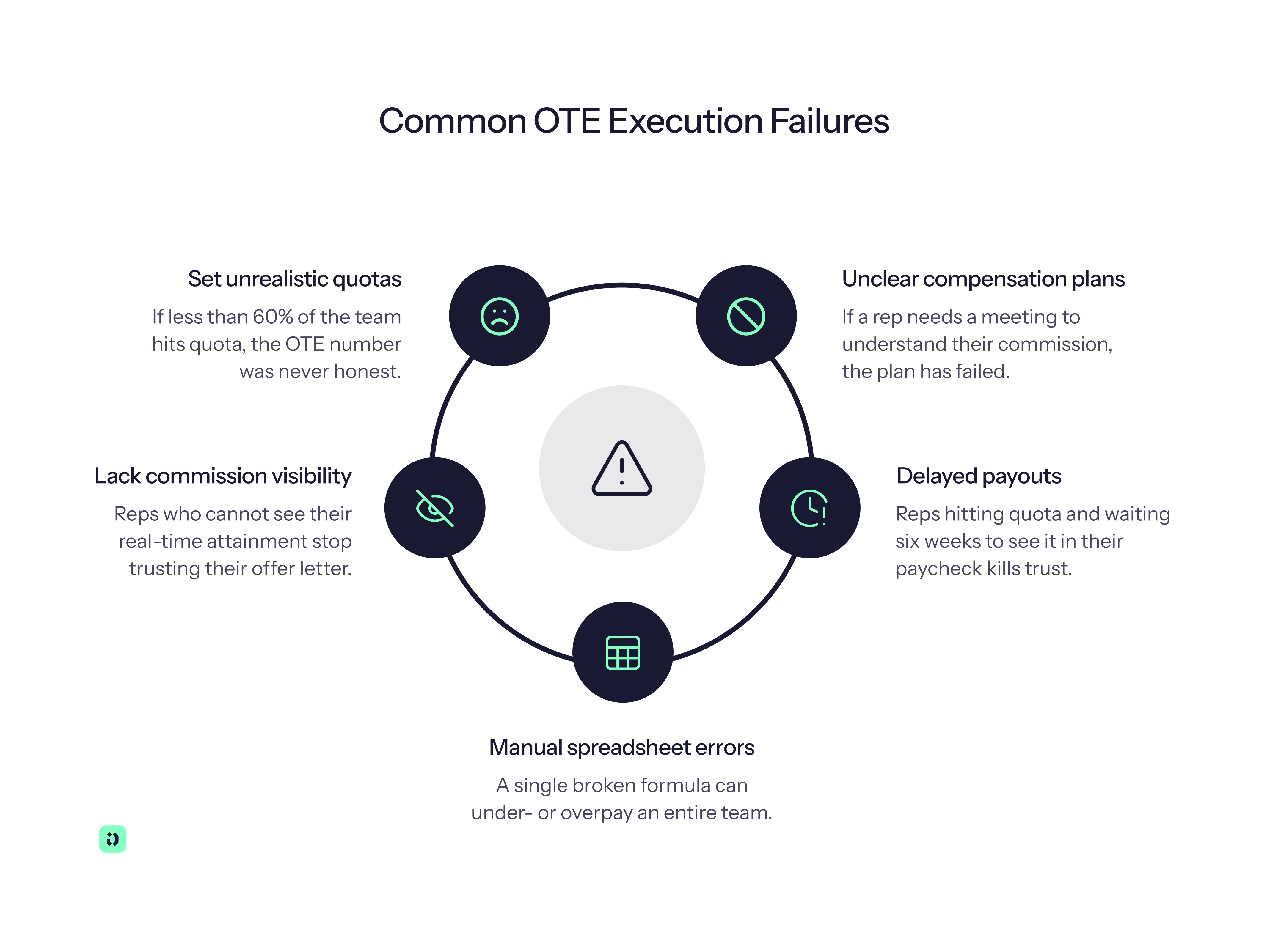
  • Unrealistic quotas. If less than 60% of the team hits quota, the OTE number was never honest to begin with. The sales compensation statistics every RevOps leader should know back this up: attainment rates below that threshold are a plan design problem, not a talent problem.
  • Poor commission visibility. Reps who can't see their real-time attainment stop trusting the number on their offer letter.
  • Manual spreadsheet errors. A single broken formula can under- or overpay an entire team, and nobody notices until finance reconciles at quarter end.
  • Unclear compensation plans. If a rep needs a meeting to understand how their own commission is calculated, the plan has failed. Starting with a solid framework, like our guide on how to build a sales compensation plan, prevents most of this.
  • Delayed payouts. Nothing kills trust in OTE faster than a rep hitting quota and waiting six weeks to see it in their paycheck.

Every one of these mistakes traces back to the same root cause: comp plans that live in spreadsheets instead of systems built to manage them. It's also why overcomplicating commission plans kills performance just as fast as vague ones do.

Managing OTE Without Spreadsheets

Here's the part most companies figure out the hard way. OTE is easy to define and hard to manage, especially once you're past a handful of reps.

The common challenges:

  • Manual commission calculations that eat hours every payout cycle
  • Formula errors that quietly under- or overpay reps
  • Zero transparency into how a number was actually calculated
  • No real-time way to track quota attainment mid-quarter
  • Constant, time-consuming updates every time a plan or deal changes

None of this is a people problem. It's a tooling problem. Once headcount and plan complexity grow past what a spreadsheet can safely hold, something has to give, and it's usually accuracy or trust.

That's where dedicated compensation management software comes in. Platforms built specifically for this job automate commission calculations, manage compensation plans centrally, and track quota attainment in real time instead of after the fact. Reps get visibility into their own earnings as they happen, which cuts disputes before they start. Finance gets forecasting they can actually rely on. And nobody's cross-checking a formula in row 4,000 of a spreadsheet the night before payroll runs.

This is exactly the gap Driven was built to close. Driven gives Finance, RevOps, and sales teams one accurate source of truth for compensation, from plan design to payout, so OTE stops being a promise on an offer letter and starts being a number every rep can trust and track in real time.

Conclusion

OTE is a target, not a guarantee. It's built from two clear pieces, base salary and target variable pay, and it only works when the underlying comp plan is realistic and transparent. Clear compensation plans don't just prevent disputes. They build trust, and trust is what keeps good reps motivated to hit the number.

As organizations grow, managing OTE by hand becomes harder to sustain and easier to get wrong. Solutions like Driven help automate compensation management, giving Finance, RevOps, and sales teams greater accuracy, transparency, and confidence in every payout.

Frequently Asked Questions

What does OTE mean?
OTE stands for On-Target Earnings. It's the total income a salesperson can expect to earn in a year if they hit 100% of their assigned quota, combining base salary and target variable pay.
Is OTE guaranteed?
No. Only the base salary portion of OTE is guaranteed. The variable pay portion is earned based on actual performance against quota.
Can you earn more than OTE?
Yes. Reps who exceed 100% quota can earn more than their OTE through accelerators, overachievement pay, or uncapped commission structures.
Is commission included in OTE?
Yes. Commission, or any variable bonus tied to quota, is the second half of the OTE formula, alongside base salary.
What is a good OTE?
A good OTE is one built on a realistic, achievable quota where the majority of the team, typically 60% or more, can reasonably hit target. The dollar amount itself varies widely by role, industry, and deal size.
Got a quick question?
Get directly in contact with our team.

Contact us

Contact us

Related Blogs

View All Blogs

View All Blogs

July 28, 2026
Sales Compensation

Understanding SPIFFs, Bonuses, and Commissions

A SPIFF (Sales Performance Incentive Fund) is a short-term cash incentive tied to a specific, immediate action, usually selling a particular product, hitting a short-window target, or pushing a specific behavior the company wants right now.

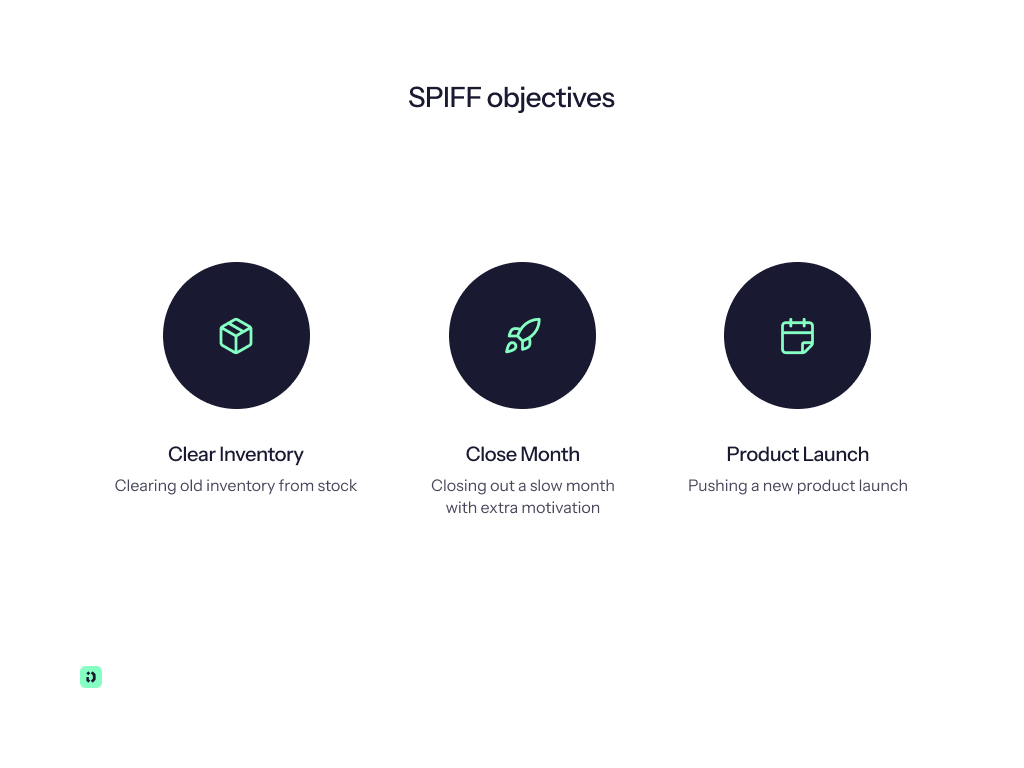
SPIFFs are built for speed. They're announced, run for a defined stretch, usually days or weeks, and paid out fast, sometimes even same-day or same-week, specifically because the immediacy is what makes them effective. A SPIFF isn't meant to replace commission, it's meant to temporarily redirect a rep's attention toward something specific: clearing old inventory, pushing a new product launch, or closing out a slow month with extra motivation.

Andres De Jonge
Co-founder & Tech
July 28, 2026
Sales Compensation

Non-Recoverable Draw vs. Recoverable Draw: What's the Difference?

A draw in sales compensation is a guaranteed advance payment made to a salesperson against their future commissions. This means it is an advance against future commission, paid out on a regular schedule, usually monthly, so reps have predictable income before their pipeline turns into closed deals and actual commission.

Companies use draws to protect new reps' income during ramp. A brand-new AE with a three-month sales cycle isn't going to close anything in week two, but they still need to pay rent. A draw bridges that gap.

For sales professionals, understanding draw type matters because it affects real take-home pay, not just cash flow timing. Two reps can be offered the exact same dollar amount as a "draw" and end up with completely different financial outcomes, depending on which type it actually is.

Ludovic Diercxsens
Co-founder & Growth
July 28, 2026
Sales Compenation

Sales Compensation Plans for SDRs vs AEs: What's the Difference?

Before comparing pay, it helps to be clear on what each role is actually on the hook for. They sit on the same team, but they're not doing the same job.

What Does an SDR Do?

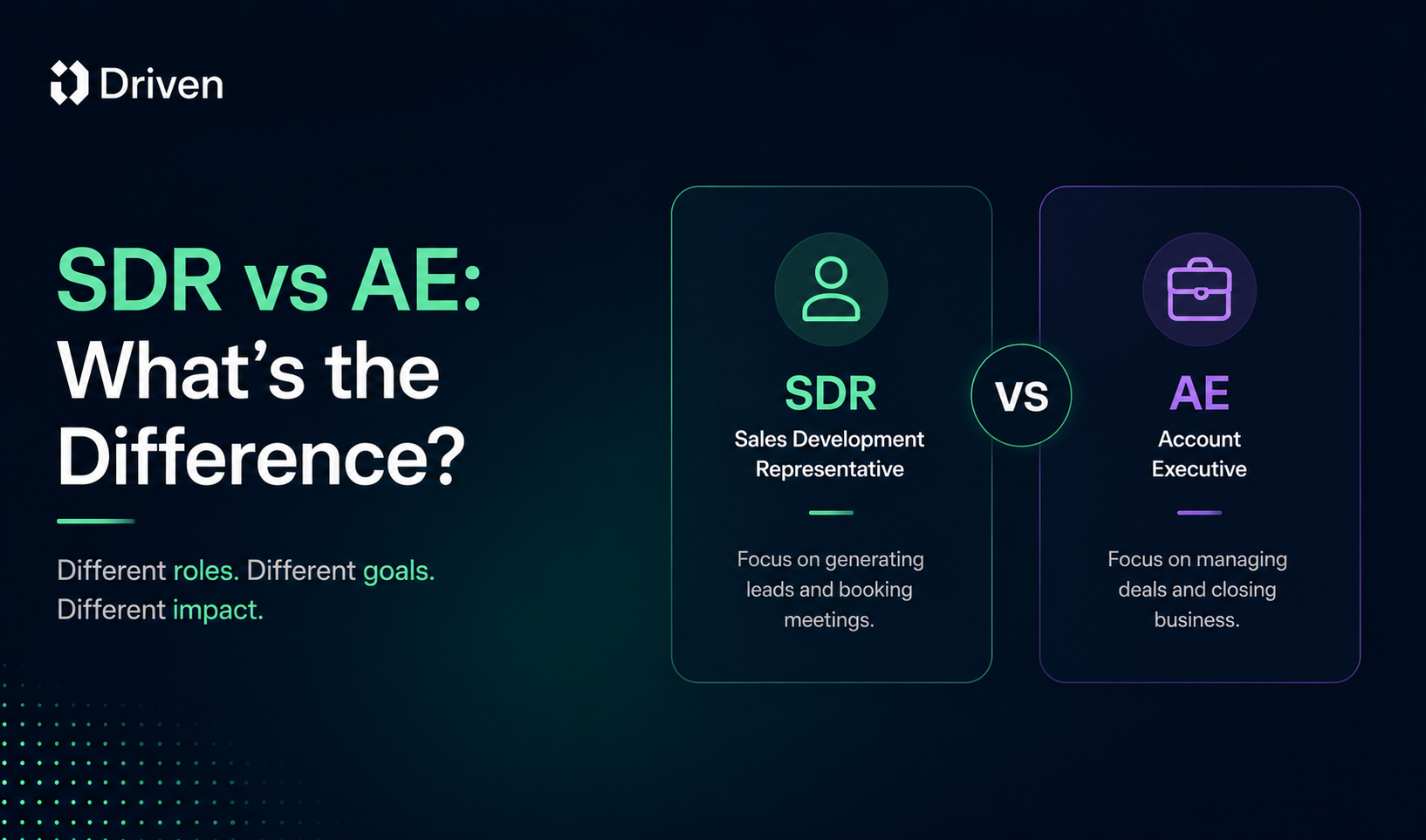
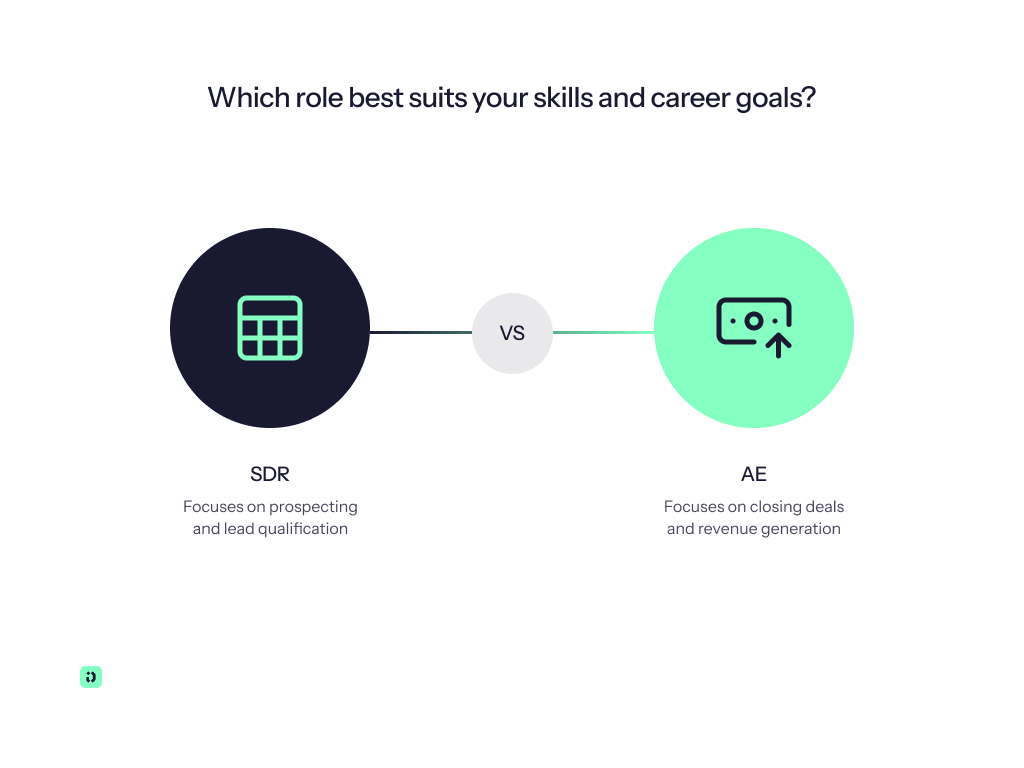
SDRs own the top of the funnel. Their day is built around prospecting, outbound outreach, and lead qualification, all pointed at one outcome: booking meetings and creating a pipeline for AEs to work. SDRs generally aren't responsible for closing deals. Their job ends where the AE's job begins.

What Does an AE Do?

AEs own the deal once it's qualified. That means running discovery calls, delivering product demos, negotiating terms, and closing the deal. AEs carry direct revenue ownership, and in a lot of organizations, they also handle account management once the deal is signed. The pressure sits differently here: an AE's number is measured in dollars closed, not meetings booked.

Tom De Kooning
Co-founder & Product