Why Overcomplicating Commission Plans Kills Performance


TL;DR
Most sales teams don’t fail because they lack effort or talent. They fail because the system meant to reward performance is too complex to understand. Commission plans are meant to drive behavior. But when they become overloaded with rules, tiers, exceptions, and calculations, they stop being motivational tools and start becoming confusion engines.
Modern compensation systems are evolving beyond manual design, with AI and automation reshaping how incentive structures are created and optimized. And once reps stop clearly understanding how their earnings work, performance drops, not because they stop trying, but because they stop trusting the system. This is becoming more important as AI is reshaping sales compensation systems and incentive design.
What Overcomplicated Commission Plans Look Like
Overcomplication in commission plans rarely shows up as a single obvious mistake. It usually starts small, an extra rule here, a new exception there, and gradually builds into a structure that becomes difficult to understand, manage, and trust. What once felt like “fine tuning” eventually turns into unnecessary complexity that slows down performance instead of improving it. Here’s what it usually looks like:
- Multiple tiers with unclear progression rules
- Different commission structures for different regions or products
- Frequent exceptions and manual overrides
- Several KPIs tied to payouts without clear hierarchy
- Bonus structures layered on top of already complex logic
- Lack of a simple “if I do X, I earn Y” clarity
If a sales rep cannot understand their earnings without using a spreadsheet or asking the finance team, the commission plan is too complicated. A good plan should be instantly clear and self explanatory.
The Real Cost of Complexity
Complexity in commission plans doesn’t just create confusion, it directly impacts revenue performance, team behavior, and operational efficiency. In many cases, it also leads to hidden costs that quietly reduce business performance over time.
What looks like a detailed and “well structured” system often ends up creating hidden friction across the entire sales organisation.
- Motivation Breaks Down: When outcomes feel unpredictable, reps stop optimising their behaviour around the plan. Instead of pushing for higher performance, they default to safer, more familiar actions that feel more controllable. Over time, this reduces ambition and slows overall sales momentum.
- Misaligned Selling Behaviour: Instead of focusing on strategic revenue driving activities, reps prioritise what they can clearly understand and measure in their own minds. This often leads to effort being directed toward easier wins rather than the actions that actually matter for business growth.
- Operational Burden Increases: Finance, RevOps, and Sales Operations teams end up spending significant time resolving disputes, explaining calculations, and handling exceptions. This shifts focus away from strategic improvement and turns compensation into a constant support function burden.
- Ramp Time Slows Down: New sales hires struggle to understand how they earn, which directly impacts how quickly they become productive. The longer it takes to understand the system, the longer it takes to build confidence and consistent performance.
Complexity doesn’t just affect compensation design; it impacts how sales teams think, act, and perform. Over time, it weakens alignment, slows execution, and reduces the effectiveness of the entire revenue engine.
Why Companies Overcomplicate Commission Plans
Most companies don’t intentionally design complicated commission plans. No team starts by thinking, “Let’s make this hard to understand.” Instead, complexity builds slowly over time as different needs, concerns, and decisions get added layer by layer. This problem is often only fully uncovered during a structured sales compensation audit.
It usually happens because:
- Trying to account for every edge case: Companies want to be “fair” in every possible situation, so they keep adding extra rules for exceptions. Over time, this makes the system heavier and harder to follow.
- Fear of reps “gaming” the system: To avoid misuse, companies add restrictions and conditions. While the intention is control, the result is often confusion and over engineering.
- Legacy structures that were never simplified: Old commission models often stay in place for years. Instead of rebuilding them, companies keep adding updates on top of outdated logic.
- Department level incentives added without system alignment: Different teams add their own KPIs or bonus structures without checking how they fit into the overall compensation design.
- Continuous patching instead of redesigning: Instead of simplifying the core structure, companies keep fixing small issues, which slowly turns a simple system into a complex one.
Individually, each change makes sense. But when all these layers stack up, they create unnecessary friction that makes the plan harder to understand and manage.
The Psychology of Simple vs Complex Incentives
At its core, compensation is not just about money, it’s about human behavior. And human behavior is highly influenced by how clear or confusing a system feels.
When a commission plan is simple:
- It creates predictability: People clearly understand what actions lead to what outcomes.
- Predictability builds trust: When outcomes feel consistent, reps trust the system more.
- Trust leads to consistent performance: Reps stay motivated because they believe effort will reliably translate into reward.
On the other hand, when a commission plan is complex:
- It creates uncertainty: Reps are never fully sure how their earnings are calculated.
- Uncertainty leads to hesitation: They become cautious and avoid taking bold, high impact actions.
- Hesitation reduces speed and quality of output: Decision making slows down, and performance becomes inconsistent.
The key idea is simple: a commission plan is not just a financial structure, it is a behavioral system. And behavior performs best when there is clarity, not confusion.
What High Performing Companies Do Differently
High performing organizations don’t try to solve everything in the compensation plan. Instead, they focus on clarity.They:
- Limit core performance metrics to 1–3 key drivers
- Ensure payout logic is easy to explain in under 60 seconds
- Align compensation directly with revenue outcomes
- Reduce exceptions wherever possible
- Standardize structures across similar roles
The goal is not sophistication. The goal is predictability.
How to Simplify Your Commission Plan (Practical Framework)
Simplifying a commission plan is about removing unnecessary complexity while keeping it tightly aligned with revenue outcomes. The goal is clarity, consistency, and ease of execution.
Step 1: Identify true revenue drivers: Focus on the core actions that directly lead to revenue growth, such as closing deals or driving pipeline quality. These are the only behaviors that should influence compensation. Everything else adds noise.
Step 2: Remove non essential metrics: Eliminate KPIs that do not have a direct and measurable impact on revenue. Too many metrics dilute focus and make the plan harder to understand. Keep only what truly matters for performance.
Step 3: Reduce structural variation:Avoid unnecessary differences in commission rules across teams, regions, or products. Excess variation creates confusion and inconsistency. A simpler, more unified structure improves clarity and fairness.
Step 4: Create direct earnings clarity: Reps should clearly understand how actions translate into earnings. The plan should make it obvious: “If I achieve X, I earn Y.” Any hidden logic or unclear linkage reduces motivation.
Step 5: Validate simplicity: Test the plan in real conditions with fresh eyes. If a new hire cannot explain it in under a minute, it is still too complex. Simplicity should be obvious, not assumed.
Example: Before vs After Simplification
This section shows how a complex commission plan changes when it is simplified, and what impact that has on performance.
Before simplification
Earlier, the commission structure is overly complicated. It has multiple tiers, meaning reps need to constantly track which level they fall into. There are also several bonus conditions layered on top, making payouts harder to predict.
On top of that, different product lines follow different rules, and exceptions often require manual adjustments. This creates confusion, delays, and a lack of trust in the system.
After simplification
The structure becomes much clearer and easier to manage. Instead of multiple tiers, there are just 2 simple tiers directly linked to revenue achievement.
All roles follow a single payout logic, and calculations are automated, removing manual effort and reducing errors. The system becomes predictable and transparent.
Result
Once simplified, the impact is immediate:
- New hires ramp up faster because the plan is easy to understand
- Reps have clearer visibility on quotas and earnings
- Fewer disputes arise due to transparency
- Performance becomes more consistent across the team
How Driven Helps You Fix Overcomplicated Commission Plans
At Driven, we help organizations move from complex, unclear compensation structures to simple, performance driven systems that actually work in the real world.
Most companies don’t struggle because they lack data , they struggle because their compensation design has become too layered, too fragmented, and too hard to operationalize. That’s where we step in.
We help you:
- Diagnose complexity in your current commission structure: Identify what’s creating confusion, misalignment, and inefficiency across sales teams.
- Redesign compensation plans around revenue outcomes: Strip away unnecessary layers and rebuild plans around 1–3 clear performance drivers.
- Align Sales, Finance, and RevOps on a single framework: Ensure everyone interprets and manages compensation the same way , no silos, no ambiguity.
- Improve transparency for sales teams: Make it easy for reps to understand exactly how their actions translate into earnings.
- Enable scalable compensation systems: Design plans that don’t break as your organization grows.
The outcome
With Driven, compensation stops being a source of confusion and becomes a clear performance engine that drives predictable revenue growth.
Conclusion
Overcomplicated commission plans don’t just create administrative work, they actively reduce performance. When reps can’t understand how they earn, they disengage from the system meant to motivate them. But when compensation is clear, simple, and aligned with outcomes, it becomes a powerful driver of behavior.
The best commission plan is not the most detailed one. The most effective systems are built to drive performance by focusing on how to design a sales compensation plan that actually improves execution. It is the one that is easiest to understand, and hardest to misinterpret. Simplicity is not minimalism. It is performance design. If your commission plan feels harder to manage than it should be, it may be time to rethink the foundation. Find out how Driven helps companies design compensation systems that are simple, aligned, and built for performance.



See your comp plan, fully built in minutes

Frequently Asked Questions
About the author
Andres De Jonge






Understanding SPIFFs, Bonuses, and Commissions
Ask a sales rep what's driving their next paycheck, and you'll often hear all three words used interchangeably: SPIFF, bonus, and commission. They get lumped together as "extra money for selling," but they're not the same thing, and treating them like they are leads to confused reps, inconsistent payouts, and comp plans nobody can actually explain.
A SPIFF is a short-term, targeted incentive. A bonus is a lump-sum reward tied to hitting a broader goal. A commission is the ongoing, formula-based pay tied directly to sales, the core of most sales comp plans, not an add-on to it.
This guide breaks down what each one actually means, when companies use them, how they're calculated, and how they stack together so you can build a comp plan where every payout has a clear reason behind it.
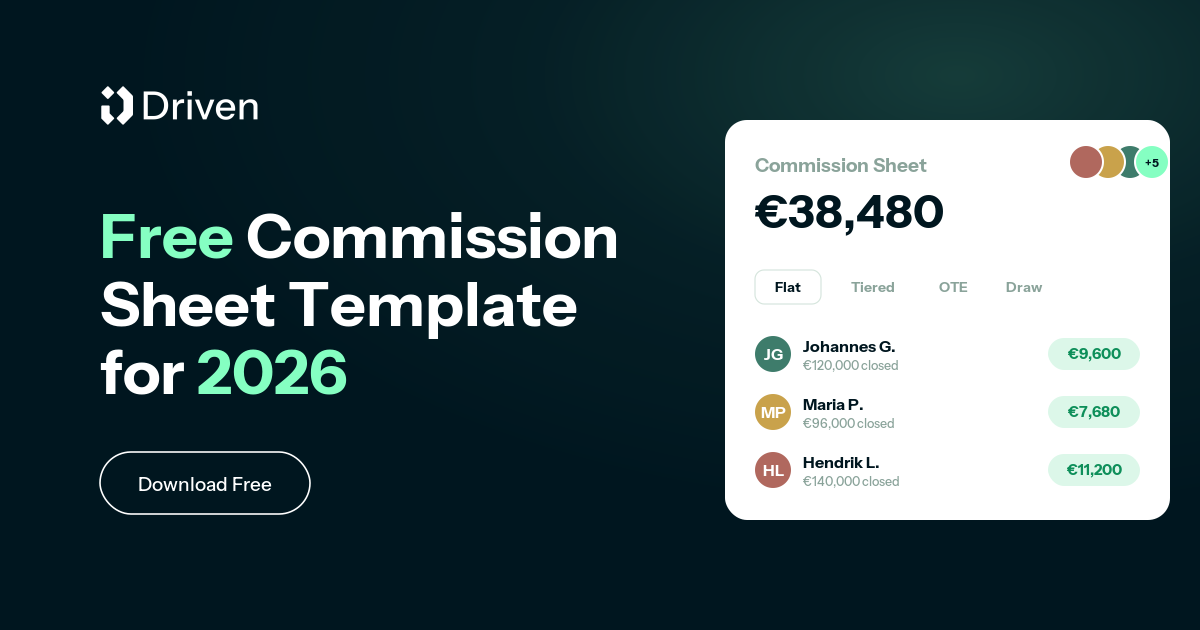
Free Commission Sheet Template: 8 Sales Commission Spreadsheets in One Excel File
Most commission plans don't fail because the idea is wrong. They fail because nobody modelled the numbers before rolling them out. A rate that looks generous on a slide turns into a payout you can't afford at 130% attainment, or an accelerator so flat that your best reps stop pushing the moment they hit quota.
So we built a free commission sheet template to fix that. It's one Excel file with eight ready-to-use sales commission spreadsheets, each structure on its own tab, each with live formulas and a filled-in sample row. Change a rate, a quota, or a revenue number and every payout updates instantly, and because everything lives in one workbook you can compare models side by side without juggling downloads.
Download the commission sheet template, or start for free and let Driven build the plan for you.

New to comp design? Start with our guide to sales compensation structure types, then model your pick here.


Non-Recoverable Draw vs. Recoverable Draw: What's the Difference?
New sales hires often get offered a "draw" against commission, and most sign the offer letter without knowing there are two very different types. That gap in understanding can mean thousands of dollars either staying in a rep's pocket or getting clawed back months later.
A draw is essentially an advance on future commission, designed to give reps steady income while they ramp up pipeline and close their first deals. But whether that advance is recoverable or non-recoverable determines something much bigger: whether it ever has to be paid back.
This guide breaks down what each draw type means, how they're calculated, when companies typically use each one, and the mistakes that turn a helpful ramp tool into a trust problem between reps and the company that hired them.




.svg%201.avif)