What Ops Means in Business


TL;DR
If you’ve spent any time around startups, scaling companies, or even corporate teams, you’ve probably heard the term “Ops” thrown around in meetings, job titles, or strategy discussions. Sales Ops, Marketing Ops, RevOps, DevOps, it’s everywhere. But what does “Ops” actually mean in business? And more importantly, why has it become such a critical function for companies that want to grow efficiently.
The truth is, most businesses don’t struggle because they lack ideas or demand. They struggle because things break internally, processes are unclear, teams are misaligned, and execution becomes messy. That’s where Ops comes in. In this guide, we’ll break down what Ops really means, what it includes, and why it plays a central role in building a scalable, high performing business.
What Does OPS Mean in Business?
“Ops” is simply short for operations. In a business context, operations refer to the systems, processes, workflows, and structures that keep a company running on a day to day basis. At its core, Ops answers one fundamental question: How does work actually get done inside the company? It includes everything from the following:
- How leads are managed
- How projects are delivered
- How teams collaborate
- How data is tracked and used
- How customers receive your product or service
If strategy is about deciding what a business wants to achieve, Ops is about ensuring it actually happens consistently, efficiently, and at scale.
What Falls Under ‘Ops’?
One of the reasons 'Ops' can feel confusing is because it’s not limited to a single department. Instead, it spans across multiple functions in a business. Here are the most common types of Ops you’ll encounter:
- Sales Operations (Sales Ops): Improves sales team efficiency by managing CRM systems, tracking pipelines, forecasting revenue, and analyzing performance data to ensure consistent, predictable sales outcomes and better decision making.
- Marketing Operations (Marketing Ops): Manages campaign execution, automation tools, and data tracking systems to optimize marketing performance, improve lead management, and ensure all activities align with measurable business goals.
- Revenue Operations (RevOps): Aligns sales, marketing, and customer success into one system to remove silos, streamline processes, and create a predictable, scalable revenue engine driven by shared data and goals.
- Product Operations (Product Ops): Enhances product team efficiency by refining workflows, managing feedback loops, and ensuring product development aligns closely with customer needs, business goals, and overall strategic direction.
- Customer Support Operations: Builds systems and workflows that enable fast, consistent, and high quality customer service, improving response times, issue resolution, and overall customer satisfaction across all support channels.
- IT Operations / DevOps: Ensures system reliability and performance by managing infrastructure, deployment processes, and technical workflows, enabling faster releases, reduced downtime, and efficient collaboration between development and operations teams.
Why Ops Matters in Business
Operations is often underestimated, especially in early stage companies where speed is prioritized over structure. But as a business grows, weak operations quickly turn into bottlenecks that slow progress, create confusion, and limit scalability. Here’s why Ops plays such a critical role:
1. It Drives Efficiency
Efficiency is one of the biggest advantages of strong operations. Without clear processes, teams spend unnecessary time figuring out tasks, duplicating efforts, or fixing avoidable mistakes, which reduces overall productivity.
Strong Ops helps to:
- Streamline workflows
- Reduce manual effort
- Eliminate redundancies
The result is a more productive and focused team that can accomplish more in less time without wasting resources.
2. It Enables Scalability
As businesses grow, complexity increases. What works for a small team often breaks at scale, leading to chaos if systems are not in place.
With strong ops:
- Processes are documented
- Tasks are standardized
- Systems handle increasing complexity
This creates a stable foundation for growth, allowing businesses to scale smoothly without constantly fixing operational issues.
3. It Improves Decision Making
Operations play a key role in making business performance visible and measurable through structured data and reporting systems.
Ops enables visibility into:
- Performance metrics
- Bottlenecks
- Opportunities for improvement
Instead of relying on assumptions, leaders can make informed decisions based on accurate, real time insights.
4. It Enhances Customer Experience
Even though customers don’t see internal processes, they directly experience the outcomes of your operations through service quality and delivery.
Strong Ops ensures:
- Faster response times
- Consistent service delivery
- Fewer errors
Better operations lead to a smoother, more reliable customer experience, while poor ops result in delays and frustration.
5. It Increases Profitability
Operations directly impact how efficiently a business uses its resources to generate results, making it a key driver of profitability.
Better Ops leads to:
- Lower operational costs
- Higher output per employee
- Improved profit margins
It’s not just about increasing effort, it’s about optimizing how work gets done to maximize returns and long term business success.
Ops vs Strategy: What’s the Difference?
A common misconception is that Ops and strategy are the same thing. They’re closely related, but they serve different purposes.

Think of strategy as the blueprint that defines your business goals, direction, and vision, while operations are the construction process that turns those plans into reality. A strong strategy outlines what needs to be achieved, but without efficient operations to execute tasks, manage workflows, and ensure consistency, even the best ideas fail to deliver results. In simple terms, strategy sets the destination, but operations are what actually get you there.
The Modern Evolution of Ops
Operations was once considered a back office function, quietly supporting the business without much strategic importance. Today, that perception has completely changed. Ops now plays a central role in driving growth, improving efficiency, and enabling smarter decision making across the organization. Here’s what’s changed:
- Rise of RevOps: Businesses are shifting from siloed departments to unified revenue systems where sales, marketing, and customer success work together, improving alignment and visibility and creating more predictable, scalable revenue growth.
- Automation & Tools: Companies increasingly rely on automation tools to handle repetitive tasks, centralize data, and streamline workflows, allowing teams to focus on high impact work while improving overall operational efficiency.
- Data Driven Decision Making: Ops teams now lead analytics and reporting, providing actionable insights through dashboards and performance tracking, enabling businesses to make informed decisions based on real time data rather than assumptions.
- AI & Intelligent Workflows: Artificial intelligence is transforming operations by enabling smarter processes like lead scoring, predictive forecasting, and automated workflows, helping businesses operate faster, more accurately, and at greater scale.
In today’s business environment, Ops is no longer reactive or purely supportive. It has become a proactive, strategic function that directly impacts growth, efficiency, and long term competitive advantage.
Signs Your Business Needs Better Ops
Not sure if your operations need improvement? Here are some common red flags:
- Things feel chaotic as you grow
- Teams are misaligned or working in silos
- You rely heavily on manual work
- There’s no clear visibility into performance
- Processes are inconsistent or undocumented
- Growth feels stuck despite strong demand
If any of these sound familiar, it’s likely an ops issue, not a strategy problem.
How to Improve Your Ops
Improving operations isn’t a quick fix; it requires a structured, intentional approach. The goal is to create systems that are efficient, scalable, and adaptable as your business grows. Here’s how to do it step by step:
- Map Your Processes: Start by clearly documenting how work currently flows across your business, from lead generation to delivery. This helps you visualize gaps, redundancies, and inefficiencies that often go unnoticed in day to day execution.
- Identify Bottlenecks: Once your processes are mapped, pinpoint where things slow down or break. Look for delays, repeated errors, or tasks overly dependent on specific individuals, as these limit scalability and consistency.
- Implement the Right Tools: Introduce tools and systems that automate repetitive tasks, streamline workflows, and centralize information. The right technology reduces manual effort, improves accuracy, and keeps teams aligned across functions.
- Define Clear KPIs: Establish measurable metrics that reflect performance, such as conversion rates, turnaround times, or customer satisfaction. Clear KPIs ensure accountability and help you track what’s working and what needs improvement.
- Continuously Optimize: Operations should evolve with your business. Regularly review processes, analyze performance data, and refine workflows to adapt to new challenges, scale efficiently, and maintain long term effectiveness.
How Driven Helps Your Business
At Driven.work, operations aren’t treated as a back office necessity, they’re built as a core growth engine for your business. Instead of patching inefficiencies or adding more tools to an already messy system, the focus is on designing clean, scalable operations that actually support how your business runs and grows. Here’s how that translates in practice:
- Building Scalable Systems Tailored to Your Workflows: Every business operates differently, which is why Driven.work doesn’t rely on generic templates. Systems are designed around your actual workflows, ensuring they scale with you instead of breaking as complexity increases.
- Aligning Teams Across Departments: Misalignment between sales, marketing, and delivery teams is one of the biggest growth blockers. Driven.work creates connected systems and shared processes so every team works toward the same goals with full visibility.
- Eliminating Inefficiencies and Manual Work: Manual tasks, duplicate efforts, and scattered data slow everything down. By automating repetitive processes and streamlining workflows, Driven helps your team focus on high impact work instead of busywork.
- Creating Data Driven Processes for Better Decision Making: Clear dashboards, structured reporting, and reliable data systems give you real time insights into performance. This allows you to make faster, smarter decisions backed by actual numbers, not assumptions.
- Turning Operations into a Competitive Advantage: Most businesses treat Ops as a support function. Driven.work helps you use it as a strategic lever, improving efficiency, increasing predictability, and enabling sustainable growth.
The objective is simple: help you scale without operational chaos. With the right systems in place, your business doesn’t just grow; it grows efficiently, predictably, and with far less friction. If you’re ready to build operations that actually support your growth, explore how Driven can help you out.
Conclusion
Operations is the backbone of every successful business. You can have a great product, a smart strategy, and a talented team, but without strong operations, execution breaks down and results become inconsistent. When operations are well structured, work flows smoothly, teams stay aligned, and growth becomes predictable rather than chaotic. In today’s competitive landscape, ops is no longer optional; it’s a critical function that determines whether a business struggles or scales efficiently.
If you’re ready to turn your operations into a growth engine, Driven can help you build scalable systems, streamline workflows, and align your teams for predictable success. Explore how Driven can transform your Ops.



See your comp plan, fully built in minutes

Frequently Asked Questions
About the author
Andres De Jonge






Understanding SPIFFs, Bonuses, and Commissions
Ask a sales rep what's driving their next paycheck, and you'll often hear all three words used interchangeably: SPIFF, bonus, and commission. They get lumped together as "extra money for selling," but they're not the same thing, and treating them like they are leads to confused reps, inconsistent payouts, and comp plans nobody can actually explain.
A SPIFF is a short-term, targeted incentive. A bonus is a lump-sum reward tied to hitting a broader goal. A commission is the ongoing, formula-based pay tied directly to sales, the core of most sales comp plans, not an add-on to it.
This guide breaks down what each one actually means, when companies use them, how they're calculated, and how they stack together so you can build a comp plan where every payout has a clear reason behind it.
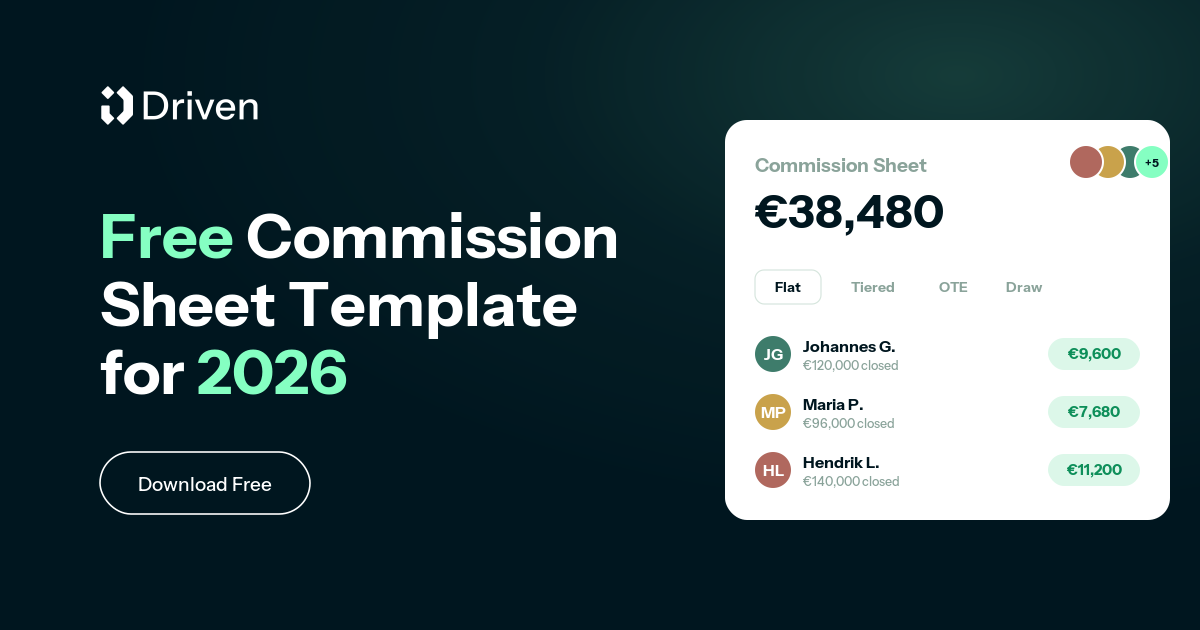
Free Commission Sheet Template: 8 Sales Commission Spreadsheets in One Excel File
Most commission plans don't fail because the idea is wrong. They fail because nobody modelled the numbers before rolling them out. A rate that looks generous on a slide turns into a payout you can't afford at 130% attainment, or an accelerator so flat that your best reps stop pushing the moment they hit quota.
So we built a free commission sheet template to fix that. It's one Excel file with eight ready-to-use sales commission spreadsheets, each structure on its own tab, each with live formulas and a filled-in sample row. Change a rate, a quota, or a revenue number and every payout updates instantly, and because everything lives in one workbook you can compare models side by side without juggling downloads.
Download the commission sheet template, or start for free and let Driven build the plan for you.

New to comp design? Start with our guide to sales compensation structure types, then model your pick here.


Non-Recoverable Draw vs. Recoverable Draw: What's the Difference?
New sales hires often get offered a "draw" against commission, and most sign the offer letter without knowing there are two very different types. That gap in understanding can mean thousands of dollars either staying in a rep's pocket or getting clawed back months later.
A draw is essentially an advance on future commission, designed to give reps steady income while they ramp up pipeline and close their first deals. But whether that advance is recoverable or non-recoverable determines something much bigger: whether it ever has to be paid back.
This guide breaks down what each draw type means, how they're calculated, when companies typically use each one, and the mistakes that turn a helpful ramp tool into a trust problem between reps and the company that hired them.



.svg%201.avif)