AI vs. Manual Quota Setting: Which Actually Gets Better Results?


TL;DR
Most sales teams assume missed targets are a performance issue. When numbers fall short, the default response is to push harder: more calls, more pipeline, more pressure on reps. But that reaction overlooks a more fundamental problem. In many cases, the issue isn’t how your team is selling; it’s what they’re being asked to achieve. Quotas shape behavior, motivation, and outcomes, and when they’re set incorrectly, even strong teams struggle to perform.
The reality is simple: the quota itself might be wrong. Set it too high, and reps disengage. Set it too low, and you cap your revenue potential. Distribute it unevenly, and your top performers lose trust in the system. Despite this, many organizations still rely on spreadsheets and manual processes to define targets. If that sounds familiar, it’s a sign that your approach to quota setting may need a serious rethink
Why Quota Setting Impacts More Than You Think
Quota setting might seem like a simple task of assigning targets, but its impact goes far beyond just numbers. It influences how your entire revenue engine operates, from planning to performance to payouts. Here’s how it directly affects your business:
- Revenue predictability: Well set quotas create stable and predictable revenue. Poorly set quotas lead to inconsistent performance and missed targets.
- Rep motivation and retention: Fair, achievable quotas keep reps engaged. Unrealistic or uneven targets lead to frustration and higher churn.
- Compensation accuracy: Since payouts depend on quotas, incorrect targets create confusion, disputes, and manual commission tracking challenges across teams.
- Forecasting confidence: Leadership relies on quotas to plan revenue. If quotas are off, forecasts become unreliable.
And most importantly: If reps don’t believe their quota reflects real opportunity, they stop taking it seriously. And when trust drops, performance follows. That’s why quota setting should never operate in isolation. It needs to be tightly connected to your sales compensation tool and commission logic, so everything stays aligned, transparent, and easy to understand.
The Reality of Manual Quota Setting
Manual quota setting feels logical because it’s familiar. Most teams follow a predictable process, start with last year’s numbers, add a growth target, divide it across reps, and tweak based on experience. But this approach also creates hidden operational strain, especially when manual commission tracking is still being handled separately from quota planning. On the surface, this approach gives a sense of control and simplicity. But the problem is, it’s built on limited inputs.
- Same quota, different realities: Not all territories are equal. Some reps have strong markets; others don't, yet quotas often ignore this, creating unfair expectations.
- Static numbers in a dynamic market: Markets shift constantly in demand, competition, and deal cycles. But once quotas are set, they usually stay fixed.
- Slow planning cycles: Updating spreadsheets, aligning stakeholders, and revising numbers can take weeks, slowing down decision making.
- Too many stakeholders, no alignment: Sales wants achievable targets, Finance wants predictability, RevOps wants accuracy. Without a shared system, alignment becomes difficult.
- Constant back and forth: Quota discussions turn into debates, "This number doesn’t make sense," leading to delays and frustration.
At its core, the issue comes down to limited data and too much manual effort. You’re trying to solve a complex problem with tools that weren’t built for it.
What Changes With AI Quota Setting
AI doesn’t remove the need for human judgment, but it dramatically improves the quality of inputs. Instead of relying on assumptions, AI analyzes multiple factors at once:
- Pipeline health
- Territory potential
- Historical performance
- Deal velocity
- Seasonality
This shifts the focus from “What did we do last year?” to a much more useful question: What is actually achievable right now? That shift changes everything.
- Quotas based on real opportunity: Targets are grounded in actual data, not rough estimates.
- Territory aware targets: Each rep gets a quota that reflects their specific market conditions.
- Faster planning: What used to take weeks in spreadsheets can now be done in hours.
- Less debate, more clarity: With data backed reasoning, teams spend less time arguing and more time executing.
The result isn’t just better quotas; it's a smoother, more aligned planning process where sales, RevOps, and finance are working from the same reality.
Manual vs AI: The Difference in Practice

The Scaling Problem Most Teams Hit
Manual quota setting doesn’t usually break on day one; it breaks as your team grows. As teams grow, one of the first operational bottlenecks appears in manual commission tracking, especially when quota complexity increases. In the early stages, things feel manageable:
- 5 reps: You know everyone’s territory, performance, and pipeline. Adjustments are easy.
- 20 reps: Complexity creeps in. More territories, more variables, more opinions.
- 50+ reps: It becomes a bottleneck. Spreadsheets can’t keep up, and alignment slows everything down.
As you scale, the cracks become visible:
- More quota disputes: Reps start questioning fairness because targets don’t reflect real conditions
- Lower attainment rates: Quotas drift away from reality, making them harder to hit
- Slower planning cycles: What used to take days now takes weeks of coordination
- Misalignment across teams: Sales, Finance, and RevOps operate with different assumptions
This is the turning point. Teams don’t look for a better system because they want to, they do it because the current one stops working.
The Hidden Cost of Bad Quotas
Bad quotas don’t just impact targets. They impact the entire revenue engine.
What Happens When Quotas Are Wrong
- Reps stop trusting the numbers: If quotas feel unrealistic or uneven, motivation drops
- Finance struggles with forecasting: Unreliable targets lead to unreliable revenue projections
- RevOps spends time fixing issues: Instead of driving strategy, they’re stuck managing exceptions
- Leadership loses visibility: It becomes harder to tell what’s actually working
You lose a clear measure of performance. If the benchmark itself is flawed, you can’t accurately judge how your team is doing. That makes every decision, from hiring to planning, less reliable.
Why AI Alone Isn’t Enough
AI can absolutely improve how quotas are set, but only if people can actually understand and use it. The problem is, many tools focus so much on adding intelligence that they forget about usability. Instead of simplifying the process, they introduce new layers of complexity. Here’s how that usually shows up:
- Overcomplicate workflows
- Act like black boxes
- Are hard to explain to reps
This creates a bigger problem than inaccurate quotas. Adoption drops. Which means even if the AI is technically correct, it doesn’t matter if teams don’t trust it or use it. Quota setting isn’t just a data problem; it’s a people problem. And if the system isn’t clear and usable, it fails regardless of how advanced the technology is.
Why Simplicity Wins (Every Time)
Simplicity wins because quota setting isn’t just a technical exercise; it’s a communication problem. You can have the most accurate system in the world, but if people don’t understand it, it won’t work.
- Reps need clarity: They should instantly know what their target is, why it’s set that way, and how to achieve it. If quotas feel confusing or arbitrary, motivation drops.
- Leaders need explainability: They’re constantly asked, “Why is my quota this number?” If they can’t clearly answer that, confidence in the system breaks.
- Finance needs reliability: They depend on quotas for forecasting and planning. If the logic isn’t transparent, the numbers become hard to trust.
This is where many systems fail. They focus on making quotas more advanced instead of making them more understandable. The best systems do both:
- They improve accuracy with data and AI
- But more importantly, they improve clarity with simple, transparent logic
Where Driven Fits In
Most teams don’t struggle because they lack data. They struggle because their quota and compensation process is fragmented, manual, and hard to trust. Driven is built for teams that are capable of dealing with:
- Managing quotas in spreadsheets that break as soon as complexity increases
- Explaining numbers that don’t have a clear, traceable logic
- Constant back and forth on compensation disputes between Sales, Finance, and RevOps
Instead of adding more complexity, Driven simplifies the entire system. It brings structure to how quotas are set and maintained through the following:
- Clear, data backed quotas grounded in real performance and opportunity
- Simple, explainable logic that every stakeholder can understand
- Fast adjustments without chaos when plans or markets change
- Alignment across Sales, RevOps, and Finance so everyone works from the same numbers
And because quotas are directly connected to commissions inside the same system:
- There’s no disconnect between targets and payouts.
- No confusion about “how this number was calculated.
- No misalignment between planning and compensation
Everything becomes transparent to the people who matter most, the teams actually being measured and paid
The Bottom Line
Let’s keep it simple: manual quota setting is familiar, but it’s often inconsistent. It relies heavily on spreadsheets, assumptions, and historical averages that don’t always reflect current market reality. On the other hand, AI driven quota setting is more scalable, accurate, and fair because it uses real data like pipeline, territory potential, and performance trends to set more grounded targets.
But the real advantage isn’t just choosing AI over manual; it’s choosing AI that is simple enough for the entire organization to trust and actually use. Because at the end of the day, better quotas don’t just improve planning accuracy; they directly improve sales performance, alignment, and execution. If your team is still stuck managing quotas in spreadsheets, it may be time to rethink the system. Explore how Driven helps teams set smarter, fairer, and simpler quotas with a modern sales compensation platform built for clarity and scale.



See your comp plan, fully built in minutes

Frequently Asked Questions
About the author
Tom De Kooning






Understanding SPIFFs, Bonuses, and Commissions
Ask a sales rep what's driving their next paycheck, and you'll often hear all three words used interchangeably: SPIFF, bonus, and commission. They get lumped together as "extra money for selling," but they're not the same thing, and treating them like they are leads to confused reps, inconsistent payouts, and comp plans nobody can actually explain.
A SPIFF is a short-term, targeted incentive. A bonus is a lump-sum reward tied to hitting a broader goal. A commission is the ongoing, formula-based pay tied directly to sales, the core of most sales comp plans, not an add-on to it.
This guide breaks down what each one actually means, when companies use them, how they're calculated, and how they stack together so you can build a comp plan where every payout has a clear reason behind it.

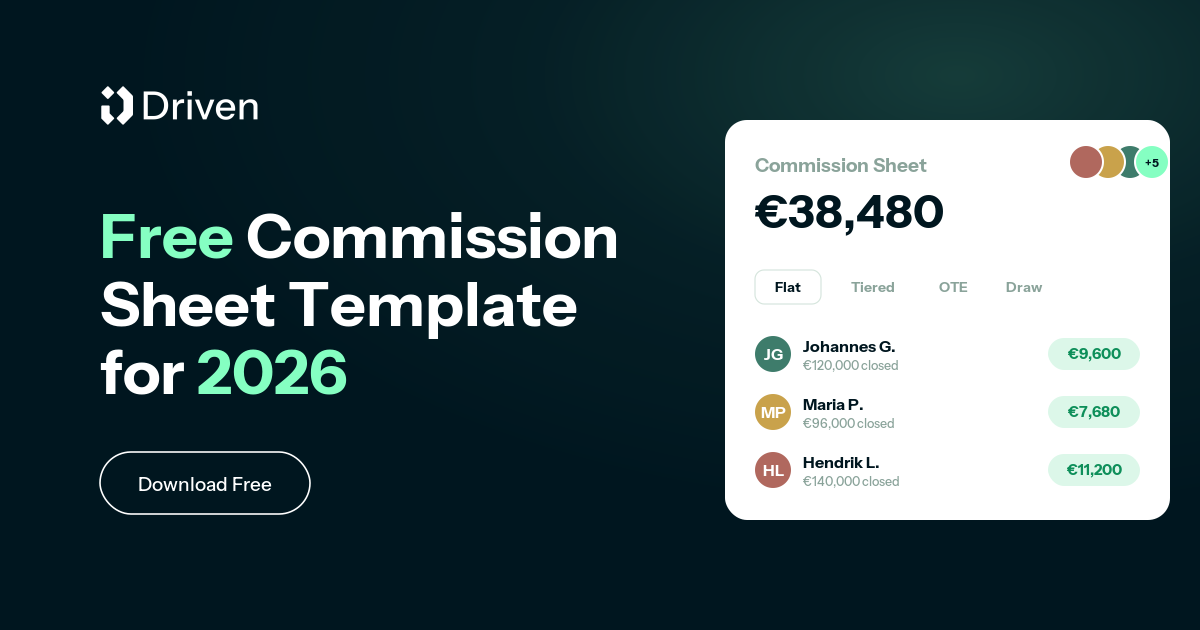
Free Commission Sheet Template: 8 Sales Commission Spreadsheets in One Excel File
Most commission plans don't fail because the idea is wrong. They fail because nobody modelled the numbers before rolling them out. A rate that looks generous on a slide turns into a payout you can't afford at 130% attainment, or an accelerator so flat that your best reps stop pushing the moment they hit quota.
So we built a free commission sheet template to fix that. It's one Excel file with eight ready-to-use sales commission spreadsheets, each structure on its own tab, each with live formulas and a filled-in sample row. Change a rate, a quota, or a revenue number and every payout updates instantly, and because everything lives in one workbook you can compare models side by side without juggling downloads.
Download the commission sheet template, or start for free and let Driven build the plan for you.

New to comp design? Start with our guide to sales compensation structure types, then model your pick here.

Non-Recoverable Draw vs. Recoverable Draw: What's the Difference?
New sales hires often get offered a "draw" against commission, and most sign the offer letter without knowing there are two very different types. That gap in understanding can mean thousands of dollars either staying in a rep's pocket or getting clawed back months later.
A draw is essentially an advance on future commission, designed to give reps steady income while they ramp up pipeline and close their first deals. But whether that advance is recoverable or non-recoverable determines something much bigger: whether it ever has to be paid back.
This guide breaks down what each draw type means, how they're calculated, when companies typically use each one, and the mistakes that turn a helpful ramp tool into a trust problem between reps and the company that hired them.




.svg%201.avif)