Sales Compensation in B2B vs B2C: Key Differences


TL;DR
Sales compensation is not just about paying commissions; it’s about shaping behaviour, driving performance, and aligning teams with business goals. But here’s where many organisations go wrong: they design compensation plans without accounting for how their sales actually work.
B2B and B2C sales operate in fundamentally different environments. They differ in deal size, buyer complexity, and sales cycles. Yet, companies often apply similar compensation logic across both, and the result is predictable: misaligned incentives, inconsistent performance, and lost revenue opportunities. To build an effective compensation strategy, you need to start with a simple principle: how you sell should define how you pay.
What Defines B2B vs. B2C Sales?
Before diving into compensation, it’s important to understand the structural differences.
- B2B (Business to Business) sales involve selling products or services to organisations rather than individual consumers. These deals are typically higher in value and require approval from multiple stakeholders, such as finance, procurement, and leadership teams. As a result, sales cycles are longer and more complex. Sales representatives often take on a consultative role, focusing on understanding business needs, building relationships, and guiding clients through detailed, strategic decision making processes.
- B2C (Business to Consumer) sales, on the other hand, focus on selling directly to individual customers. These transactions are usually lower in value but occur at a much higher frequency. The decision making process is simpler and often driven by emotion, convenience, or immediate need. Sales cycles are short, and success depends on speed, customer experience, and conversion efficiency, making volume and consistency the key drivers of performance.
These differences are not just operational; they directly influence what behaviours you need to incentivise.
Core Differences in Sales Compensation: B2B vs B2C
Sales compensation differs significantly between B2B and B2C due to how sales are made. B2B focuses on longer sales cycles and high value deals, while B2C emphasizes speed and volume. Understanding these differences is key to designing effective, performance driven compensation plans, as outlined in this guide on how to design a sales compensation plan that drives peak performance.
1. Deal Size vs Sales Volume
In B2B environments, revenue comes from fewer but significantly larger deals. Each win has a meaningful impact on business performance.
In B2C, success is driven by high transaction volume. Individual sales may be smaller, but scale is everything.
Compensation Impact:
- B2B plans should reward high value deal closure and strategic wins
- B2C plans should reward consistent activity and sales volume
2. Sales Cycle Length
B2B sales cycles can stretch over weeks or months, sometimes even longer. Reps invest time in nurturing relationships, managing stakeholders, and navigating approvals.
B2C sales cycles are much shorter, often completed within minutes, hours, or days.
Compensation Impact:
- B2B requires milestone based or delayed incentives to sustain motivation across long cycles
- B2C benefits from immediate, frequent payouts that reinforce quick wins
3. Decision Complexity
B2B buying decisions are rarely made by a single person. They involve multiple stakeholders, finance teams, procurement, and leadership, each with different priorities.
In B2C, the decision is typically individual and emotionally driven.
Compensation Impact:
- B2B plans should reward relationship building, deal progression, and stakeholder management
- B2C plans should focus on conversion efficiency and closing speed
4. Performance Metrics
What you measure defines what your team prioritizes, which is why understanding what sales performance management (SPM) is and why it matters is critical.
B2B metrics typically include:
- Revenue or quota attainment
- Pipeline quality and progression
- Average contract value (ACV)
B2C metrics typically include:
- Units sold
- Conversion rates
- Average order value
Compensation Impact:
- B2B incentives must align with long term revenue generation and pipeline health
- B2C incentives should emphasize volume and transactional efficiency
5. Pay Structure and Mix
Because B2B sales cycles are longer and less predictable, compensation structures tend to offer more stability.
B2C roles, driven by high frequency transactions, often rely more heavily on variable pay and different types of incentive pay programs.
Compensation Impact:
- B2B: Higher base salary + performance based incentives
- B2C: Lower base + commission heavy or incentive driven structures
6. Relationship vs Transactional Focus
B2B sales are built on long term relationships. Closing the deal is just the beginning, renewals, upsells, and expansions often drive the real value.
B2C sales are more transactional, though repeat purchases and loyalty still matter.
Compensation Impact:
- B2B plans should include retention, expansion, and account growth incentives
- B2C plans should prioritize customer acquisition and repeat purchase behavior
B2B vs B2C Compensation: A Side-by-Side Comparison

Designing the Right Compensation Model
Designing the right compensation model is critical to driving the right sales behaviors and outcomes. A well structured plan aligns incentives with business goals, motivates performance, and ensures clarity for the sales team. The key is to balance simplicity, fairness, and strategic impact.
For B2B Teams: Reward Impact, Not Activity
Effective B2B compensation plans are designed to reflect the complexity of the sales process.
They typically include:
- Tiered commission structures to reward overperformance
- Bonuses for closing high value or strategic deals
- Incentives tied to renewals and expansions
The goal is clear: incentivize meaningful outcomes, not just effort.
For B2C Teams: Reward Consistency and Speed
B2C compensation should be simple, transparent, and fast paced.
Common structures include:
- Per sale commissions
- Daily or weekly performance bonuses
- Gamified incentives to maintain engagement, such as SPIFs.
The focus here is different: drive repeatable, high frequency performance.
Common Mistakes Companies Make
Even when the differences between B2B and B2C are clear, many companies make avoidable compensation mistakes that misalign incentives, confuse teams, and ultimately weaken sales performance.
- Applying volume based incentives to B2B teams: B2B sales rely on relationship building and high value deals, not just volume. Overemphasizing quantity can push the wrong behaviors and hurt deal quality.
- Overcomplicating B2C compensation structures: B2C thrives on speed and simplicity. Complex plans slow down understanding, reduce motivation, and make it harder for reps to focus on selling.
- Ignoring the impact of sales cycle length on motivation: This is one of the key reasons why sales reps lose motivation. Long B2B cycles require milestone based incentives, while short B2C cycles need frequent rewards. Ignoring this can lead to disengagement.
- Failing to align compensation metrics with business goals: If incentives don’t reflect strategic priorities, like profitability, retention, or product focus, teams may hit targets but still miss business outcomes.
These mistakes go beyond compensation, they shape behavior, trust, and performance. Getting the structure right is essential to driving consistent and sustainable revenue growth.
How Driven Helps Align Compensation with Sales Models
Designing the right compensation plan is only half the battle. The real challenge lies in execution, especially without systems like automating sales commission plans. This ensures plans are clear, adaptable, and consistently aligned with evolving business goals. This is where Driven plays a critical role.
Driven enables organizations to move beyond static compensation plans and build dynamic, performance driven systems that align closely with both B2B and B2C sales models.
- Simplify complex compensation structures: Many organizations struggle with overly complicated plans that are difficult to manage and even harder for sales teams to understand. Driven streamlines these structures, making them easy to communicate, track, and execute, without losing strategic depth.
- Align incentives with real business outcomes: Instead of rewarding isolated metrics, Driven helps tie compensation directly to what matters most, revenue growth, profitability, customer retention, or strategic product focus. This ensures sales efforts translate into meaningful business impact.
- Provide real time visibility into performance and earnings: Transparency is key to motivation. Driven gives sales reps and managers instant access to performance data and earnings, helping them understand exactly how their actions influence payouts and where to focus next.
- Adapt plans as business needs evolve: Markets change, and compensation plans should too. Driven allows organizations to quickly adjust incentive structures based on new goals, market conditions, or sales strategies, without disrupting operations.
With the right systems in place, compensation becomes more than just a payout mechanism. It transforms into a strategic growth lever, guiding behavior, improving alignment, and driving measurable business outcomes.
Final Thoughts
B2B and B2C sales operate in fundamentally different ways, and your compensation strategy needs to reflect that. B2B sales involve longer cycles, complex deal structures, and relationship driven decisions, while B2C focuses on speed, volume, and quick conversions. When compensation is aligned with buyer behavior, sales cycle dynamics, and deal structure, it naturally drives the right actions, keeps teams motivated, and ensures performance is closely tied to business outcomes.
The companies that get this right don’t just compensate their sales teams, they enable them to perform at their best. With Driven, you can design and manage compensation plans that adapt to your sales model, simplify execution, and provide full visibility into performance. If you're looking to turn compensation into a true growth lever, it’s time to explore how Driven can help.



See your comp plan, fully built in minutes

Frequently Asked Questions
About the author
Ludovic Diercxsens






Understanding SPIFFs, Bonuses, and Commissions
Ask a sales rep what's driving their next paycheck, and you'll often hear all three words used interchangeably: SPIFF, bonus, and commission. They get lumped together as "extra money for selling," but they're not the same thing, and treating them like they are leads to confused reps, inconsistent payouts, and comp plans nobody can actually explain.
A SPIFF is a short-term, targeted incentive. A bonus is a lump-sum reward tied to hitting a broader goal. A commission is the ongoing, formula-based pay tied directly to sales, the core of most sales comp plans, not an add-on to it.
This guide breaks down what each one actually means, when companies use them, how they're calculated, and how they stack together so you can build a comp plan where every payout has a clear reason behind it.

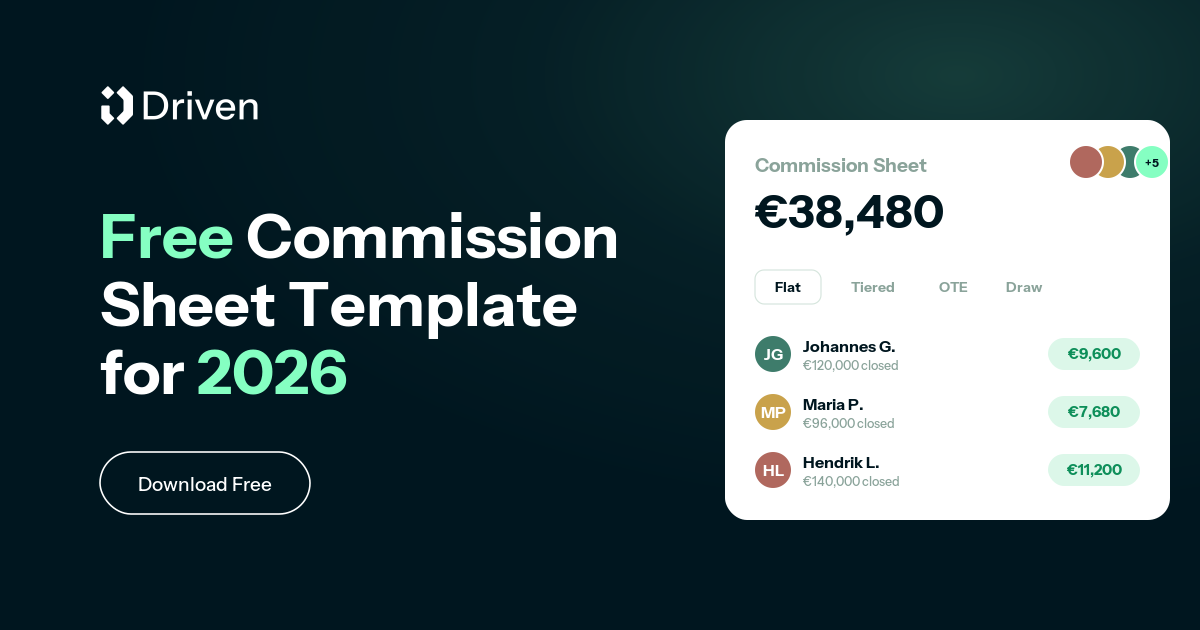
Free Commission Sheet Template: 8 Sales Commission Spreadsheets in One Excel File
Most commission plans don't fail because the idea is wrong. They fail because nobody modelled the numbers before rolling them out. A rate that looks generous on a slide turns into a payout you can't afford at 130% attainment, or an accelerator so flat that your best reps stop pushing the moment they hit quota.
So we built a free commission sheet template to fix that. It's one Excel file with eight ready-to-use sales commission spreadsheets, each structure on its own tab, each with live formulas and a filled-in sample row. Change a rate, a quota, or a revenue number and every payout updates instantly, and because everything lives in one workbook you can compare models side by side without juggling downloads.
Download the commission sheet template, or start for free and let Driven build the plan for you.

New to comp design? Start with our guide to sales compensation structure types, then model your pick here.


Non-Recoverable Draw vs. Recoverable Draw: What's the Difference?
New sales hires often get offered a "draw" against commission, and most sign the offer letter without knowing there are two very different types. That gap in understanding can mean thousands of dollars either staying in a rep's pocket or getting clawed back months later.
A draw is essentially an advance on future commission, designed to give reps steady income while they ramp up pipeline and close their first deals. But whether that advance is recoverable or non-recoverable determines something much bigger: whether it ever has to be paid back.
This guide breaks down what each draw type means, how they're calculated, when companies typically use each one, and the mistakes that turn a helpful ramp tool into a trust problem between reps and the company that hired them.



.svg%201.avif)