What Sales Performance Management (SPM) Is and Why It Matters

%20and%20Why%20It%20Matters%20(1).jpg)
TL;DR
In today’s competitive business environment, achieving consistent sales growth is a challenge. Organizations often face real challenges when it comes to keeping sales teams motivated, tracking performance accurately, and making sure everyone’s efforts support the company’s bigger goals. Sales Performance Management (SPM) helps bring clarity to all of this. Instead of just offering tools, SPM provides a structured, fair way to evaluate performance, reward the right people, and strengthen the entire sales process so revenue grows consistently.
In this blog, we’ll explore what SPM is, why it matters, its core functions, the benefits it brings, the risks of operating without it, and how to choose the right SPM solution for your business.
Understanding Sales Performance Management (SPM)
Sales Performance Management (SPM) is a structured approach to managing, monitoring, and improving the performance of a sales team. It encompasses everything from setting sales targets and planning territories to measuring performance, providing coaching, and incentivizing employees. The ultimate goal of SPM is to make selling predictable, fair, and aligned with business growth.
SPM isn’t limited to large enterprises. Small and mid-sized businesses can also benefit significantly by introducing clarity, transparency, and efficiency into their sales operations.
The key components of SPM typically include:
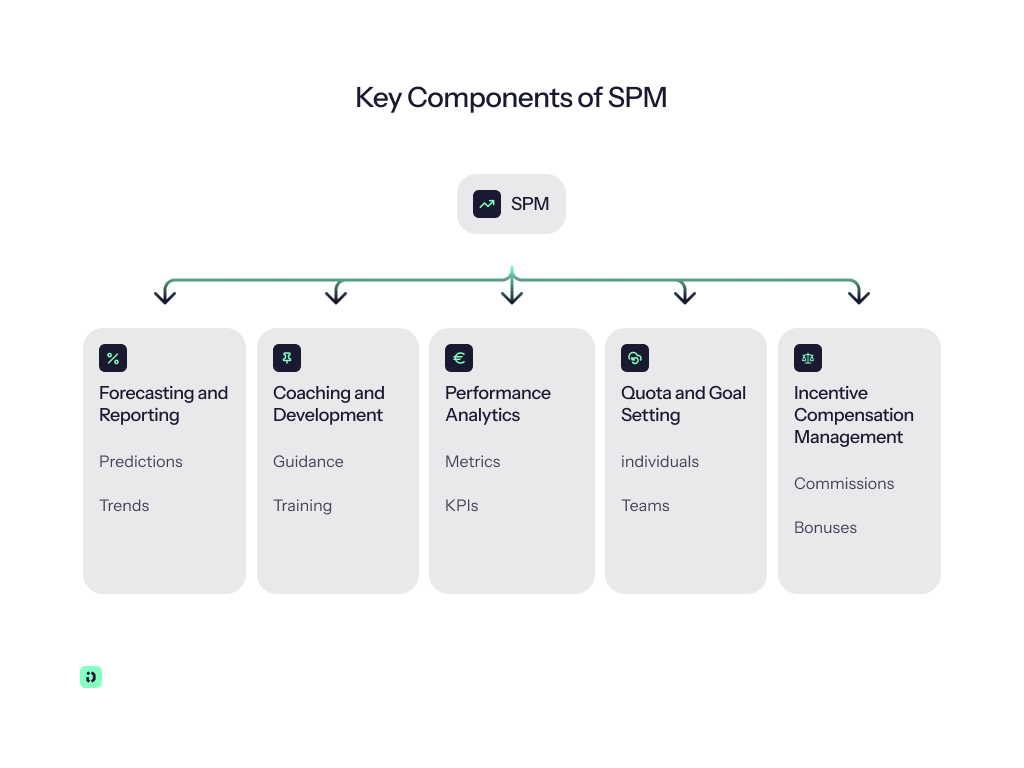
- Incentive Compensation Management (ICM): Ensuring fair and timely calculation of commissions and bonuses.
- Quota and Goal Setting: Assigning realistic and data-driven targets to individuals and teams.
- Performance Analytics: Using metrics and KPIs to track results and identify areas for improvement.
- Coaching and Development: Providing guidance and training to strengthen the sales team.
- Forecasting and Reporting: Predicting future sales outcomes and tracking performance trends.
Territory changes, quota adjustments, account ownership updates, and organizational restructures all affect how commissions should be calculated. Modern SPM platforms like Fullcast connect territory planning, quota management, and compensation management in a single workflow, which helps RevOps teams keep commission data aligned with the latest organizational changes while reducing manual corrections and payout disputes.
By implementing SPM, organizations can not only optimize their sales efforts but also create a motivated, high-performing workforce that is accountable and focused.
How Driven Powers Modern Sales Performance Management
Traditional SPM systems are slow and complex and take months to implement. Driven is different. It gets teams live in days, not quarters—and everything connects directly to your CRM (HubSpot or Salesforce), so there's zero manual data entry. Driven isn’t another tool. It’s the system that finally makes comp, clarity, and performance work the way revenue teams need.
1) Automated, Transparent Compensation Management
Driven eliminates spreadsheets and manual commission tracking by automatically calculating payouts based on live CRM data. Reps get instant visibility into what they earned, why they earned it, and what actions will increase future payouts. This transparency reduces errors, removes disputes, and keeps teams focused on selling instead of questioning numbers or chasing clarification.
2) AI-Guided Incentive Design
Instead of simply calculating payouts, Driven uses AI to simulate future outcomes, identify risks, and recommend smarter compensation structures before plans launch. Teams receive scenario modeling, predictive insights, and automated adjustments that increase fairness and impact. The result: stronger plans, faster planning cycles, and incentives that drive behavior—not accidental revenue leakage or guesswork.
3) Real-Time Performance Dashboards
Driven provides one real-time source of truth, giving reps, managers, and finance instant visibility into quota progress, commissions, pipeline health, and performance trends. No waiting for reports or cross-checking disconnected systems. With live insights and no delays, teams react faster, coach smarter, and execute with confidence—because critical performance data finally moves at the speed of revenue.
4) Fast Alignment Across Sales, Finance & HR
With the Comp Plan Wiki, everyone operates from the same rules, documentation, and interpretations—instantly accessible and always current. This eliminates conflicting versions, outdated references, and long clarification loops. When sales, finance, and HR work from shared context and structure, decisions speed up, execution becomes consistent, and internal friction disappears.
5) Scalable for Growing Teams
Driven grows with your organization—from early-stage teams to global revenue operations. Compensation rules, user roles, workflows, and territories can expand without rebuilding the system or slowing operations. Whether the team doubles or the plan becomes more complex, Driven adjusts seamlessly, ensuring scalability never becomes a bottleneck to growth.
Benefits of Implementing SPM
Investing in SPM delivers numerous tangible and intangible benefits that can significantly impact a company’s growth trajectory.
.png)
1. Increased Sales Productivity
By automating administrative tasks such as commission calculations and performance tracking, SPM frees up sales reps to focus on what matters most—selling. Sales managers can also use insights from SPM tools to identify high-impact activities and prioritize them, boosting overall productivity.
2. Motivated and Engaged Sales Teams
Transparent incentive plans and clear performance metrics create a culture of accountability. When employees know that their efforts are fairly rewarded, motivation rises, engagement improves, and turnover decreases. SPM ensures that high performers are recognized while providing guidance to those who need support.
3. Data-Driven Decision Making
SPM provides a centralized view of sales data, allowing managers to make informed decisions rather than relying on gut feelings. Metrics such as pipeline health, conversion rates, and win/loss analysis help identify opportunities, allocate resources effectively, and optimize sales strategies.
4. Consistency Across Teams
Standardized processes for setting quotas, managing incentives, and evaluating performance ensure fairness and consistency. This reduces conflicts, eliminates bias, and helps create a unified sales culture that aligns with organizational goals.
5. Revenue Growth
Ultimately, the goal of SPM is to increase revenue. By aligning sales efforts with business objectives, improving productivity, motivating employees, and providing actionable insights, companies can achieve higher sales performance and sustainable growth.
Challenges Without SPM
Organizations that operate without a formal SPM system often face a range of challenges that can hinder growth:
- Manual Errors: Tracking quotas and commissions manually leads to mistakes, disputes, and frustration among employees.
- Lack of Visibility: Managers cannot accurately assess performance, making it difficult to identify underperforming areas or recognize top talent.
- Misaligned Goals: Without a structured system, sales targets may not align with company objectives, resulting in wasted effort.
- Demotivated Teams: Inconsistent or opaque incentive programs reduce morale, engagement, and retention.
- Inefficient Processes: Sales teams spend excessive time on administrative tasks, leaving less time for revenue-generating activities.
These challenges highlight the importance of implementing SPM as a strategic approach rather than relying on manual processes or ad-hoc solutions.
How to Choose the Right SPM Solution
Selecting the right SPM solution can make or break your sales performance strategy. Here are key factors to consider:
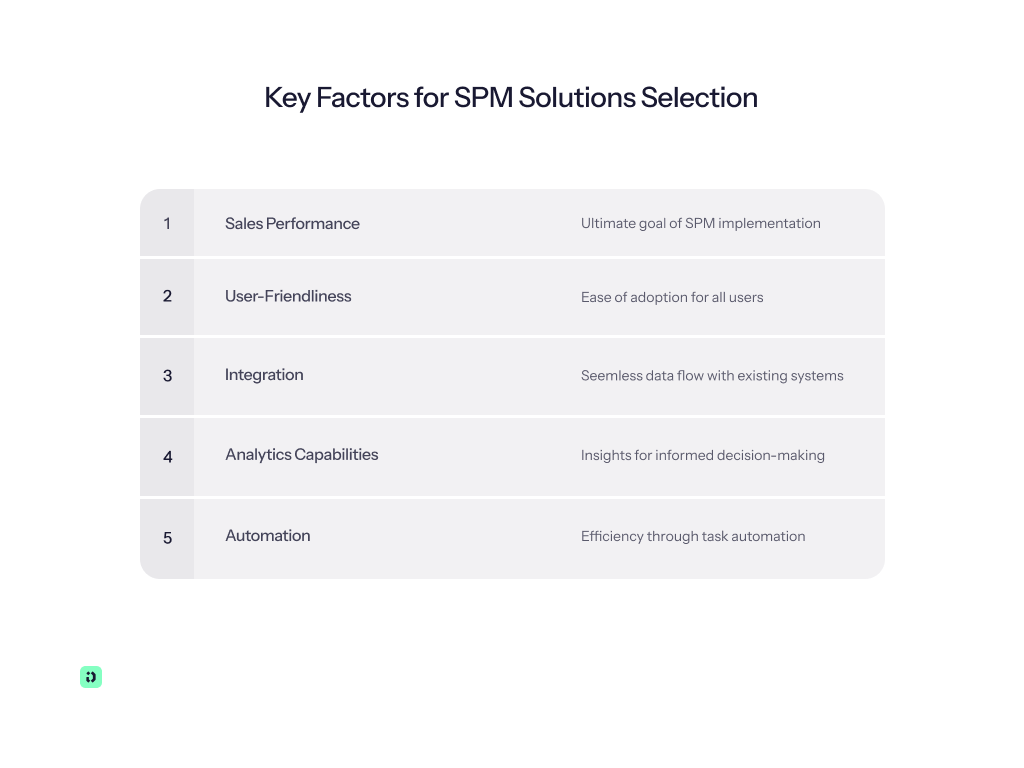
- Scalability: Ensure the system can grow with your business. It should handle additional users, territories, and complex incentive plans as your organization expands.
- Automation: Look for solutions that automate time-consuming tasks such as commission calculations, reporting, and data collection. Automation reduces errors and saves valuable time.
- Analytics Capabilities: The tool should provide actionable insights into performance trends, sales activities, and revenue forecasts. Real-time dashboards and predictive analytics are highly valuable.
- Integration: SPM systems should seamlessly integrate with your CRM, ERP, and other sales tools. Smooth data flow between platforms ensures accuracy and efficiency.
- User-Friendliness: The system should be easy to adopt for both sales managers and sales reps. Complex interfaces can hinder adoption and reduce the overall impact of the solution.
By carefully evaluating these factors, companies can select an SPM solution that maximizes ROI and drives measurable improvements in sales performance.
Conclusion
Sales Performance Management (SPM) is no longer optional for modern businesses—it is essential. By combining strategic planning, incentive management, performance tracking, and data-driven insights, SPM empowers sales teams to perform at their best Organizations that implement SPM benefit from increased productivity, motivated employees, consistent processes, and ultimately, higher revenue. On the other hand, companies that neglect SPM risk errors, misaligned goals, demotivated teams, and lost growth opportunities.
In an era where sales efficiency and accountability are key differentiators, adopting an SPM solution is a smart investment. Whether you are a small business looking to scale or a large enterprise aiming to optimize your sales processes, SPM provides the structure, transparency, and tools necessary to achieve long-term success. Take the first step toward transforming your sales organization today—evaluate your current processes, identify gaps, and explore SPM solutions that can unlock the full potential of your sales team.



See your comp plan, fully built in minutes

Frequently Asked Questions (FAQ)
About the author
Tom De Kooning






Understanding SPIFFs, Bonuses, and Commissions
Ask a sales rep what's driving their next paycheck, and you'll often hear all three words used interchangeably: SPIFF, bonus, and commission. They get lumped together as "extra money for selling," but they're not the same thing, and treating them like they are leads to confused reps, inconsistent payouts, and comp plans nobody can actually explain.
A SPIFF is a short-term, targeted incentive. A bonus is a lump-sum reward tied to hitting a broader goal. A commission is the ongoing, formula-based pay tied directly to sales, the core of most sales comp plans, not an add-on to it.
This guide breaks down what each one actually means, when companies use them, how they're calculated, and how they stack together so you can build a comp plan where every payout has a clear reason behind it.

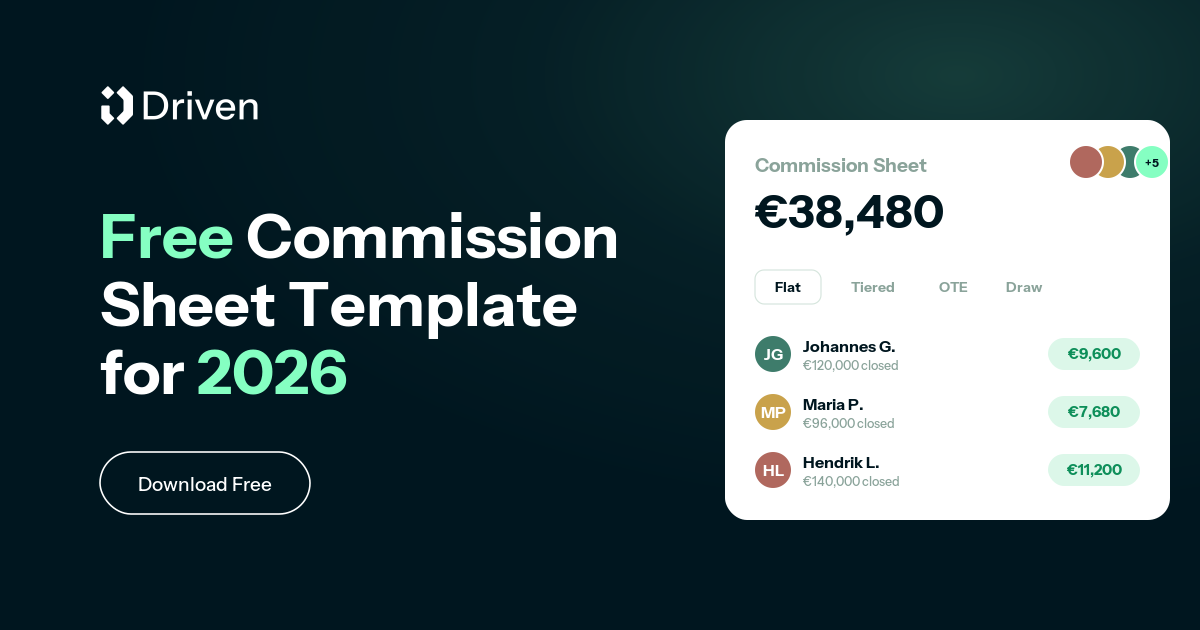
Free Commission Sheet Template: 8 Sales Commission Spreadsheets in One Excel File
Most commission plans don't fail because the idea is wrong. They fail because nobody modelled the numbers before rolling them out. A rate that looks generous on a slide turns into a payout you can't afford at 130% attainment, or an accelerator so flat that your best reps stop pushing the moment they hit quota.
So we built a free commission sheet template to fix that. It's one Excel file with eight ready-to-use sales commission spreadsheets, each structure on its own tab, each with live formulas and a filled-in sample row. Change a rate, a quota, or a revenue number and every payout updates instantly, and because everything lives in one workbook you can compare models side by side without juggling downloads.
Download the commission sheet template, or start for free and let Driven build the plan for you.

New to comp design? Start with our guide to sales compensation structure types, then model your pick here.

Non-Recoverable Draw vs. Recoverable Draw: What's the Difference?
New sales hires often get offered a "draw" against commission, and most sign the offer letter without knowing there are two very different types. That gap in understanding can mean thousands of dollars either staying in a rep's pocket or getting clawed back months later.
A draw is essentially an advance on future commission, designed to give reps steady income while they ramp up pipeline and close their first deals. But whether that advance is recoverable or non-recoverable determines something much bigger: whether it ever has to be paid back.
This guide breaks down what each draw type means, how they're calculated, when companies typically use each one, and the mistakes that turn a helpful ramp tool into a trust problem between reps and the company that hired them.




.svg%201.avif)