What Is Incentive Pay & Different Types of Incentive Pay Programs

.png)
TL;DR
In today’s competitive business environment, companies are constantly looking for ways to attract, retain, and motivate talented employees. One of the most effective methods to achieve this is through incentive pay since it is a compensation strategy that directly rewards performance and achievement.
Unlike a fixed salary, incentive pay links employee effort to tangible rewards, making it a powerful motivator and performance driver. Let’s explore what incentive pay really means, how it’s calculated, its key types, and how it differs from traditional bonuses.
What Is Incentive Pay?
Incentive pay refers to additional compensation given to employees based on their performance, productivity, or contribution to company goals. It acts as a performance-based reward system that goes beyond the standard paycheck.
While base pay compensates employees for their time and role, incentive pay rewards results and motivates individuals and teams to work harder, smarter, and more efficiently. Incentive pay is not just about financial rewards; it’s about recognition, accountability, and alignment between employee performance and organizational success.
Example:
A sales executive may receive a 5% commission on every sale they close beyond their monthly target. Similarly, a production team might earn a group bonus for meeting efficiency or quality goals.
Types of Incentive Pay Programs
Incentive pay programs vary based on business goals, job roles, and performance metrics. Here are the most common types:
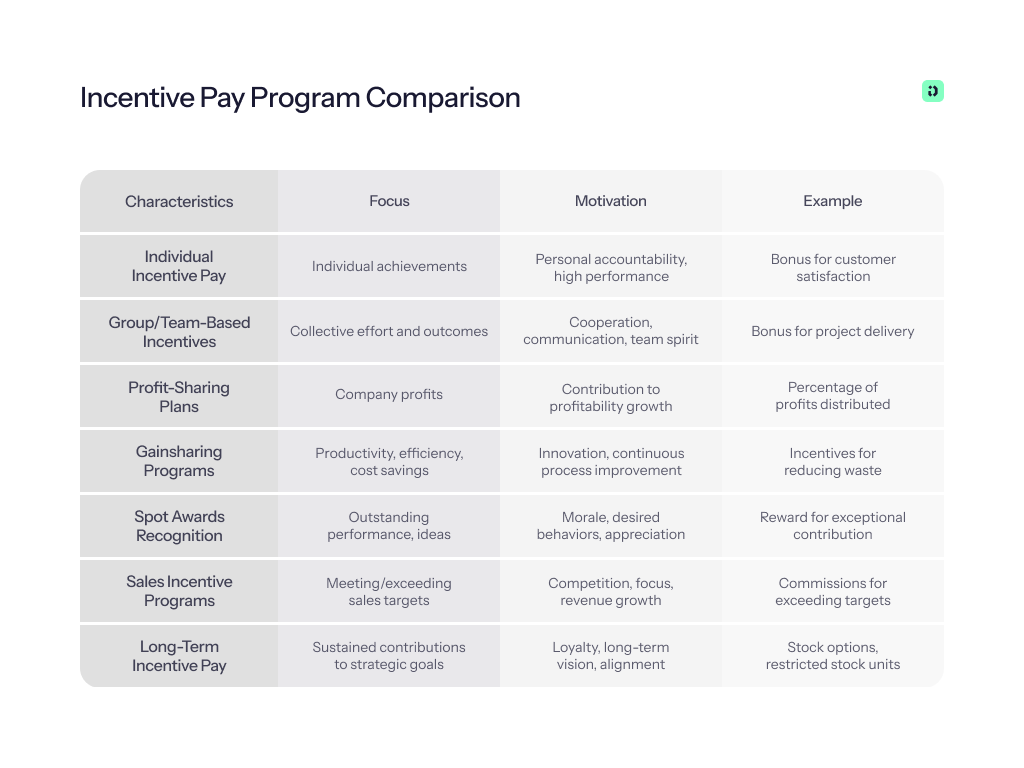
1. Individual Incentive Pay
This plan rewards employees for their individual achievements, linking pay directly to measurable outcomes like sales, production, or efficiency. It motivates personal accountability, encourages high performance, and allows top performers to be recognized and compensated based on their direct contributions to organizational success.
Example:
A call center agent earns a bonus for achieving 95% customer satisfaction ratings.
Benefits:
- Promotes accountability.
- Encourages self-improvement.
2. Group or Team-Based Incentives
Team-based incentives reward collective effort and outcomes rather than individual achievements. This approach promotes cooperation, enhances communication, and strengthens team spirit by ensuring everyone works toward a shared objective, fostering unity and a sense of mutual responsibility for results.
Example:
A project team earns a group bonus after delivering a project ahead of schedule.
Benefits:
- Enhances teamwork.
- Builds a sense of shared ownership.
3. Profit-Sharing Plans
Profit-sharing programs distribute a portion of company profits among employees, aligning their interests with the organization’s success. When the company performs well, everyone benefits, motivating employees to contribute more effectively to profitability and long-term business growth.
Example:
An organization sets aside 10% of its annual profits to be divided among eligible employees based on their roles and tenure.
Benefits:
- Encourages employees to think like business owners.
- Strengthens long-term loyalty.
4. Gainsharing Programs
Gainsharing focuses on rewarding employees or teams for measurable improvements in productivity, efficiency, or cost savings. Unlike profit-sharing, which depends on overall company profit, gainsharing rewards operational performance, promoting innovation and continuous process improvement.
Example:
A manufacturing unit receives incentives for reducing material waste or increasing production output.
Benefits:
- Promotes innovation and process improvement.
- Builds continuous performance focus.
5. Spot Awards or Recognition Incentives
Spot awards provide immediate recognition for outstanding performance, creative ideas, or exceptional contributions. These spontaneous rewards—cash, gift cards, or public acknowledgment—boost morale, reinforce desired behaviors, and create a culture of appreciation and motivation across the workplace.
Example:
An employee receives a ₹5,000 reward for going above and beyond during a product launch.
Benefits:
- Provides immediate recognition.
- Reinforces positive behavior.
6. Sales Incentive Programs
Sales incentive plans reward employees based on meeting or exceeding targets, quotas, or specific performance levels. Often structured in tiers or contests, they encourage competition, enhance focus, and drive revenue growth by motivating sales teams to achieve consistent, measurable results.
Example:
Sales representatives earn commissions or additional bonuses for achieving 120% of their monthly target.
Benefits:
- Drives sales performance.
- Keeps teams motivated in competitive environments.
7. Long-Term Incentive Pay
Long-term incentive pay is designed to retain top talent and encourage sustained contributions toward strategic company goals. Rewards, often in the form of stock options or bonuses, are tied to multi-year performance, promoting loyalty, long-term vision, and alignment with organizational success.
Examples:
- Stock Options: Allow employees to buy company shares at a discounted price.
- Restricted Stock Units (RSUs): Employees receive shares after meeting performance or tenure requirements.
Benefits:
- Promotes loyalty and long-term commitment.
- Aligns employee interests with company growth.
How Driven Makes Incentive Pay Smarter
Driven is the AI-powered platform that automates and optimizes incentive programs, ensuring they actually drive performance.
- Integrated & Real-Time: Syncs directly with your CRM so reps and managers always see live data.
- AI-Powered Compensation: Builds plans that motivate the right behaviors, detects free riders, and flags sandbagging.
- Instant Insights: Managers get proactive alerts to adjust plans, identify trends, and keep reps performing at their best.
Lightning-Fast Onboarding: Plug, play, and go — no months of setup or expensive implementations.
See Driven in Action
Why Incentive Pay Matters
Incentive pay isn’t just extra money; it shapes behavior, keeps your team motivated, and connects effort directly to results. When done in the right way, incentive pay programs benefits both employers and employees in multiple ways.
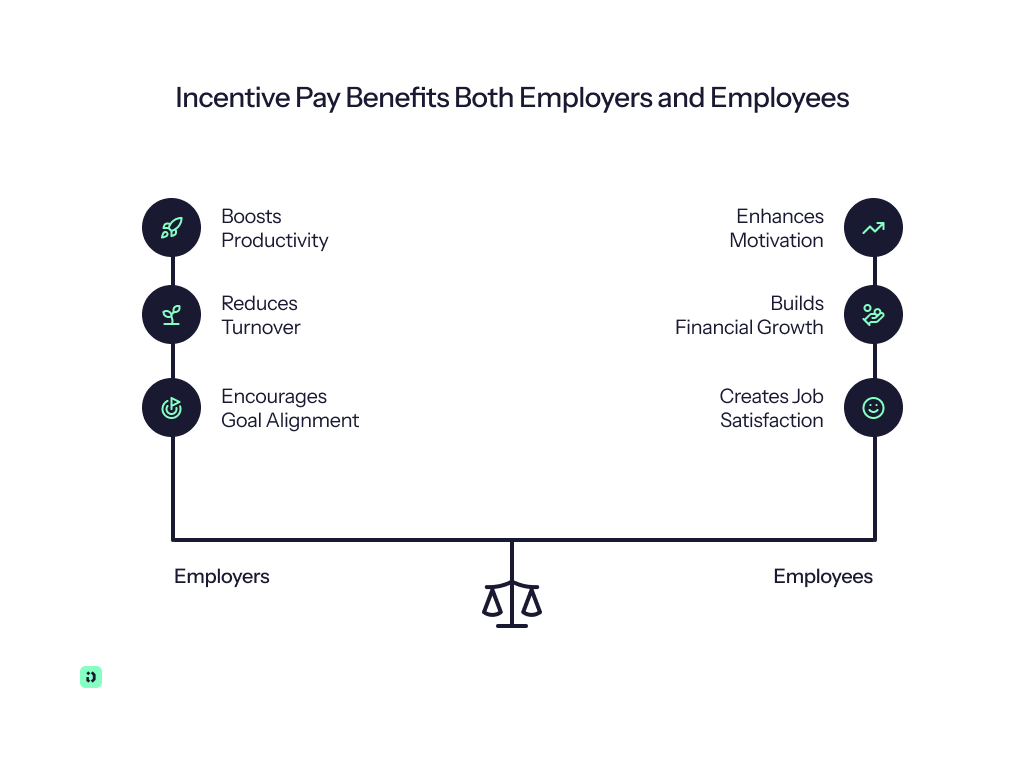
For Employers
- Boosts Productivity: Employees tend to perform better when they know their hard work leads to tangible rewards.
- Reduces Turnover: Rewarding effort fosters loyalty and reduces the cost of hiring and training new staff.
- Encourages Goal Alignment: Incentives connect employee actions directly to company goals, such as sales targets or profit margins.
For Employees
- Enhances Motivation: When efforts are recognized and rewarded, motivation naturally increases.
- Builds Financial Growth: Employees can supplement their regular income through bonuses and incentives.
- Creates Job Satisfaction: Recognition for performance enhances morale and engagement.
With Driven, incentive pay is clear, automated, and intelligent. Reps know exactly what’s expected, managers get real-time insights, and everyone stays focused on what matters most: hitting targets and driving results.
How Is Incentive Pay Calculated?
The method for calculating incentive pay depends on the program type and performance criteria. However, the basic principle remains the same that is reward based on measurable achievement.
General Formula:
Incentive Pay = (Performance Output ÷ Target) × Incentive Rate
Example 1 – Sales Commission:
If a salesperson earns a 5% commission on all sales above ₹5,00,000:
- Sales achieved = ₹7,00,000
- Incentive = 5% of ₹2,00,000 = ₹10,000
Example 2 – Performance Bonus:
An employee achieving 110% of their KPI goals might receive ₹15,000 as an incentive for exceeding expectations.
Example 3 – Profit Sharing:
If the company allocates 10% of profits to staff and total profit is ₹10 lakh, an employee may receive a share based on tenure or role.
Key Takeaway: To be effective, incentive calculations must be transparent, consistent, and performance-driven, ensuring employees clearly understand how their efforts translate into earnings.
What Are the Differences Between Incentive Pay and a Bonus?
While incentive pay and bonuses are both performance-related rewards, they serve different purposes.
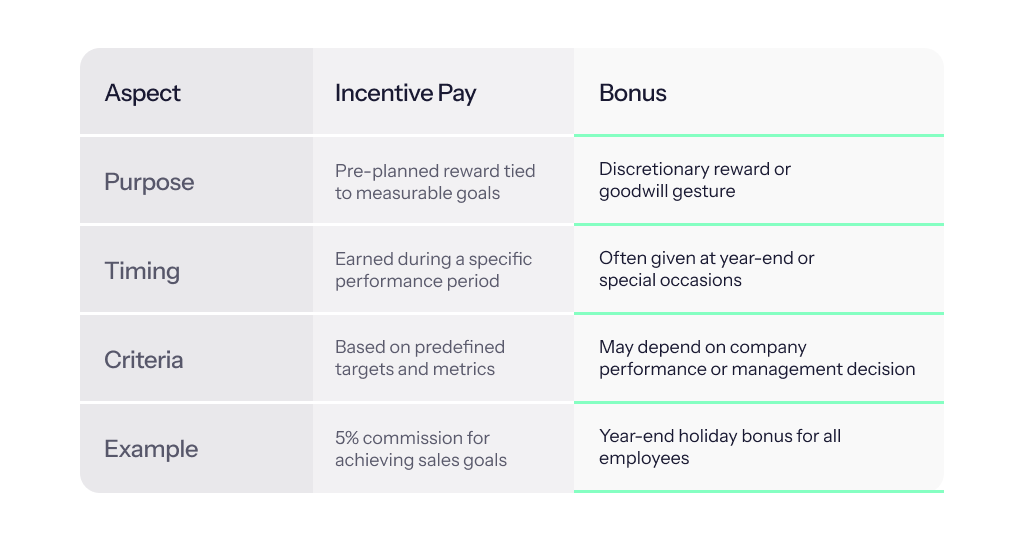
In short:
- Incentive pay is performance-linked, motivating future achievements.
- Bonuses are retrospective rewards, recognizing past contributions.
Both can coexist effectively, as incentives drive ongoing performance, while bonuses enhance appreciation and morale.
How to Choose the Right Incentive Pay Program
Selecting the right incentive pay structure depends on your organization’s goals, industry, and workforce. Here’s what to consider:
- Define Clear Objectives:
Align incentives with measurable outcomes like revenue growth, quality improvement, or customer satisfaction. - Know Your Workforce:
Tailor programs based on employee roles — individual incentives for sales teams, group rewards for collaborative projects. - Ensure Fairness and Transparency:
Communicate eligibility and calculation methods clearly to avoid confusion or resentment. - Set Realistic and Achievable Targets:
Goals should be challenging yet attainable to maintain motivation. - Monitor and Adjust Regularly:
Review performance data and feedback to fine-tune the program for relevance and impact.
Common Challenges & Best Practices
Discover the common challenges businesses face when implementing incentive pay programs and learn best practices to design fair, motivating, and effective reward systems that drive employee performance and retention.
Challenges:
- Lack of clarity in performance metrics: When goals aren’t clearly defined, employees may feel confused about expectations, leading to inconsistent performance and dissatisfaction.
- Overemphasis on short-term results: Focusing only on immediate gains can harm long-term growth, teamwork, and sustainable performance.
- Perceived favoritism or unfair reward distribution: Unequal recognition can lower morale and create mistrust among employees.
- Risk of employee burnout or unhealthy competition: Excessive pressure to perform can cause stress, conflict, and decreased overall productivity.
Best Practices:
- Use SMART Goals: Define clear, measurable, and achievable targets to ensure fairness and focus.
- Balance Rewards: Combine monetary incentives with recognition, growth opportunities, and appreciation.
- Track Consistently: Monitor performance through transparent, data-driven tools to ensure accountability and fairness.
- Communicate Frequently: Keep employees updated about goals, progress, and reward criteria to maintain trust and motivation.
Conclusion
Incentive pay is more than a financial reward since it’s a strategic tool that motivates employees, strengthens morale, and aligns individual performance with organizational goals. A well-structured incentive program encourages accountability, drives productivity, and fosters a sense of ownership among team members. When employees clearly understand how their efforts translate into tangible rewards, they are inspired to perform consistently at their best. For businesses, this creates a culture of excellence, engagement, and shared success. In essence, incentive pay transforms motivation into measurable results, benefiting both employees and employers in the long run.



See your comp plan, fully built in minutes

Frequently Asked Questions
About the author
Ludovic Diercxsens






Understanding SPIFFs, Bonuses, and Commissions
Ask a sales rep what's driving their next paycheck, and you'll often hear all three words used interchangeably: SPIFF, bonus, and commission. They get lumped together as "extra money for selling," but they're not the same thing, and treating them like they are leads to confused reps, inconsistent payouts, and comp plans nobody can actually explain.
A SPIFF is a short-term, targeted incentive. A bonus is a lump-sum reward tied to hitting a broader goal. A commission is the ongoing, formula-based pay tied directly to sales, the core of most sales comp plans, not an add-on to it.
This guide breaks down what each one actually means, when companies use them, how they're calculated, and how they stack together so you can build a comp plan where every payout has a clear reason behind it.

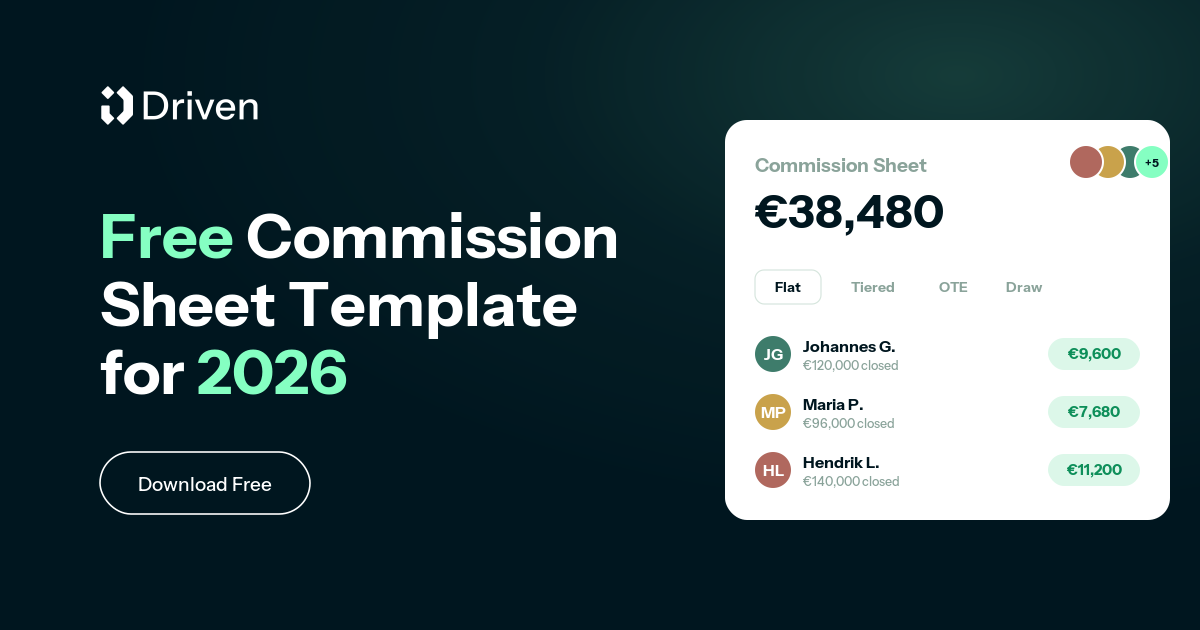
Free Commission Sheet Template: 8 Sales Commission Spreadsheets in One Excel File
Most commission plans don't fail because the idea is wrong. They fail because nobody modelled the numbers before rolling them out. A rate that looks generous on a slide turns into a payout you can't afford at 130% attainment, or an accelerator so flat that your best reps stop pushing the moment they hit quota.
So we built a free commission sheet template to fix that. It's one Excel file with eight ready-to-use sales commission spreadsheets, each structure on its own tab, each with live formulas and a filled-in sample row. Change a rate, a quota, or a revenue number and every payout updates instantly, and because everything lives in one workbook you can compare models side by side without juggling downloads.
Download the commission sheet template, or start for free and let Driven build the plan for you.

New to comp design? Start with our guide to sales compensation structure types, then model your pick here.


Non-Recoverable Draw vs. Recoverable Draw: What's the Difference?
New sales hires often get offered a "draw" against commission, and most sign the offer letter without knowing there are two very different types. That gap in understanding can mean thousands of dollars either staying in a rep's pocket or getting clawed back months later.
A draw is essentially an advance on future commission, designed to give reps steady income while they ramp up pipeline and close their first deals. But whether that advance is recoverable or non-recoverable determines something much bigger: whether it ever has to be paid back.
This guide breaks down what each draw type means, how they're calculated, when companies typically use each one, and the mistakes that turn a helpful ramp tool into a trust problem between reps and the company that hired them.



.svg%201.avif)