How Aikido Security Cut Commission Processing from 3 Days to 3 Hours with Driven

.png)
TL;DR
Aikido Security, a fast-growing cybersecurity platform out of Belgium, was drowning in manual commission work every quarter. After adopting Driven, their CRO went from 3 days of spreadsheet work to 3 hours of review — while giving every rep real-time earnings visibility across 6 global regions.
About Aikido Security
Aikido is a fast-growing cybersecurity platform out of Belgium, securing code for thousands of companies worldwide. Their CRO, Thijs Janse, manages a team of 120+ sales professionals across 6 regions: EU, UK, US, APAC, and the Middle East — with plans to double the team again this year.
Growing that fast means paying commissions doesn't stay simple for long.
The Breaking Point
Every quarter, Aikido's CRO disappeared for 3 days. Not into deals — into spreadsheets.
Pulling deal data from HubSpot. Cross-referencing with billing. Manually calculating every rep's payout across multiple regions, each with different rates, currencies, and accelerator logic. Then fielding a week of Slack messages from reps asking why their number looked off.
Meanwhile, every rep was building their own shadow spreadsheet. Managers were doing their own math to check if their team target was right. Finance was waiting on final numbers before they could even start the payout process.
The combined time cost across the org? Easily a full week per quarter, burned on admin — not on selling. And Aikido was about to double the team. The spreadsheet wasn't going to survive that.
Why Driven
Aikido didn't want another tool that needed a 3-month implementation, a dedicated admin, and a consultant to set up formulas. They wanted a simple, reliable solution that gets the job done.
For Thijs, correctness came first, speed second. Commissions had to be right, every time, without manual cross-checking. Driven delivered both: the agentic comp builder set up all plans in hours, and the Driven Agent answers any question new joiners might have about their comp on the spot.
The HubSpot connection was instant. No CSV exports, no manual data mapping — deal data and revenue streams flowing in automatically, all plans across every region and role configured and validated within a few days.
Support That Feels Like an Extra Team Member
"It felt like Driven was part of the Aikido team during onboarding. Shared Slack channel, instant replies."
That's not a one-time onboarding experience — it's how the relationship works every day. Aikido has a shared Slack channel with the Driven team. When a rep spots something off, they ask. When a manager needs a target adjusted, it happens the same day.
No ticket queue. No 3-5 business day response times. No "we'll escalate this to engineering." Just a direct line to the people who built the system. Not a vendor. An extension of the team.
What Changed

"We went from spending 3 days on commission calculations to getting it done in 3 hours. Driven gave our reps real-time visibility into their earnings, which was a game-changer for our team."
— Thijs Janse, CRO, Aikido Security
- For the CRO: Those 3 days turned into 3 hours. One session to review and approve all payouts. Done.
- For Finance: No more being the bottleneck. Payouts are calculated automatically and ready for review. No spreadsheet archaeology, no manual formulas to audit.
- For Managers: Team targets update automatically as reps ramp in. No more guessing, no more asking "what's my number this quarter?"
- For Reps: Log in, see every deal, see the exact rate applied, see the payout. No shadow spreadsheets. No waiting until end of quarter to find out what you earned.
- For New Joiners: One click and they're in the system. Driven explains their plan, their targets, their ramp. Instantly ready to sell.
Scaling Without the Overhead
Aikido is planning to double their sales team in the coming year. New regions. New plan types. New reps every quarter with individual ramp schedules.
Before Driven, every new hire meant more rows in the spreadsheet, more edge cases to handle manually, more room for error. Now, adding a new rep takes minutes. Their plan, target, and ramp are configured once — and everything calculates from there. Doubling the team doesn't mean doubling the admin.
The Numbers
3 days → 3 hours — CRO commission processing time per quarter
1 week from HubSpot connection to live with 120 reps
0 individual spreadsheets created by reps after onboarding
120+ reps across 6 regions, all on automated plans
New rep onboarding: instant



See your comp plan, fully built in minutes

About the author
Ludovic Diercxsens






Understanding SPIFFs, Bonuses, and Commissions
Ask a sales rep what's driving their next paycheck, and you'll often hear all three words used interchangeably: SPIFF, bonus, and commission. They get lumped together as "extra money for selling," but they're not the same thing, and treating them like they are leads to confused reps, inconsistent payouts, and comp plans nobody can actually explain.
A SPIFF is a short-term, targeted incentive. A bonus is a lump-sum reward tied to hitting a broader goal. A commission is the ongoing, formula-based pay tied directly to sales, the core of most sales comp plans, not an add-on to it.
This guide breaks down what each one actually means, when companies use them, how they're calculated, and how they stack together so you can build a comp plan where every payout has a clear reason behind it.

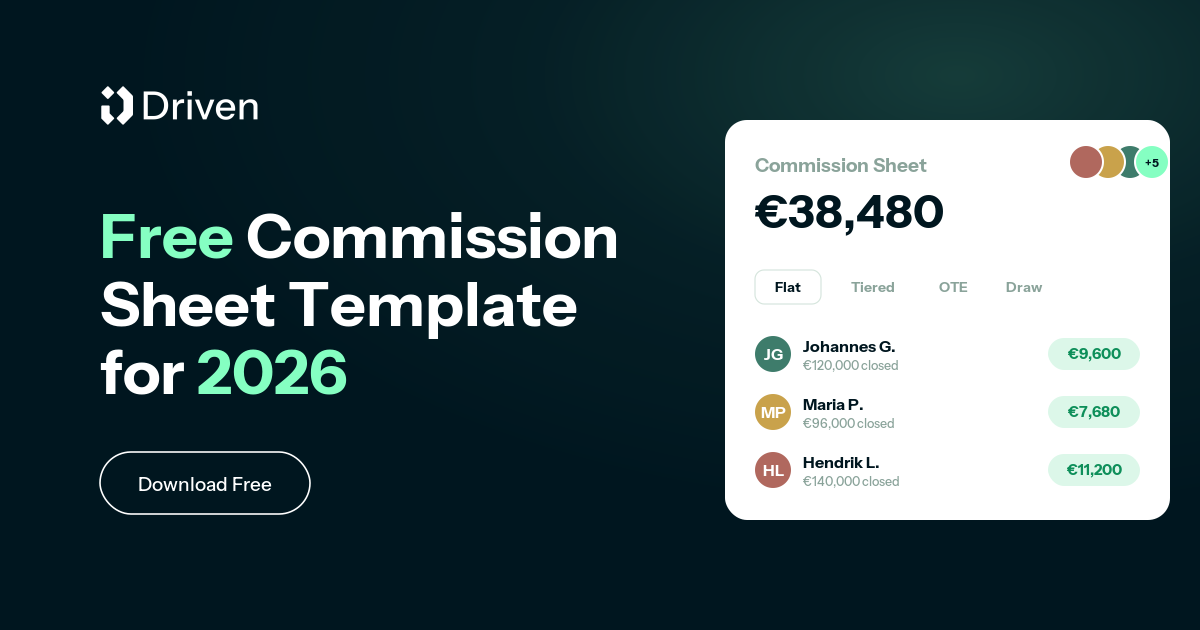
Free Commission Sheet Template: 8 Sales Commission Spreadsheets in One Excel File
Most commission plans don't fail because the idea is wrong. They fail because nobody modelled the numbers before rolling them out. A rate that looks generous on a slide turns into a payout you can't afford at 130% attainment, or an accelerator so flat that your best reps stop pushing the moment they hit quota.
So we built a free commission sheet template to fix that. It's one Excel file with eight ready-to-use sales commission spreadsheets, each structure on its own tab, each with live formulas and a filled-in sample row. Change a rate, a quota, or a revenue number and every payout updates instantly, and because everything lives in one workbook you can compare models side by side without juggling downloads.
Download the commission sheet template, or start for free and let Driven build the plan for you.

New to comp design? Start with our guide to sales compensation structure types, then model your pick here.


Non-Recoverable Draw vs. Recoverable Draw: What's the Difference?
New sales hires often get offered a "draw" against commission, and most sign the offer letter without knowing there are two very different types. That gap in understanding can mean thousands of dollars either staying in a rep's pocket or getting clawed back months later.
A draw is essentially an advance on future commission, designed to give reps steady income while they ramp up pipeline and close their first deals. But whether that advance is recoverable or non-recoverable determines something much bigger: whether it ever has to be paid back.
This guide breaks down what each draw type means, how they're calculated, when companies typically use each one, and the mistakes that turn a helpful ramp tool into a trust problem between reps and the company that hired them.