Sales compensation management is undergoing a major transformation. What was once a manual, rule-based, and spreadsheet-heavy process is now becoming more intelligent, automated, and insight-driven. At the core of this shift is artificial intelligence (AI) in revenue operations and commission management. Businesses are no longer just looking for tools that calculate commissions; they want systems that can think, analyse, and optimise.
Here's where things get confusing: what exactly is an AI commission agent, and how does it differ from conventional commission software? This blog explains it well. Most commission software calculates payouts. An AI commission agent goes several steps further, it analyses, predicts, automates, and even assists decision-making.
What Is Commission Software?
Commission software is a system designed to automate the calculation and tracking of sales commissions based on predefined rules and performance data. It primarily focuses on accuracy, automation, and reporting, not intelligence or decision-making. For a deeper look at tools used in this space, explore the best sales compensation software solutions:
Automates commission calculations
Tracks sales performance
Reduces spreadsheet dependency
Generates payout reports
Core Features
Commission calculation automation: Automatically computes sales commissions based on predefined rules, ensuring accurate and timely payouts while reducing manual errors, spreadsheets, and administrative effort in compensation processing.
Incentive plan management: Enables creation, configuration, and management of sales incentive structures, allowing businesses to define rules for bonuses, tiers, quotas, and performance-based rewards efficiently.
Payroll integration: Connects commission systems with payroll software to ensure seamless and accurate salary and commission payouts, reducing delays, duplication errors, and manual data transfers.
Sales performance dashboards: Provides visual insights into sales performance metrics such as revenue, quotas, and commissions, helping teams track progress and make data-driven decisions easily.
Dispute management: Allows sales reps and managers to raise, track, and resolve commission-related disputes efficiently, ensuring transparency, accountability, and faster resolution of payout discrepancies.
Reporting & analytics: Generates detailed reports and analytics on sales performance, commission trends, and payout structures, helping businesses optimise compensation strategies and improve financial planning.
Common Users
Sales teams
Finance teams
HR & payroll departments
When a sales representative closes a deal, the system automatically records the sale. Then, instead of a human manually calculating earnings, the software applies predefined rules such as commission percentage, product type, or deal size.
For example:
If the rule says “5% commission on every closed deal”
And a rep closes a $10,000 deal
The software automatically calculates a $500 commission
This process is fast and accurate, but it is strictly rule-based, meaning it does not analyse context, optimise incentives, or provide insights; it simply executes the logic that has already been defined.
Many companies still rely on spreadsheets and manual processes, but these inefficiencies often lead to the hidden costs of manual commission tracking, including errors, delays, and reduced sales team trust.
What Is an AI Commission Agent?
An AI commission agent is an intelligent system that goes beyond basic automation to actively understand, analyse, and optimise sales commission processes. Unlike traditional tools that only follow fixed rules, it learns from data and improves decision-making over time.
This evolution is part of a much larger shift in how businesses are using artificial intelligence across revenue operations. AI is transforming revenue operations, reshaping modern RevOps systems by making them more intelligent, automated, and insight-driven.
It not only processes commissions but also the following.
Understands commission data
Learns from historical patterns
Detects anomalies in payouts
Provides smart recommendations
Supports decision-making for finance and sales teams
Key Capabilities
AI commission agents are designed to do more than calculate payouts. They bring intelligence, prediction, and automation into every stage of commission management. AI also plays a major role in improving sales motivation and performance outcomes.
1. Intelligent Commission Analysis
AI continuously monitors commission data in real time to identify issues and patterns that are difficult to detect manually.
It can:
Detect payout anomalies across teams or individuals
Identify overpayments or underpayments
Highlight inconsistencies in commission structures
2. Predictive Insights
AI shifts commission management from reactive reporting to proactive planning by forecasting future outcomes.
It helps teams by:
Forecasting future commission payouts
Predicting sales performance trends
Estimating incentive costs before payout cycles
3. Natural Language Assistance
Instead of navigating dashboards or filters, users can interact with the system using simple questions in plain language.
For example:
“Why did my commission decrease this month?”
“Show top-performing regions by incentive ROI.”
AI responds with clear, instant explanations that are easy to understand.
4. Automated Decision Support
AI helps organisations improve compensation strategy by providing data-driven recommendations.
It supports decision-making by:
Suggesting better commission structures
Recommending incentive adjustments
Identifying underperforming plans
5. Workflow Automation
AI reduces manual workload by automating repetitive and time-consuming commission-related tasks.
It can:
Auto-approve valid dispute cases
Trigger alerts for unusual commission patterns
Reduce manual intervention in routine operations
AI Commission Agent vs Traditional Commission Software
Why Businesses Are Moving Toward AI Commission Agents
Businesses are increasingly shifting from traditional commission software to AI-powered commission agents because they offer more intelligence, automation, and strategic value. Instead of just calculating payouts, AI helps improve accuracy, speed, and decision-making across the entire compensation process.
Improved Accuracy
AI significantly reduces errors in commission calculations by continuously monitoring data and identifying inconsistencies that manual audits often miss.
It helps by:
Detecting calculation errors early
Identifying incorrect or missing payout data
Reducing human dependency in audit processes
Faster Decision-Making
AI enables managers and finance teams to access real-time insights instead of waiting for manual reports or end-of-cycle analysis.
It improves decision-making by:
Providing instant commission insights
Highlighting performance trends in real time
Enabling quicker corrective actions
Better Sales Motivation
AI helps organisations design smarter incentive structures that align with performance and business goals, leading to higher sales motivation. Poorly designed incentive plans often lead to reduced performance and disengaged sales teams. Understanding why sales reps lose motivation and how to fix it is critical for improving outcomes.
It supports this by:
Optimizing incentive plans based on performance data
Identifying what drives higher sales outcomes
Helping tailor rewards to motivate teams effectively
Reduced Administrative Work
AI reduces the burden of repetitive manual tasks involved in managing commissions, approvals, and dispute handling. Automation can save operational time in commission management by reducing manual checks, streamlining workflows, and minimising time spent on data validation and reporting.
It achieves this by:
Minimizing manual commission cheques
Automating dispute resolution workflows
Reducing time spent on data validation and reporting
Scalability
AI commission agents are designed to handle complex and growing sales structures without increasing administrative complexity.
They help businesses by:
Managing large and multi-region sales teams
Supporting complex commission rules at scale
Ensuring consistent accuracy as operations grow
How Driven Helps Businesses Modernize Commission Management
As commission structures become more complex, businesses need more than spreadsheets and static commission tools. Platforms like Driven are helping organisations simplify incentive compensation management with automation, visibility, and intelligent workflows. Modern businesses are moving toward AI-powered sales compensation platforms.
Driven enables companies to:
Automate commission calculations
Reduce manual payout errors
Improve transparency for sales teams
Streamline incentive compensation workflows
Deliver real-time performance insights
Moving Beyond Traditional Commission Tracking
Traditional commission software mainly focuses on calculations and reporting. Modern platforms like Driven are evolving toward smarter compensation management by helping businesses.
Connect sales performance with incentives
Improve operational efficiency
Increase sales team trust through transparent payouts
Scale compensation processes across growing teams
Supporting Revenue and Sales Operations Teams
Revenue operations, finance, and sales leaders can use Driven to:
Manage complex compensation plans
Track performance metrics in real time
Reduce administrative overhead
Align incentives with business goals
Why This Matters in the AI Era
As AI becomes more integrated into sales operations, businesses are increasingly looking for commission platforms that not only automate processes but also provide deeper visibility and smarter decision-making capabilities.
Solutions like Driven represent the shift from manual commission management toward more intelligent, scalable, and data-driven compensation operations.
Challenges and Considerations
Although AI commission agents offer powerful automation and intelligence, businesses must still be aware of a few important challenges before adopting them.
Data Quality Matters
AI systems rely heavily on the quality of data they receive from CRM and sales systems. If the data is incomplete, inconsistent, or inaccurate, the AI may generate misleading insights or incorrect commission calculations. That is why clean, well-structured, and regularly updated data is essential for reliable results.
Integration Complexity
AI commission agents do not work in isolation and need to connect with multiple business systems to function effectively. This often requires integration with CRM platforms for sales data, ERP systems for financial records, and payroll systems for payout processing. Without smooth integration, businesses may face data gaps and workflow inefficiencies.
Human Oversight Is Still Important
Even though AI can automate analysis and decision support, it cannot fully replace human expertise in compensation strategy. Finance leaders and RevOps teams are still needed to review outputs, validate decisions, and ensure fairness and business alignment. Human judgement remains essential for handling complex or sensitive compensation scenarios.
The Future of Commission Management
Commission management is rapidly evolving from static, rule-based systems into intelligent, AI-driven ecosystems. Instead of simply calculating payouts, future systems will focus on real-time insights, automation, and strategic decision-making that actively support business growth. AI is becoming a core driver of revenue operations transformation:
Key Trends Shaping the Future
Conversational AI interfaces
Real-time commission intelligence
Autonomous compensation operations
AI copilots for RevOps and finance teams
These innovations are strongly connected to the broader transformation happening across revenue operations, where AI is becoming a core driver of how businesses manage efficiency, performance, and decision-making.
Overall, AI is transforming commission management from basic calculation tools into advanced strategic intelligence systems. Instead of only processing payouts, future platforms will actively guide business decisions, optimise incentives, and improve overall sales performance through continuous learning and insights.
Final Thoughts
Commission software automates commission calculations using predefined rules, ensuring accurate and efficient payouts. In contrast, AI commission agents add intelligence, prediction, automation, and decision support, helping businesses optimise incentives, detect anomalies, and improve decision-making. As a result, more companies are shifting toward AI-driven solutions for smarter sales compensation management.
If you’re looking to modernise your commission process, explore how Driven can help improve efficiency, transparency, and overall sales performance through AI-powered commission management.
Frequently Asked Questions
Is an AI commission agent the same as commission software?
No. Commission software is rule-based and focuses on automating commission calculations, while AI commission agents go further by adding intelligence, predictive insights, anomaly detection, and decision-support capabilities for sales compensation management.
Can AI commission agents reduce commission errors?
Yes. AI commission agents can significantly reduce errors by continuously analysing payout data, detecting anomalies, flagging inconsistencies, and automating validation processes before commissions are finalised.
Do AI commission agents replace finance teams?
No. AI commission agents do not replace finance or RevOps teams. Instead, they support them by automating repetitive tasks, improving accuracy, and providing insights that help in faster and better decision-making.
What industries use AI commission agents?
AI commission agents are used across industries with complex sales compensation structures, including SaaS, insurance, telecom, manufacturing, and retail, where accurate and scalable commission management is critical.
How do AI commission agents improve sales performance?
AI commission agents improve sales performance by analysing incentive effectiveness, identifying high-performing behaviours, and recommending optimised commission structures that better align with business goals and motivate sales teams more effectively.
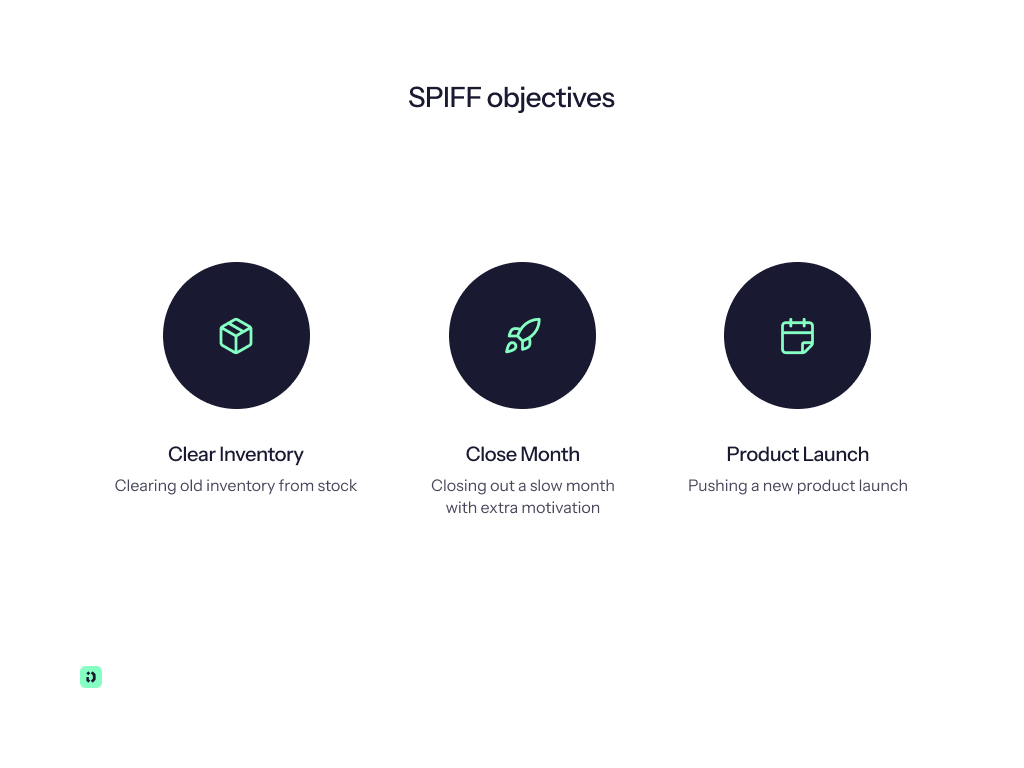
A SPIFF (Sales Performance Incentive Fund) is a short-term cash incentive tied to a specific, immediate action, usually selling a particular product, hitting a short-window target, or pushing a specific behavior the company wants right now.
SPIFFs are built for speed. They're announced, run for a defined stretch, usually days or weeks, and paid out fast, sometimes even same-day or same-week, specifically because the immediacy is what makes them effective. A SPIFF isn't meant to replace commission, it's meant to temporarily redirect a rep's attention toward something specific: clearing old inventory, pushing a new product launch, or closing out a slow month with extra motivation.
A draw in sales compensation is a guaranteed advance payment made to a salesperson against their future commissions. This means it is an advance against future commission, paid out on a regular schedule, usually monthly, so reps have predictable income before their pipeline turns into closed deals and actual commission.
Companies use draws to protect new reps' income during ramp. A brand-new AE with a three-month sales cycle isn't going to close anything in week two, but they still need to pay rent. A draw bridges that gap.
For sales professionals, understanding draw type matters because it affects real take-home pay, not just cash flow timing. Two reps can be offered the exact same dollar amount as a "draw" and end up with completely different financial outcomes, depending on which type it actually is.
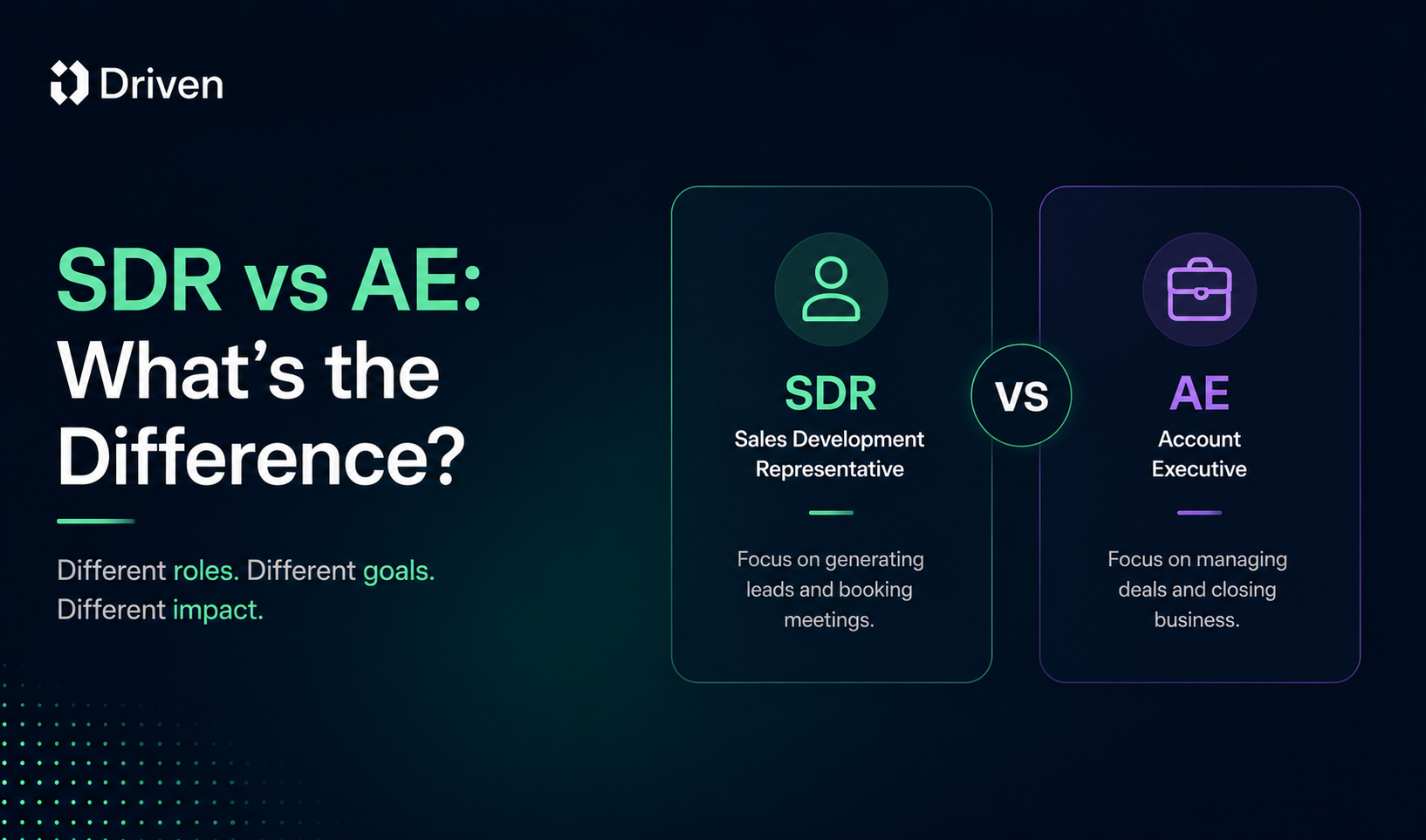
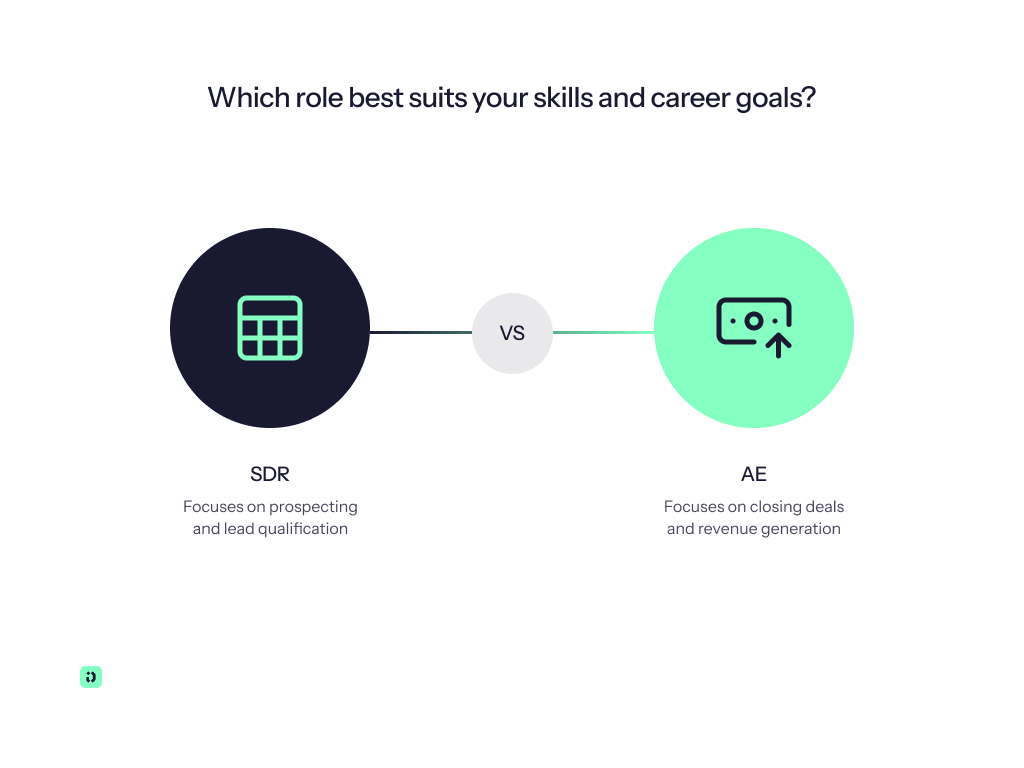
Before comparing pay, it helps to be clear on what each role is actually on the hook for. They sit on the same team, but they're not doing the same job.
What Does an SDR Do?
SDRs own the top of the funnel. Their day is built around prospecting, outbound outreach, and lead qualification, all pointed at one outcome: booking meetings and creating a pipeline for AEs to work. SDRs generally aren't responsible for closing deals. Their job ends where the AE's job begins.
What Does an AE Do?
AEs own the deal once it's qualified. That means running discovery calls, delivering product demos, negotiating terms, and closing the deal. AEs carry direct revenue ownership, and in a lot of organizations, they also handle account management once the deal is signed. The pressure sits differently here: an AE's number is measured in dollars closed, not meetings booked.

.png)


.avif)



.png)
.png)
.png)
.png)
.png)
.png)








.svg%201.avif)