Every sales leader knows the pain of month-end compensation calculations. Pulling reports, merging spreadsheets, double-checking formulas, answering endless rep questions, and trying to close the books on time. What should be a straightforward process often becomes a chaotic, error-prone marathon that eats up 20–40 hours every month. Yet most companies still rely on spreadsheets and manual workflows to manage one of the most critical parts of their revenue engine: sales compensation. And the impact is real—automating this process can help teams reclaim 20–40 hours a month, reduce disputes by up to 80%, and eliminate costly calculation errors.
Automation has changed almost every function in business—finance, marketing, and sales forecasting. But one area still lags behind: commission calculation. Companies that finally automate sales compensation don’t just modernize their systems—they get back hours of productivity, eliminate costly mistakes, and build a more motivated sales team. This blog breaks down how automating sales comp saves more than 20 hours a month, where that time comes from, and why automation is becoming a must-have for revenue organizations.
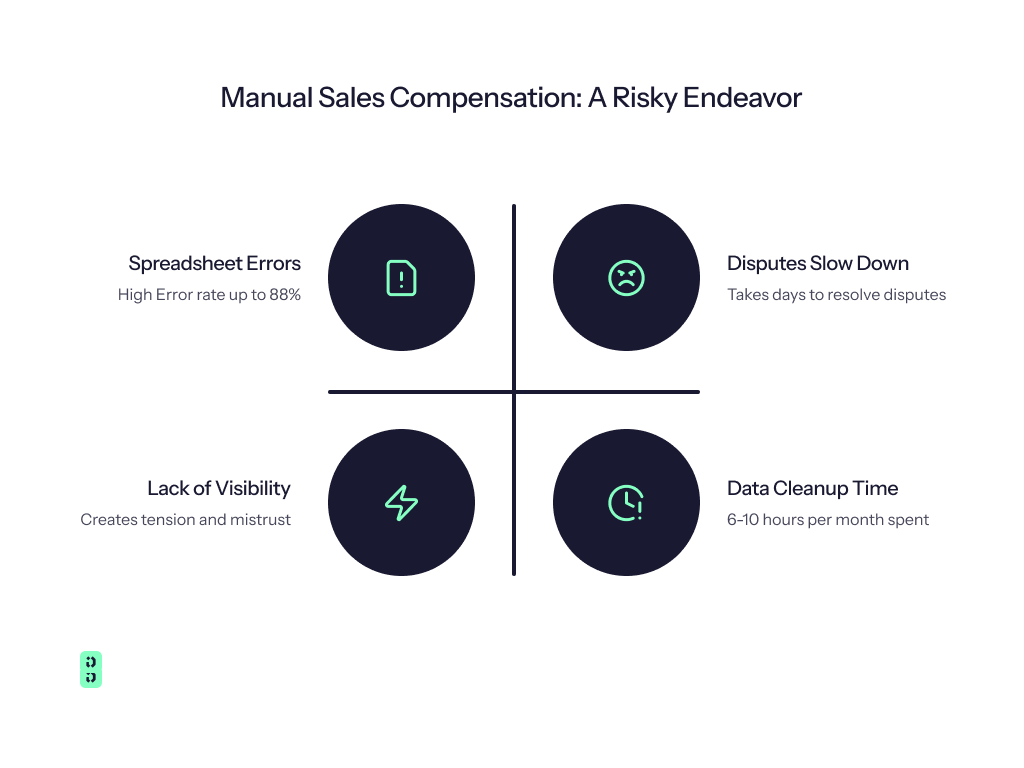
The average spreadsheet has an error rate of up to 88%, according to industry studies. That’s not surprising when you consider:
Dozens of linked formulas
Multiple data sources
Manual copy-and-paste steps
Reps modifying shared spreadsheets
Managers adding exceptions on the fly
One incorrect formula can change a rep’s payout—and easily cost the company thousands before anyone notices.
2. Endless Time Spent on Data Cleanup
Every month, sales ops and finance teams spend hours:
Exporting CRM reports
Cleaning up deal data
Removing duplicates
Fixing missing fields
Consolidating spreadsheets across teams and regions
This alone can burn 6–10 hours per month for a mid-sized sales org.
3. Disputes Slow Everything Down
Reps rarely accept numbers at face value, especially when commissions decide their income. Manual systems often create:
Misunderstandings
Disputes that take days to resolve
Breakdowns in trust
Delayed payouts
Each dispute takes anywhere from 20 minutes to several hours to investigate.
4. Lack of Visibility Creates Tension
When reps can't see how their commission is calculated until payday, they:
Overestimate their earnings
Assume the company made a mistake
Spend time chasing answers instead of closing deals
Managers waste time trying to explain calculations instead of coaching or strategizing.
The challenge grows as your team grows
For a small team, month-end comp work might take a few hours. But as the sales org expands—more reps, more deals, more exceptions—the workload increases exponentially. A process that takes a few hours with 5 reps can balloon into days of work with 20, 50, or 100+ reps. Larger teams don’t just add complexity—they multiply it.
Poorly managed commissions also drain rep productivity
When reps can’t see accurate, real-time earnings, they start doing their own math—building personal spreadsheets, double-checking CRM entries, and chasing managers for clarity. This is all the time they’re not selling. With Driven, reps see everything clearly in real time, eliminating unnecessary calculations and giving them back valuable selling hours.
How Sales Compensation Automation Delivers Immediate ROI
For most revenue organizations, automating sales compensation isn’t just a productivity upgrade—it’s one of the fastest ROI wins available. The time savings alone make the investment worthwhile.
Here’s what teams typically see within the first 30–60 days:
20–40 hours saved every month on data cleanup, manual calculations, dispute resolution, and reporting
$2,000–$10,000 in monthly productivity savings, depending on team size and hourly labor costs
30–80% fewer disputes, saving both time and administrative overhead
A payback period of under 60 days for most organizations
When you eliminate manual work, reduce errors, and free operations and finance teams to focus on higher-value tasks, the return becomes immediate and measurable. Automation isn’t a long-term bet—it’s an instant efficiency boost.
Reclaiming Time for Better Forecasting and Smarter Decisions
Beyond time savings, automation frees teams to focus on high-impact work:
Finance can shift from reconciliation to forward-looking forecasting, helping leadership plan budgets and revenue with confidence.
Sales operations can prioritize optimization, enablement, and performance insights instead of chasing down errors or fixing formulas.
Automation doesn’t just remove manual tasks—it upgrades the quality of work your teams can do.
How Driven Helps Revenue Teams Automate Without the Complexity
When it comes to building a sales compensation plan, Driven helps teams remove the usual inefficiencies of manual commission management while keeping things simple—no enterprise-level complexity required.
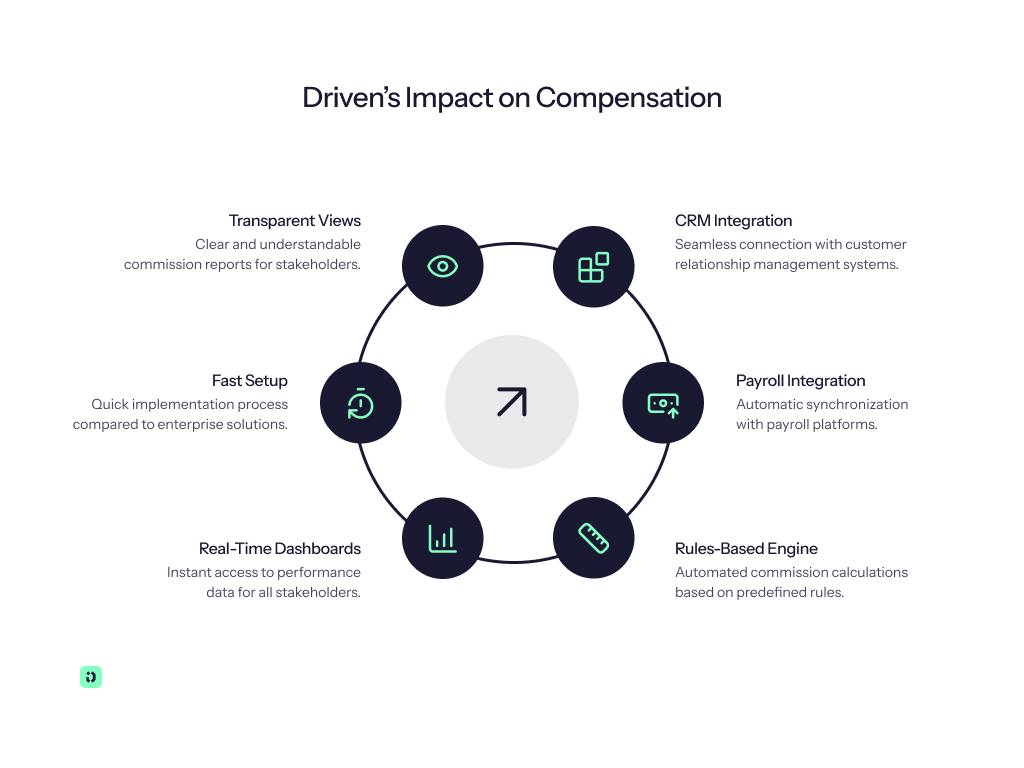
Teams choose Driven because it offers
Instant CRM and payroll integrations
A powerful, rules-based engine that calculates commissions automatically
Real-time dashboards for reps, managers, and finance
A setup process that takes days—not months
Transparent, rep-friendly views that cut disputes dramatically
Driven makes automation simple, scalable, and fast—helping revenue teams reclaim time and unlock meaningful ROI right away.
How Automation Changes Everything
Sales compensation automation eliminates the manual bottlenecks and replaces them with fast, transparent, rules-based systems. Modern platforms like Driven, which specialize in automated commission management, make it easy for sales and finance teams to reclaim valuable hours each month.
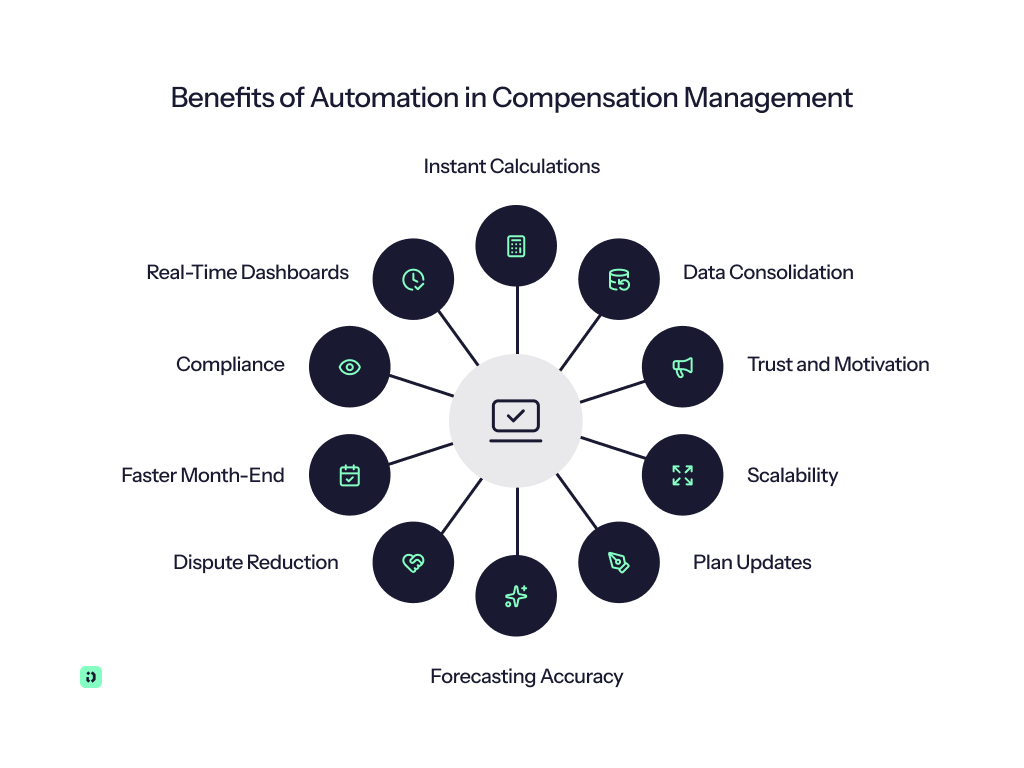
1. Automatic Data Consolidation
Automation replaces tedious manual data gathering with clean, reliable, and continuous syncing across systems. It ensures every payout is powered by accurate, real-time information without the usual spreadsheet chaos.
Key benefits include:
Real-time data syncing from CRM, ERP, and payroll
No manual exports or copy-paste errors
Always up-to-date, accurate information powering payouts
Eliminates the need for spreadsheet merges
In short, automation keeps comp data clean, consistent, and ready to calculate.
2. Instant, Rules-Based Calculations
Instead of recalculating commissions every month, automation applies compensation rules instantly and consistently. This ensures fairness, accuracy, and significant time savings.
What automation enables:
Build compensation rules once and reuse them repeatedly
Instant calculations whenever deal data updates
Centralized management for exceptions and adjustments
Guaranteed consistency across all rep payouts
This reduces calculation time from days to minutes, freeing teams from spreadsheet overload.
3. Real-Time Dashboards for Reps and Managers
Automation provides unparalleled visibility, giving both reps and leadership the clarity they need. Instead of waiting until payday, everyone sees their numbers as they update.
Reps can instantly view:
Real-time earnings
Quota progress
Deal-by-deal commission breakdowns
Managers gain access to:
Team performance metrics
Forecasted commission payouts
Compensation trends
With transparency at every level, disputes drop and confidence rises.
4. Built-In Compliance and Audit Trails
Automated systems bring structure and reliability to compensation data. Every change is tracked, logged, and easily accessible, a critical advantage during audits.
Compliance advantages include:
Full audit logs for every rule change
Version histories of compensation plans
Traceability for every calculation
Reduced risk during audits or financial reviews
This ensures your compensation process is compliant, defensible, and fully documented.
5. Faster Month-End Close
Automation dramatically shortens the month-end process by eliminating manual checks and consolidations. Finance teams can close out books faster and with greater confidence.
This is made possible through:
Instant reconciliation of comp data
Removal of error-prone manual review steps
Centralized, easily accessible calculation records
Earlier and more accurate financial reporting
The result is a smoother, faster, and more predictable month-end cycle.
6. Reduction in Commission Disputes
When reps understand how commissions are calculated, disputes naturally decline. Automation provides the clarity that teams need to trust the process.
Benefits include:
50–80% fewer disputes overall
Faster resolution when questions do arise
Significantly fewer rep inquiries about payouts
More time saved for sales ops and managers
Clear data means less confusion, fewer disputes, and more selling time.
7. Improved Forecasting Accuracy
Real-time compensation insights help leadership make better, more strategic decisions. Accurate commission data also prevents budget surprises.
Automation enhances forecasting through:
Reliable commission forecasting
Better budgeting for payroll expenses
Full visibility into upcoming payouts
Smarter planning based on real-time trends
This ensures leaders always know where the business stands financially.
8. Simplified Plan Updates and Rollouts
Compensation plans evolve—especially in growing companies. Automation platforms like Driven make updating them quick, safe, and error-free.
Automation makes updates easier by enabling:
Instant quota or accelerator updates
Fast rollout of new comp plans—no spreadsheets needed
Seamless support for multiple rules and roles
Elimination of costly formula mistakes
This flexibility lets companies adapt rapidly without administrative headaches.
9. Scalability for Growing Teams
As headcount grows, manual compensation processes break. Automation keeps calculations accurate and consistent, no matter how large the team becomes.
Scalability benefits include:
Smooth onboarding of new reps
Consistent payouts across expanding teams
Reliable system performance even with large data volumes
Support for complex or multi-tiered compensation plans
Automation ensures you scale without losing accuracy or efficiency.
10. Increased Trust and Motivation Among Reps
Visibility into earnings builds trust—trust builds motivation. Automation supports a healthier sales culture by removing uncertainty.
It boosts motivation through:
Real-time, trust-building visibility
Reps clearly understanding how earnings are calculated
Reduced frustration about payouts
More time spent selling, not double-checking numbers
A transparent comp process fuels higher engagement and stronger performance.
Where the 20+ Hours Saved Actually Comes From
Let’s break down the monthly time savings companies typically see after implementing automation.
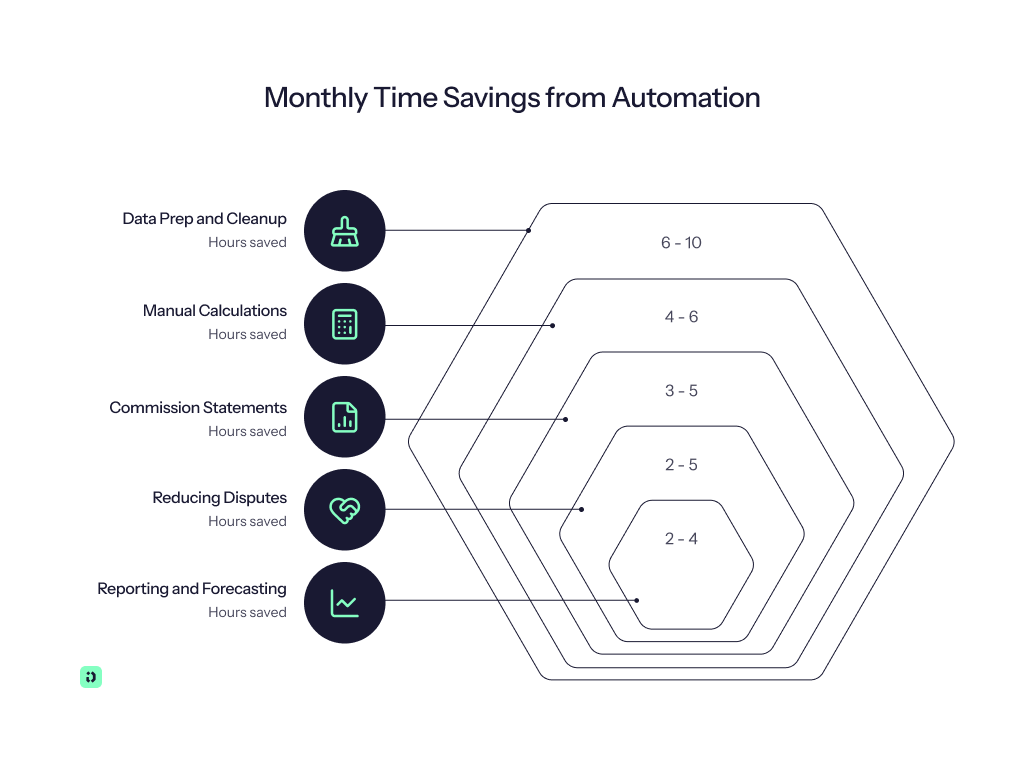
1. Data Prep and Cleanup (6–10 Hours Saved)
No more manual data exports
No formatting or deduplication
No cross-checking data sources
2. Manual Calculations (4–6 Hours Saved)
Automated rules eliminate spreadsheets
No formula fixing
No recalculations after updates
3. Commission Statements and Approvals (3–5 Hours Saved)
Statements generated instantly
Approvals streamlined
No back-and-forth email chains
4. Reducing Disputes (2–5 Hours Saved)
Reps have real-time visibility
Clear audit trails
Fewer misunderstandings
5. Reporting and Forecasting (2–4 Hours Saved)
Dashboards update automatically
No manual report-building
Total Potential Time Saved: 20–40 hours per month.
That's half a workweek—every single month—handed back to sales ops and finance.
The Benefits Go Far Beyond Time Savings
Automation doesn’t just save hours; it improves your entire revenue ecosystem.
More Accurate Payouts: Eliminate expensive errors that can cause overpayments or underpayments.
Higher Rep Motivation: Reps who trust their comp numbers close more deals.
Faster Month-End Close: Finance teams can close books earlier, with fewer last-minute surprises.
Improved Sales Performance: Reps focus less on chasing commission clarity and more on selling.
Case Study
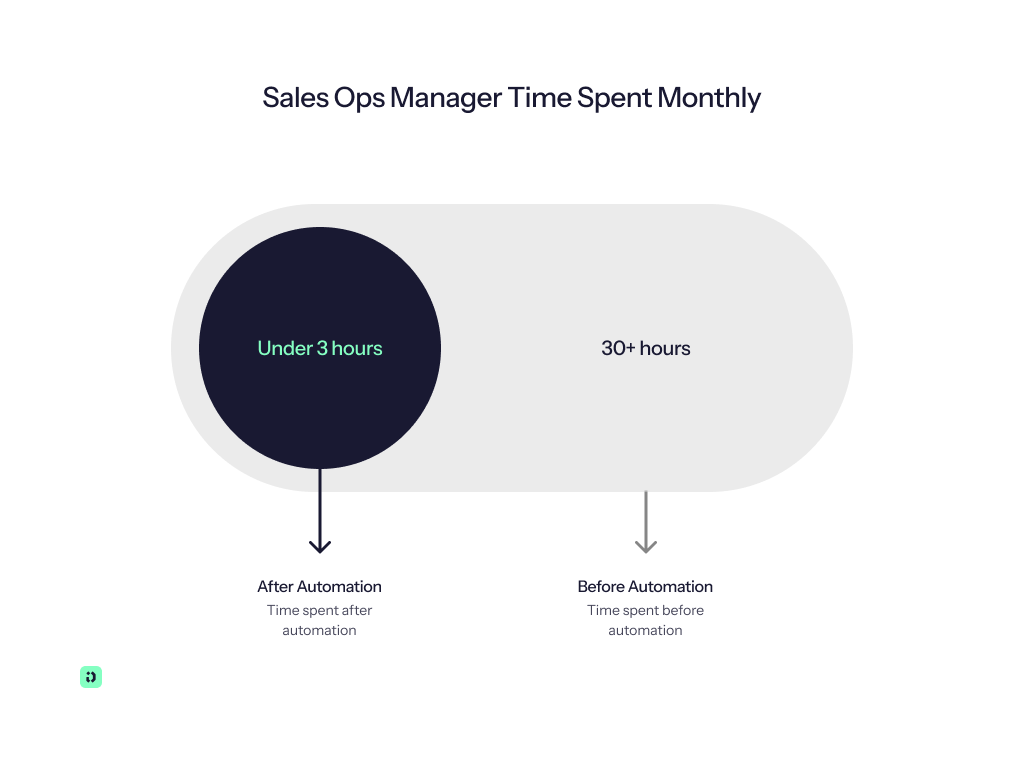
A software company with 40 reps used spreadsheets for years. Each month their sales ops manager spent:
12 hours cleaning CRM data
8 hours calculating statements
4 hours fixing formula errors
6+ hours resolving disputes
Total: 30+ hours monthly.
After implementing automation:
Data synced automatically
Commission rules ran instantly
Reps had real-time dashboards
Disputes dropped by 70%
The monthly process shrank from 30 hours to under 3 hours.
Conclusion
Manual sales compensation isn’t just inefficient—it’s harmful. It drains time, creates errors, frustrates reps, and slows down the business. Automation tools like Driven help teams reclaim 20–40 hours a month, reduce friction, and create a healthier, more productive revenue engine.
If your sales team is spending nights and weekends managing spreadsheets, it’s time to upgrade. Platforms such as Driven make the transition simple, transparent, and scalable. The fastest-growing companies are already automating—because saving 20+ hours a month isn’t just convenient. It’s strategic.
Frequently Asked Questions
How does automation save 20+ hours a month?
Automation eliminates manual tasks such as data exports, spreadsheet merges, formula checks, dispute handling, and statement creation. This typically saves sales ops and finance teams 20–40 hours per month, depending on team size and plan complexity.
Is automation reliable enough to replace spreadsheets?
Yes. Automated tools use rules-based engines that calculate commissions consistently and accurately—without the human error common in spreadsheets. They also provide audit logs, version controls, and real-time updates to ensure accuracy.
How does automation reduce commission disputes?
Automation provides reps with real-time dashboards showing deal-level calculations, rules, and earnings. This transparency eliminates confusion and typically reduces disputes by 50–80%.
Will automation integrate with our CRM and payroll systems?
Most compensation software integrates with major CRMs (like Salesforce and HubSpot), ERPs, payroll systems, and financial tools. Driven offers seamless integrations to ensure data flows automatically and securely.
Is sales compensation automation scalable as we grow?
Yes. Automation is designed to scale with your organization. Whether you double your team size or add new products, territories, or comp structures, automated systems handle the increased complexity effortlessly.
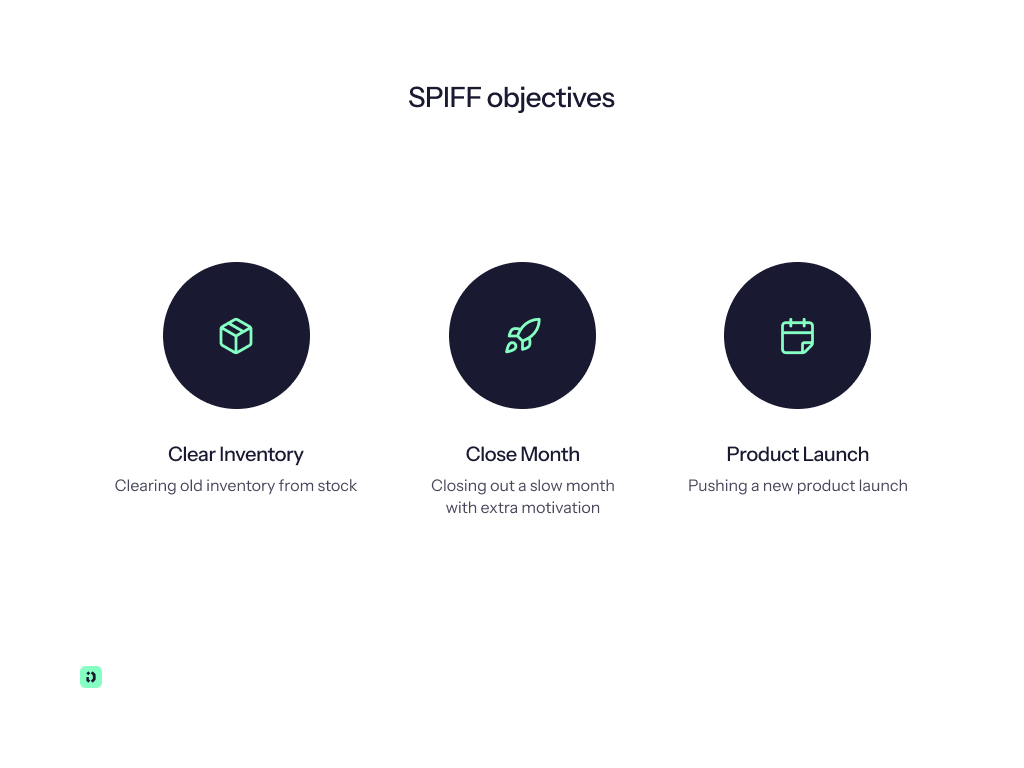
A SPIFF (Sales Performance Incentive Fund) is a short-term cash incentive tied to a specific, immediate action, usually selling a particular product, hitting a short-window target, or pushing a specific behavior the company wants right now.
SPIFFs are built for speed. They're announced, run for a defined stretch, usually days or weeks, and paid out fast, sometimes even same-day or same-week, specifically because the immediacy is what makes them effective. A SPIFF isn't meant to replace commission, it's meant to temporarily redirect a rep's attention toward something specific: clearing old inventory, pushing a new product launch, or closing out a slow month with extra motivation.
A draw in sales compensation is a guaranteed advance payment made to a salesperson against their future commissions. This means it is an advance against future commission, paid out on a regular schedule, usually monthly, so reps have predictable income before their pipeline turns into closed deals and actual commission.
Companies use draws to protect new reps' income during ramp. A brand-new AE with a three-month sales cycle isn't going to close anything in week two, but they still need to pay rent. A draw bridges that gap.
For sales professionals, understanding draw type matters because it affects real take-home pay, not just cash flow timing. Two reps can be offered the exact same dollar amount as a "draw" and end up with completely different financial outcomes, depending on which type it actually is.
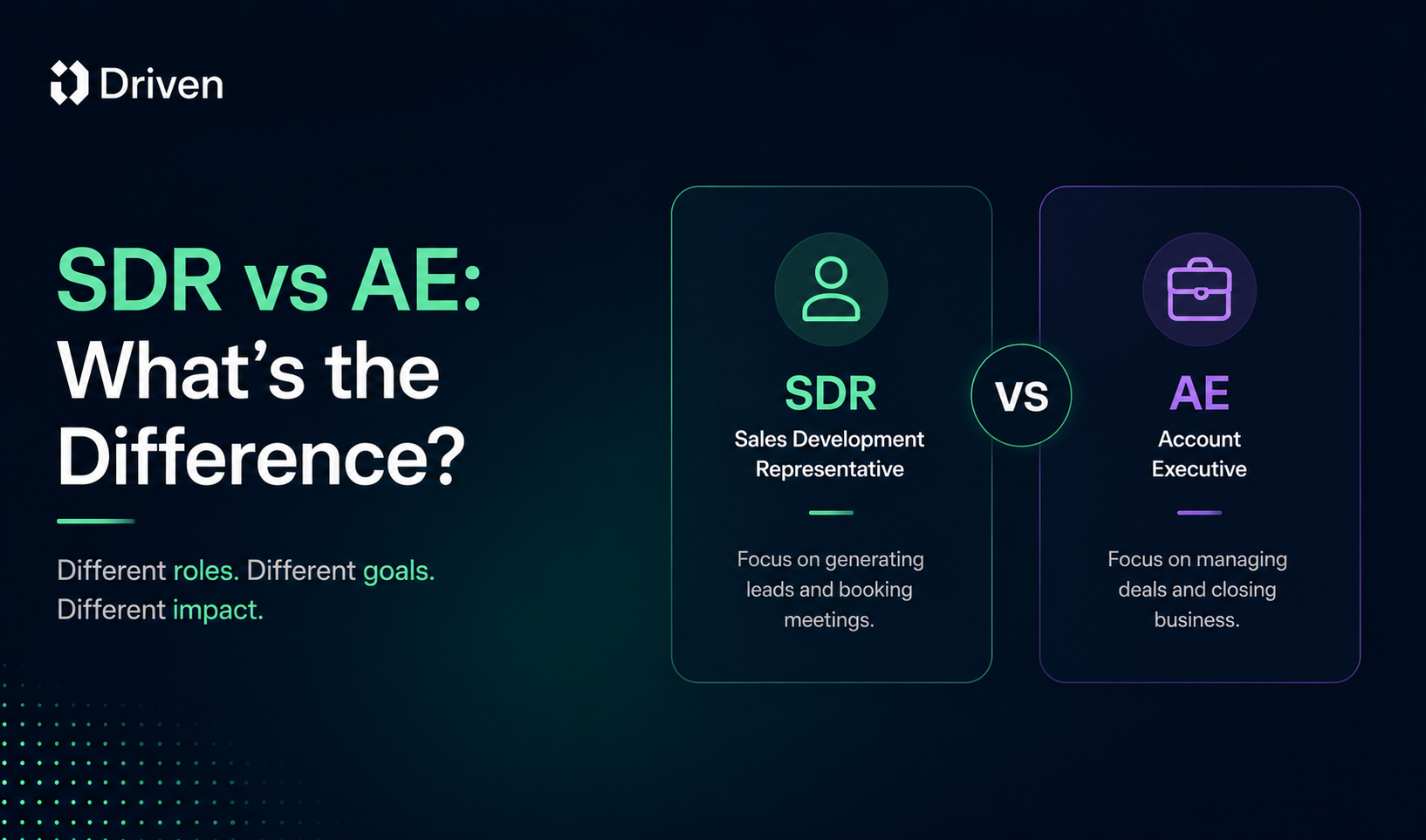
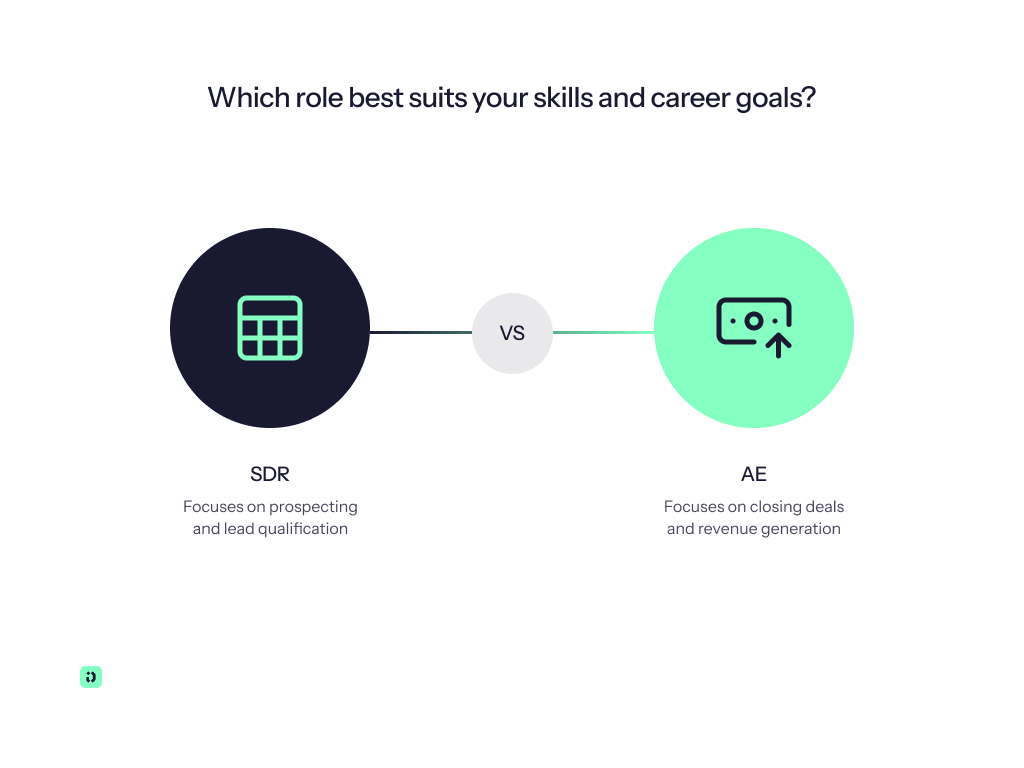
Before comparing pay, it helps to be clear on what each role is actually on the hook for. They sit on the same team, but they're not doing the same job.
What Does an SDR Do?
SDRs own the top of the funnel. Their day is built around prospecting, outbound outreach, and lead qualification, all pointed at one outcome: booking meetings and creating a pipeline for AEs to work. SDRs generally aren't responsible for closing deals. Their job ends where the AE's job begins.
What Does an AE Do?
AEs own the deal once it's qualified. That means running discovery calls, delivering product demos, negotiating terms, and closing the deal. AEs carry direct revenue ownership, and in a lot of organizations, they also handle account management once the deal is signed. The pressure sits differently here: an AE's number is measured in dollars closed, not meetings booked.

%20(1).png)


.avif)











.svg%201.avif)