Variable Incentive Pay: Types, Benefits & How to Design High Impact Plans


TL;DR
In today’s performance driven business environment, companies are moving beyond fixed salaries and embracing compensation models that directly reward results. Variable incentive pay has become a cornerstone of modern compensation strategies, especially for sales and revenue teams. But while the concept sounds simple, designing an effective variable pay plan is anything but.
Done right, it can drive performance, boost motivation, and align teams with business goals. Done poorly, it can create confusion, mistrust, and missed targets. In this guide, you’ll learn what variable incentive pay is, the different types, its key benefits, and how to design plans that actually work in 2026 and beyond.
What is Variable Incentive Pay?
Variable incentive pay (VIP) is a form of compensation where a portion of an employee’s earnings is tied to performance. Unlike fixed salaries, this pay fluctuates based on results such as revenue, targets achieved, or company performance.
For example, a sales representative might earn a base salary along with commissions based on deals closed. The more they sell, the more they earn.
This model helps organisations directly connect compensation with outcomes, making performance measurable and rewarding.
Why Variable Incentive Pay Matters More Than Ever in 2026
The shift toward variable pay isn’t just a trend; it’s a response to how businesses operate today. With the rise of AI driven decision making and data backed planning, organizations are moving toward smarter compensation strategies. Companies that use data to set quotas and performance targets are seeing more accurate goal setting, improved fairness, and stronger overall results.
At the same time, hybrid and remote work environments have made accountability more important than ever. Leaders can no longer rely on visibility, they need measurable performance. Variable incentive pay solves for this by tying rewards directly to results.
Types of Variable Incentive Pay Plans
Not all incentive plans are created equal. The right structure depends on your business model, goals, and team roles.
1. Commission Based Pay
Commission based pay directly links earnings to individual performance. Employees earn a fixed percentage of the revenue, deals, or business they generate.
For example, if a salesperson has a 10% commission rate and closes a deal worth $10,000, they earn $1,000 as commission. This model creates a very clear incentive: the more you sell, the more you earn.
This structure works best in roles where performance is easily measurable and directly tied to revenue, such as sales. However, if not designed carefully, it can encourage short term thinking, like prioritizing quick wins over long term customer relationships
2. Bonus Based Incentives
Bonus based incentives reward employees for achieving predefined goals within a specific time frame, monthly, quarterly, or annually.
These goals can be individual (e.g., hitting a target) or organizational (e.g., company revenue milestones). For instance, a marketing manager might receive a quarterly bonus for generating a certain number of qualified leads.
Unlike commissions, bonuses are usually fixed payouts tied to milestone achievement, not a percentage of revenue. This makes them more flexible and suitable for roles where performance impacts business outcomes but isn’t directly revenue linked.
3. Profit Sharing Plans
Profit sharing plans distribute a portion of the company’s profits among employees, typically at the end of a financial year.
Instead of rewarding individual performance alone, this model connects employees to the overall success of the business. If the company performs well, everyone benefits.
For example, a company might allocate 10% of its annual profit into a pool that gets distributed among employees based on salary level or tenure.
This approach is effective for building a sense of ownership and long term commitment, but it may feel less motivating for high performers who prefer direct, performance based rewards.
4. Equity or Stock Based Incentives
In this model, employees receive shares or stock options in the company, giving them partial ownership.
Rather than immediate cash rewards, the value of this incentive depends on the company’s growth over time. If the company performs well, the value of those shares increases, potentially leading to significant financial gain.
This is especially common in startups, where cash flow may be limited, but future growth potential is high. It’s also used for senior leaders to align their decisions with long term company success.
However, equity incentives are long term and less predictable, so they work best when employees are invested in the company’s future.
5. Team Based Incentives
Team based incentives reward groups of employees based on collective performance rather than individual output.
For example, a customer success team might receive a bonus if the team achieves a certain customer retention rate. Similarly, a sales team could be rewarded for hitting a regional revenue target.
This model encourages collaboration, knowledge sharing, and collective accountability, which is essential in roles where outcomes depend on multiple contributors.
The challenge, however, is ensuring fairness, high performers may feel under rewarded if others on the team contribute less.
Key Benefits of Variable Incentive Pay
When designed correctly, variable pay can transform how teams perform and engage with their work.
- Drives higher performance by rewarding results, not just effort
- Aligns employee goals with business outcomes
- Improves retention of top performers who value performance based rewards
- Controls fixed payroll costs by shifting to performance driven payouts
- Encourages accountability and ownership across teams
Common Challenges with Variable Pay Plans
Despite its benefits, many organizations struggle to implement effective plans. Some of the most common issues include:
- Poorly defined or unrealistic performance metrics
- Overly complex structures that confuse employees
- Lack of transparency in calculations
- Incentives that reward the wrong behaviors
- Weak communication during plan rollout
Many of these challenges stem from deeper structural issues. For example, poorly designed commission models can create unwanted consequences, as explored in The Hidden Costs of a Bad Commission Structure.
How to Design an Effective Variable Incentive Plan
A high impact incentive plan isn’t just about numbers, it’s about clarity, alignment, and execution.
1. Define Clear Business Objectives
Every effective incentive plan starts with a clear understanding of what the business is trying to achieve. Whether the goal is revenue growth, improving profit margins, increasing customer retention, or expanding into new markets, the incentive pay programs should directly support that priority. Trying to target too many objectives at once often leads to confusion and diluted impact. A focused plan ensures that employees are aligned with the company’s most important goals and are working toward the same outcomes.
2. Choose the Right Metrics
Once objectives are defined, the next step is selecting the right metrics to measure performance. These should be directly tied to business outcomes, easy to track, and within the employee’s control, forming a core part of an effective sales performance management (SPM) strategy. For example, sales teams may be measured on quota attainment or deal size, while customer success teams might focus on retention rates. It’s important to avoid overcomplicating the plan with too many KPIs, as this can reduce clarity and motivation. A small set of meaningful metrics is far more effective than a long list of loosely connected ones.
3. Set Realistic, Data Driven Targets
Targets play a critical role in determining how motivating an incentive plan will be. They should be challenging enough to push performance but still achievable to maintain engagement. Setting targets without data often leads to unrealistic expectations or underperformance. By using historical data, performance trends, and market insights, companies can create targets that are both fair and effective. Data driven approaches also help ensure consistency and reduce bias across teams.
4. Keep It Simple and Transparent
Simplicity is one of the most important factors in the success of any incentive plan. Employees should be able to quickly understand how their performance translates into earnings without needing complex calculations. Transparent plans build trust and reduce confusion, while overly complicated structures often lead to disengagement and disputes. When employees clearly know what they need to do to earn more, they are more likely to stay motivated and focused.
5. Align Incentives with Desired Behaviors
Incentive plans don’t just influence outcomes, they shape how employees behave. If incentives are not aligned properly, they can encourage actions that may harm long term business goals. For instance, focusing only on revenue might push employees to prioritize short term gains over customer relationships. A well designed plan ensures that rewards are tied to behaviors that truly matter, such as quality deals, customer retention, or sustainable growth. This alignment is essential for driving the right kind of performance.
6. Build Flexibility into the Plan
Business environments are constantly changing, and incentive plans need to adapt accordingly. A rigid structure can quickly become outdated if market conditions, company priorities, or team dynamics shift. Building flexibility into the plan through periodic reviews such as a sales compensation audit or adjustable targets allows organizations to stay responsive without creating disruption. This ensures that the incentive strategy remains relevant and effective over time.
7. Communicate and Reinforce Continuously
Clear and consistent communication is critical to the success of any incentive plan. It’s not enough to explain the plan once during rollout, employees need ongoing visibility into their performance and earnings. Regular updates, accessible dashboards, and continuous reinforcement from managers help maintain clarity and motivation. When employees always understand where they stand and how they are progressing, they are more engaged and better equipped to achieve their targets.
Best Practices for Managing Variable Incentive Plans
Even a well designed plan needs the right systems to succeed.
- Move away from spreadsheets to automated systems
- Provide real time visibility into performance and earnings
- Conduct regular plan reviews and audits
- Gather feedback from your sales and revenue teams
- Continuously optimize based on performance data
Tools & Technology for Managing Incentive Pay
As incentive plans grow in complexity, relying on manual processes becomes increasingly inefficient and risky. The right tools and technology help organizations streamline compensation management, improve accuracy, and provide the transparency employees need to stay motivated. Modern incentive compensation platforms make it easier to scale plans while reducing operational burden.
Why Manual Processes Fail
Many organizations begin with spreadsheets to manage incentive pay, but this approach quickly breaks down as teams expand and compensation structures evolve. Manual processes are not only time consuming but also highly prone to errors, leading to challenges often associated with manual commission tracking and inefficiencies that impact both operations and employee trust.
- Prone to calculation errors and inconsistencies
- Difficult to scale with growing teams and complex plans
- Limited visibility into real time performance and earnings
- Time intensive and dependent on manual effort
- Increases the risk of disputes and mistrust
Benefits of Using Incentive Compensation Software
Incentive compensation software replaces manual workflows with automated, data driven systems that improve efficiency and accuracy. These platforms allow organizations to manage complex plans with ease, as automating sales compensation eliminates repetitive tasks and significantly reduces operational overhead.
- Automates calculations and payout processes
- Provides real time performance tracking and dashboards
- Reduces manual errors and administrative workload
- Improves transparency and clarity for employees
- Enables faster, more reliable payouts
How Platforms Like Driven Help
Modern platforms like Driven are built to handle the complexities of incentive compensation at scale. They align with best practices seen in leading sales compensation software solutions by combining automation, accuracy, and real time visibility to improve both efficiency and trust.
- Automate end to end incentive compensation workflows
- Provide real time visibility into earnings and performance
- Ensure accurate calculations and reduce disputes
- Adapt quickly to changing business needs
- Strengthen trust with clear and transparent payout structures
Final Verdict
Variable incentive pay is no longer optional, it’s a critical lever for organizations looking to build high performing, accountable teams. But success doesn’t come from the idea itself, it comes from execution. The most effective plans are simple and transparent, aligned with clear business goals, backed by data, and consistently communicated across teams. When these elements come together, compensation shifts from being just a cost centre to becoming a powerful driver of performance, motivation, and sustainable growth.
Still managing incentive compensation through spreadsheets? It may be time to rethink your approach. Explore how Driven can help you automate, simplify, and scale your variable incentive plans, while giving your team the clarity and transparency they need to perform at their best.



See your comp plan, fully built in minutes

Frequently Asked Questions
About the author
Ludovic Diercxsens






Understanding SPIFFs, Bonuses, and Commissions
Ask a sales rep what's driving their next paycheck, and you'll often hear all three words used interchangeably: SPIFF, bonus, and commission. They get lumped together as "extra money for selling," but they're not the same thing, and treating them like they are leads to confused reps, inconsistent payouts, and comp plans nobody can actually explain.
A SPIFF is a short-term, targeted incentive. A bonus is a lump-sum reward tied to hitting a broader goal. A commission is the ongoing, formula-based pay tied directly to sales, the core of most sales comp plans, not an add-on to it.
This guide breaks down what each one actually means, when companies use them, how they're calculated, and how they stack together so you can build a comp plan where every payout has a clear reason behind it.

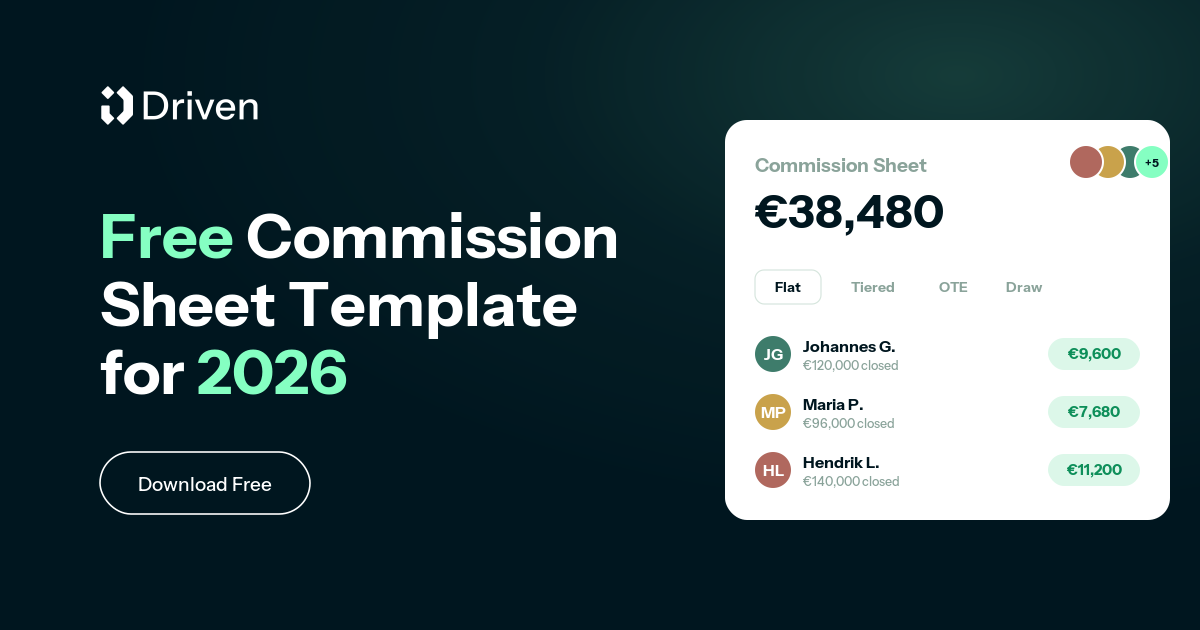
Free Commission Sheet Template: 8 Sales Commission Spreadsheets in One Excel File
Most commission plans don't fail because the idea is wrong. They fail because nobody modelled the numbers before rolling them out. A rate that looks generous on a slide turns into a payout you can't afford at 130% attainment, or an accelerator so flat that your best reps stop pushing the moment they hit quota.
So we built a free commission sheet template to fix that. It's one Excel file with eight ready-to-use sales commission spreadsheets, each structure on its own tab, each with live formulas and a filled-in sample row. Change a rate, a quota, or a revenue number and every payout updates instantly, and because everything lives in one workbook you can compare models side by side without juggling downloads.
Download the commission sheet template, or start for free and let Driven build the plan for you.

New to comp design? Start with our guide to sales compensation structure types, then model your pick here.


Non-Recoverable Draw vs. Recoverable Draw: What's the Difference?
New sales hires often get offered a "draw" against commission, and most sign the offer letter without knowing there are two very different types. That gap in understanding can mean thousands of dollars either staying in a rep's pocket or getting clawed back months later.
A draw is essentially an advance on future commission, designed to give reps steady income while they ramp up pipeline and close their first deals. But whether that advance is recoverable or non-recoverable determines something much bigger: whether it ever has to be paid back.
This guide breaks down what each draw type means, how they're calculated, when companies typically use each one, and the mistakes that turn a helpful ramp tool into a trust problem between reps and the company that hired them.


.svg%201.avif)