How to Align Sales Compensation with Revenue Goals


TL;DR
Most companies think they have a compensation problem. They don't; they have an alignment problem. Sales teams focus on what they’re paid to do, while leadership focuses on revenue growth, predictability, and profitability. When those priorities aren’t tightly connected, things start to break quietly at first, then all at once. Revenue targets are consistently missed, payouts increase without meaningful impact, and reps begin optimizing for incentives instead of outcomes.
Here’s the uncomfortable truth: if your compensation plan isn’t directly tied to revenue goals, it’s working against you. If you want to understand where sales compensation is heading, explore our take on the future of sales compensation.
What “Alignment” Actually Means
Alignment isn’t about simply assigning quotas and expecting results to follow. It’s about intentionally designing incentives so that the actions sales reps take every day directly contribute to revenue goals. Without that connection, quotas become targets on paper not drivers of real business outcomes.
It’s about designing a system where:
- Sales behavior directly drives revenue outcomes
- Incentives reflect what the business actually values
- Growth becomes predictable, not accidental
A well aligned compensation plan ensures reps don’t just close deals they close the right deals. Since revenue goals evolve (and they always do), static comp plans create immediate misalignment.
The 5 Mistakes That Break Alignment
Before you can fix alignment, you need to identify what’s causing it to fail. Most compensation issues aren’t accidental; they’re the result of predictable, fixable mistakes.
- Paying for Volume, Not Value: When incentives reward volume alone, reps focus on closing as many deals as possible, regardless of quality. This often leads to low margin or short term wins that don’t support long term revenue growth.
- Overcomplicated Incentive Structures: Too many metrics and rules create confusion and reduce motivation. If reps struggle to understand how they earn, they disengage and default to guesswork instead of consistently driving targeted outcomes.
- No Link to Business Strategy: Compensation plans often fail because they aren’t updated alongside company goals. When incentives don’t reflect strategic priorities, sales efforts become misaligned with what the business actually needs to grow.
- Static Plans in a Dynamic Market: Markets, products, and revenue strategies change frequently, but compensation plans often remain unchanged. This disconnect results in outdated incentives that no longer drive the behaviors required for current business success.
- Poor Communication: Even the best designed compensation plan will fail if it isn’t clearly communicated. Without transparency and understanding, reps lose trust in the system and fail to align their efforts with expected outcomes. Regular audits can help identify these gaps early; this is exactly what a sales compensation audit is designed to uncover.
A Practical Framework to Align Compensation with Revenue Goals
Alignment doesn’t happen by tweaking commission rates or adding new bonuses it requires a structured, intentional approach. The goal is simple: make sure the way your team earns is directly tied to how your business grows.
1. Start with Revenue Goals Not Roles
Most companies design compensation plans around job titles and responsibilities. But roles don’t drive revenue; outcomes do. When plans are built around roles instead of business priorities, misalignment is almost guaranteed.
Start with:
- Growth targets (How much revenue do you need to generate?)
- Expansion priorities (Where should that revenue come from?)
- Profitability goals (What kind of deals actually matter?)
When compensation is anchored to revenue goals instead of roles, every incentive becomes intentional, ensuring that what you pay for directly supports how your business grows. This is why designing a sales compensation plan that drives peak performance always starts with clearly defined revenue priorities.
2. Translate Goals into Sales Behaviors
Revenue doesn’t happen in dashboards or reports; it happens through the daily actions your sales team takes. If those actions aren’t clearly defined and incentivized, alignment breaks down quickly.
Ask:
- What behaviors directly drive our revenue goals?
- What should reps prioritize in their day to day work?
For example:
- New market expansion → incentivize new logo acquisition
- Retention focus → reward renewals and upsells
- Margin growth → prioritize high value or high margin deals
The stronger the link between behavior and incentives, the easier it becomes for reps to make the right decisions and for revenue outcomes to become predictable.
3. Choose Metrics That Actually Matter
Trying to measure everything is one of the fastest ways to weaken a compensation plan. More metrics don’t create better performance they create confusion and competing priorities. Choosing the right structure also matters understanding different types of incentive pay programs can help you simplify your plan without losing effectiveness.
Focus on:
- 2–4 core metrics maximum
- Metrics directly tied to revenue outcomes
- Clear, measurable performance indicators
Avoid:
- Vanity metrics that don’t impact revenue
- Overlapping or conflicting KPIs
- Metrics that are hard to track or explain
When your metrics are focused and relevant, reps know exactly where to direct their efforts leading to stronger alignment and better results.
4. Keep Incentives Simple and Transparent
Complex compensation plans create hesitation and uncertainty. When reps don’t fully understand how they earn, they disengage or make inconsistent decisions.
Ensure:
- Plans are easy to explain in under 30 seconds
- Earnings are clearly visible and trackable
- Rules and calculations are straightforward
Avoid:
- Layered incentives with too many conditions
- Hidden rules or unclear payout structures
- Frequent confusion or disputes around earnings
Clarity builds trust, and trust drives performance. The simpler your plan, the more effectively your team can act on it.
5. Build for Change, Not Stability
Revenue goals evolve constantly, but most compensation plans don’t. This creates a gap between what the business needs and what sales teams are incentivized to do.
Plan for:
- Regular adjustments to incentives and quotas
- Flexibility to respond to market or strategy shifts
- Systems that allow quick updates without disruption
Watch out for:
- Rigid annual plans that don’t adapt
- Manual processes that slow down changes
- Delayed updates that miss critical opportunities
A flexible compensation plan keeps your team aligned even as your business evolves. The faster you can adapt, the easier it is to stay competitive and drive consistent growth.
Aligning Compensation Across Different Sales Roles
Not all sales roles contribute to revenue in the same way, so they shouldn’t be incentivized the same way either. Each role plays a distinct part in the revenue cycle, and compensation needs to reflect those differences to ensure proper alignment and performance.
- Account Executives (AEs): AEs are primarily responsible for generating new revenue by closing deals. Their incentives should focus on the quality and efficiency of those deals, using metrics such as deal size, win rates, and pipeline conversion. This ensures they prioritize high value opportunities that contribute meaningfully to business growth rather than simply increasing deal volume.
- Account Managers (AMs): AMs, on the other hand, focus on retaining and expanding existing customer relationships. Their role is critical for long term revenue stability and growth, so their compensation should reward renewals, upsells, and overall account growth. This encourages them to build strong customer relationships while maximizing lifetime value.
- SDRs/BDRs: SDRs and BDRs are responsible for building the sales pipeline by generating qualified opportunities. Since they don’t close deals, their incentives should be tied to the quality of leads they produce rather than just volume. Metrics like qualified opportunities and conversion rates ensure they focus on creating a pipeline that actually turns into revenue.
A one size fits all compensation plan may seem simpler, but it ultimately breaks alignment. When each role is incentivized based on how it directly contributes to revenue, teams perform better and business outcomes become more predictable.
Why Data and Technology Are No Longer Optional
Manual compensation planning may seem manageable, but as teams grow, it creates inefficiencies, errors, and limited visibility. To keep compensation aligned with revenue goals, modern teams need systems that enable speed, accuracy, and clarity.
Modern revenue teams need:
- Real time performance visibility so reps always know where they stand
- Automated incentive calculations to reduce errors and save time
- Data backed decision making for accurate quotas and payouts
- Centralized systems that eliminate dependency on spreadsheets
Without data and technology, compensation becomes reactive and inconsistent. Alignment turns into guesswork, and guesswork doesn’t scale in a growing business.
How to Know If Your Plan Is Actually Aligned
Alignment isn’t theoretical; it can be measured through clear performance indicators. By analyzing the right signals, you can quickly identify whether your compensation plan is driving the intended outcomes.
Look at:
- Revenue vs. payout correlation (are payouts tied to real impact?)
- Percentage of reps hitting quota (are targets realistic?)
- Distribution of performance (is the plan too easy or too hard?)
- Rep behavior vs. business priorities (are the right actions being rewarded?)
If these indicators don’t align, your compensation plan isn’t working no matter how well it looks on paper. True alignment shows up in both behavior and results.
How Driven Helps You Align Sales Compensation with Revenue Goals
Most compensation tools focus on managing payouts after the fact. Driven takes a different approach, helping you design compensation plans that are directly aligned with revenue outcomes from the start.
1. Data Backed Quota Setting
Setting the right quotas is critical for alignment, but many teams rely on guesswork or outdated data. Driven uses real performance insights to create quotas that are both realistic and ambitious, ensuring they are directly tied to your revenue targets.
With Driven, you get:
- Quotas based on actual historical performance
- Balanced targets that are achievable yet challenging
- Alignment between individual goals and company revenue
When quotas are grounded in data, they become a reliable driver of performance not a source of frustration or inconsistency.
2. Incentives That Drive the Right Behavior
Generic compensation plans often reward the wrong actions. Driven enables you to design incentives that are closely tied to what actually drives business growth.
Driven helps you:
- Reward high impact, high value deals
- Prioritize strategic growth areas like expansion or retention
- Eliminate incentives that don’t contribute to revenue goals
When incentives are aligned with business priorities, sales teams naturally focus on the activities that matter most.
3. Real Time Visibility for Sales Teams
Lack of visibility is one of the biggest reasons compensation plans fail. Driven ensures reps always have a clear understanding of their performance and earnings.
Reps can always see:
- Where they currently stand against targets
- What actions they need to take next
- How their performance translates into earnings
This level of clarity removes uncertainty, increases motivation, and helps reps stay focused on achieving results.
4. Built for Flexibility
Revenue strategies evolve, and compensation plans need to keep up. Driven is designed to adapt quickly without creating operational complexity.
With Driven, you can:
- Adjust compensation plans as business priorities change
- Test and refine incentive structures
- Stay aligned without rebuilding plans from scratch
Flexibility ensures your compensation strategy evolves alongside your business, keeping teams aligned at every stage.
5. Transparency That Builds Trust
Compensation only works when people trust it. Driven makes plans simple, clear, and easy to understand for everyone involved.
Driven ensures:
- Clear plan structures with no hidden rules
- Easy to understand earnings and payouts
- Reduced disputes and better adoption across teams
Transparency builds trust, and trust leads to stronger engagement and consistent performance.
Conclusion
Sales compensation isn’t just about paying people it’s about shaping behavior at scale. The companies that consistently hit their targets don’t rely on effort alone; they design compensation systems that make success predictable. When incentives are aligned with revenue goals, teams naturally focus on high impact work, performance becomes more consistent, and growth stops feeling uncertain.
If your current plan isn’t delivering those outcomes, it’s time to rethink how it’s built. Ready to align your sales compensation with real revenue results? Stop guessing and start building smarter, data backed plans that actually drive growth. Explore how Driven can help you turn compensation into a true growth lever.



See your comp plan, fully built in minutes

Frequently Asked Questions
About the author
Tom De Kooning






Understanding SPIFFs, Bonuses, and Commissions
Ask a sales rep what's driving their next paycheck, and you'll often hear all three words used interchangeably: SPIFF, bonus, and commission. They get lumped together as "extra money for selling," but they're not the same thing, and treating them like they are leads to confused reps, inconsistent payouts, and comp plans nobody can actually explain.
A SPIFF is a short-term, targeted incentive. A bonus is a lump-sum reward tied to hitting a broader goal. A commission is the ongoing, formula-based pay tied directly to sales, the core of most sales comp plans, not an add-on to it.
This guide breaks down what each one actually means, when companies use them, how they're calculated, and how they stack together so you can build a comp plan where every payout has a clear reason behind it.

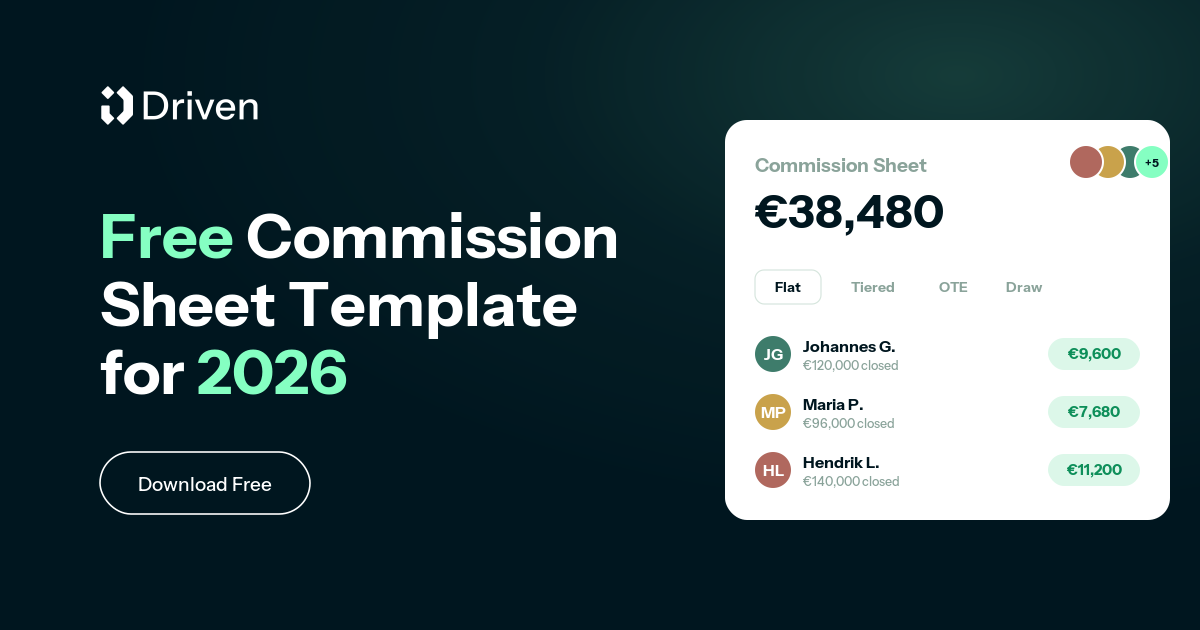
Free Commission Sheet Template: 8 Sales Commission Spreadsheets in One Excel File
Most commission plans don't fail because the idea is wrong. They fail because nobody modelled the numbers before rolling them out. A rate that looks generous on a slide turns into a payout you can't afford at 130% attainment, or an accelerator so flat that your best reps stop pushing the moment they hit quota.
So we built a free commission sheet template to fix that. It's one Excel file with eight ready-to-use sales commission spreadsheets, each structure on its own tab, each with live formulas and a filled-in sample row. Change a rate, a quota, or a revenue number and every payout updates instantly, and because everything lives in one workbook you can compare models side by side without juggling downloads.
Download the commission sheet template, or start for free and let Driven build the plan for you.

New to comp design? Start with our guide to sales compensation structure types, then model your pick here.

Non-Recoverable Draw vs. Recoverable Draw: What's the Difference?
New sales hires often get offered a "draw" against commission, and most sign the offer letter without knowing there are two very different types. That gap in understanding can mean thousands of dollars either staying in a rep's pocket or getting clawed back months later.
A draw is essentially an advance on future commission, designed to give reps steady income while they ramp up pipeline and close their first deals. But whether that advance is recoverable or non-recoverable determines something much bigger: whether it ever has to be paid back.
This guide breaks down what each draw type means, how they're calculated, when companies typically use each one, and the mistakes that turn a helpful ramp tool into a trust problem between reps and the company that hired them.




.svg%201.avif)