Sales Compensation Software in Europe: What You Need to Know
.png)
TL;DR
If you are running a sales team in Europe, you already know that managing compensation is not simple. Between navigating multiple currencies, staying compliant with regional labour laws, and keeping reps motivated across different markets, the operational complexity adds up fast. And if you are still managing it all through spreadsheets and manual processes, that complexity is likely costing you more than you realise in time, in errors, and in rep trust.
Sales compensation software has become an increasingly critical tool for European sales organizations looking to scale without sacrificing accuracy or fairness. But not all platforms are built with the European market in mind. Understanding what to look for and what questions to ask can be the difference between a tool that genuinely supports your growth and one that creates more problems than it solves.
This guide covers everything you need to know about sales compensation software in Europe: the unique challenges of the market, what good software should handle, and how to evaluate your options with confidence.
Why Sales Compensation Is More Complex in Europe
Before evaluating any software, it helps to understand what makes compensation management distinctly more challenging in European markets compared to other regions.

Multi country operations introduce layers of complexity that most generic tools were not built for:
- Currency management: Teams operating across the Eurozone, the UK, Switzerland, Scandinavia, and Eastern Europe are often working in multiple currencies simultaneously, with exchange rate fluctuations directly affecting commission values
- Varying labor laws: Employment regulations differ significantly across EU member states, and what is standard practice in Germany may be legally complicated in France or Spain
- GDPR compliance: Any platform handling employee compensation data must meet strict data privacy standards under the General Data Protection Regulation, including where data is stored and who can access it
- Diverse payroll structures: Base salary expectations, commission norms, and bonus structures vary widely by country and market, requiring flexible plan configurations rather than one-size-fits-all templates
- Language and localization: Reps working in different countries need to understand their compensation clearly, which often means more than just translating the interface
- VAT and tax implications: Commission structures that cross borders can have tax consequences that need to be factored into how plans are designed and reported
These are not edge cases. They are the everyday reality for any European sales organization operating across more than one market. And they are exactly the kind of challenges that generic compensation tools, built primarily for the US market, often fail to address adequately.
The Hidden Cost of Getting Compensation Wrong in Europe
For European businesses, compensation errors are not just an operational inconvenience. They can carry legal and financial consequences that compound quickly.
In many European countries, labor law provides strong protections around pay. Errors in commission calculations, delayed payouts, or inconsistent application of compensation rules can expose businesses to formal complaints, regulatory scrutiny, or even legal action. The bar for compliance is higher, and the consequences of falling short are more serious than in many other markets.
Beyond the legal dimension, there is the trust dimension. European sales reps, particularly in markets like Germany, the Netherlands, and the Nordics, tend to place a high value on transparency and consistency in how they are paid. A compensation system that produces errors, lacks visibility, or feels opaque will damage trust faster and more deeply than it might in other cultural contexts.
.png)
The cost of getting it wrong includes:
- Legal exposure from noncompliant commission practices or data handling
- Rep attrition among high performers who lose confidence in the system
- Operational drag from finance and HR teams spending excessive time on manual reconciliation and dispute resolution
- Reputational risk as a employer in competitive talent markets where word travels fast
- Revenue impact from motivated reps who disengage when they feel the system is unfair or unreliable
The right sales compensation software saves time. In the European context, it actively protects the business.
What Good Sales Compensation Software Should Handle in Europe
Not every platform on the market is equipped to handle the realities of European sales organisations. When evaluating your options, these are the capabilities that should be non negotiable:

- Multicurrency support: The platform should handle multiple currencies natively, not as a workaround or manual conversion, but as a built in feature that accurately reflects exchange rates and applies them consistently across calculations. Reps should see their earnings in their local currency, and finance should be able to consolidate reporting across currencies without manual intervention.
- GDPR-compliant data handling: Any platform processing employee compensation data in Europe must be fully GDPR compliant. This means clear data residency options, ideally with the ability to store data within the EU; role-based access controls; audit trails; and documented data processing agreements. This is not optional. It is a legal requirement.
- Flexible plan configuration: European organizations rarely run the same compensation structure across every market. The software should support multiple plan types simultaneously, with the ability to configure different rules, thresholds, currencies, and structures for different teams, territories, or countries, without requiring a separate instance or workaround for each.
- Real time visibility for reps: Reps across every market should have access to real time dashboards showing their current earnings, quota progress, and projected bonuses. This is particularly important in European markets where transparency in pay is both culturally expected and, in some countries, increasingly mandated by regulation.
- Audit trails and dispute resolution tools: Every calculation should be fully traceable. When a rep in France or a manager in the UK questions a payout, the answer should be immediately available, documented, step by step, and accessible without requiring a finance ticket. Clean audit trails also support compliance in the event of a regulatory inquiry.
- Integration with existing systems: European businesses typically run a mix of CRM platforms, HRIS systems, and payroll tools that vary by country. The compensation software should integrate cleanly with the systems already in use, from Salesforce and HubSpot on the CRM side to local payroll providers that handle country specific requirements.
- Scalability across markets: As your European footprint grows, your compensation software should scale with it. Adding a new country or a new team should not require rebuilding your entire compensation architecture from scratch.
Common Mistakes European Businesses Make When Choosing Compensation Software
Learning from what goes wrong is often the fastest path to making the right decision. These are the mistakes that come up most frequently when European organisations invest in compensation software:
- Choosing a US centric platform without verifying European capabilities: Many of the most well known compensation platforms were built primarily for the US market. They may handle multi currency in a limited way, lack GDPR compliant data storage options, or simply not have the configurability required for diverse European market structures. Always verify European specific capabilities explicitly; do not assume they are included.
- Underestimating implementation complexity: Moving from manual processes to a dedicated platform takes time, particularly when you are migrating data and plan structures across multiple countries. Organizations that underestimate implementation timelines often end up running parallel systems for longer than planned, which defeats much of the purpose of the investment.
- Overlooking the rep experience: Compensation software is not just a tool for finance and operations. It is something your reps interact with every day. If the interface is confusing, the visibility is limited, or the platform is not available in local languages, the motivational benefit of real time earnings tracking disappears entirely.
- Failing to involve legal and HR early: In European markets, the legal and HR implications of how compensation is structured and processed are significant. Involving these teams early in the software evaluation process, rather than bringing them in after a decision has been made, prevents compliance issues and ensures the platform meets the requirements of every market you operate in.
- Prioritizing price over fit: Compensation software is not a commodity purchase. A platform that does not handle your specific multi market, multi currency requirements accurately will cost you far more in errors, disputes, and compliance risks than the savings made on licensing fees.
What to Ask When Evaluating Sales Compensation Software in Europe
When you are in conversations with vendors, these are the questions that will quickly reveal whether a platform is genuinely built for European operations or simply marketed that way:
- Where is our compensation data stored, and can we choose EU based data residency?
- How does the platform handle multiple currencies, and how frequently are exchange rates updated?
- Can we run different compensation plans simultaneously across different countries and teams?
- What does your GDPR compliance documentation look like, and do you provide a data processing agreement?
- How does the platform integrate with our existing CRM, HRIS, and local payroll systems?
- What does the implementation process look like for a multinational organisation?
- How do reps access their earnings data, and is the interface available in multiple languages?
- What audit and traceability features are in place for commission dispute resolution?
If a vendor cannot answer these questions clearly and specifically, that is the answer.
How the Right Software Changes the Day to Day Reality
The practical impact of moving to purpose built compensation software goes beyond fixing the problems that prompted the search in the first place. Done well, it changes the day to day reality for everyone involved:
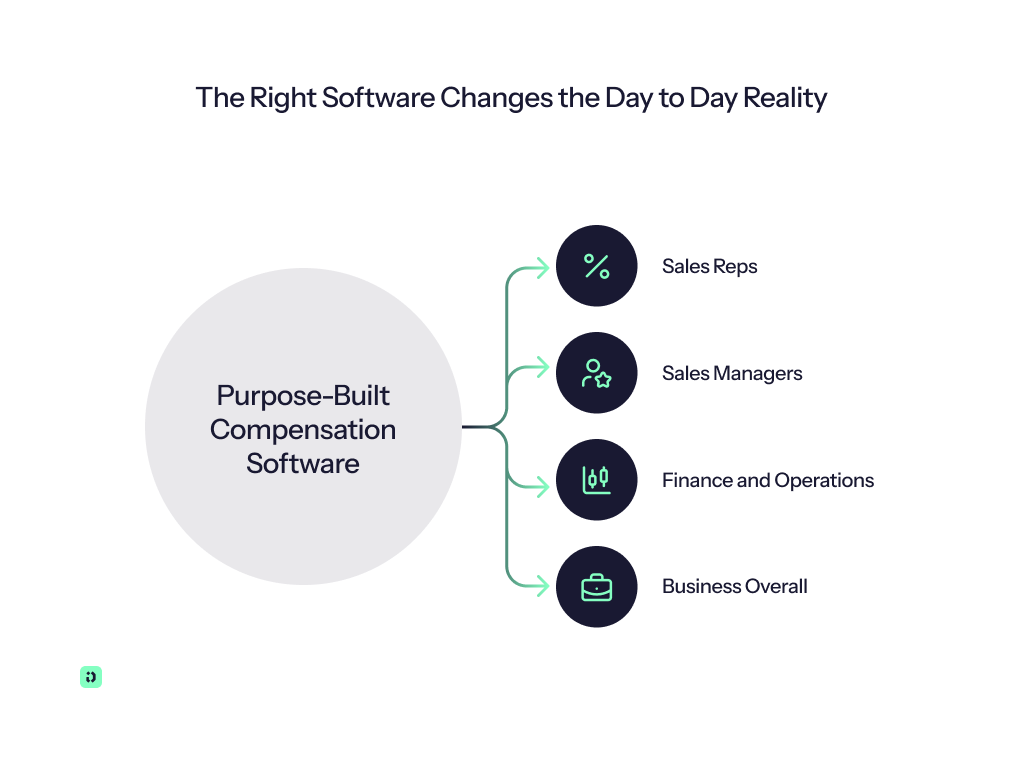
For sales reps:
- Clear, real time visibility into earnings removes anxiety and speculation around pay
- Consistent, traceable calculations build trust that the system is fair regardless of market or manager
- Less time spent questioning or disputing commissions means more time focused on selling
For sales managers:
- Clean data and automated calculations remove the administrative burden of manual commission tracking
- Transparent systems reduce the number of compensation conversations that pull managers away from coaching
- Consistent plan application across the team removes the awkward dynamic of reps comparing notes on what they were told
For finance and operations:
- Month end commission cycles become a process rather than a crisis
- Audit ready data means regulatory inquiries do not become operational emergencies
- Consolidated multi currency reporting across markets provides a clear picture of total compensation spend
For the business overall:
- Higher rep trust leads to better retention, particularly among top performers
- Accurate, compliant compensation processes reduce legal and financial exposure
- Scalable infrastructure means entering a new European market does not require rebuilding your compensation architecture
Making the Move: Where to Start
If your current compensation process is manual, fragmented, or struggling to keep up with the complexity of your European operations, the starting point is an honest audit of where the gaps are.
Ask yourself:
- How much time does your finance or ops team spend on commission reconciliation each month?
- How often do commission disputes arise, and how long do they take to resolve?
- Do your reps have real time visibility into their earnings, or do they find out at month end?
- Are you confident your current process is fully GDPR compliant?
- Can your current system scale if you add two new European markets next year?
If the answers reveal significant gaps, you are not alone. Most European sales organizations reach a point where the manual approach simply cannot keep pace with the business. The question is not whether to invest in dedicated compensation software; it is which platform is genuinely built for the way European businesses operate.
Platforms like Driven are designed with exactly this complexity in mind, built to handle the multi-currency, multi market, and compliance realities that European sales organizations face, while giving every rep the transparency and visibility they need to stay motivated and focused on performance.
Conclusion
Sales compensation management in Europe comes with a level of complexity that generic tools and manual processes simply were not built to handle. Multicurrency operations, GDPR compliance, diverse labour laws, and the cultural expectations around pay transparency all raise the bar for what good compensation software needs to do.
The organisations that get this right, that invest in platforms built for European realities rather than adapted from US centric designs, consistently see the payoff in rep trust, operational efficiency, reduced compliance risk, and stronger revenue performance.
Choosing the right software is not just an operational decision. In the European market, it is a strategic one.
If you are ready to explore what purpose built compensation management looks like for your European sales team, Driven to see how the platform is built to handle the complexity your business actually faces, not just the complexity that is easy to solve.



See your comp plan, fully built in minutes

Frequently Asked Questions
About the author





A sales compensation plan defines how your sales team gets paid: a fixed base salary, variable pay like commissions and bonuses, and a quota that decides how much of that variable pay a rep actually earns. Base salary plus target variable pay makes up a rep's on-target earnings (OTE).
Sales compensation plans do more than pay people; they shape behavior, drive revenue, and define culture. Get the plan right, and your team is aligned, motivated, and chasing the numbers that actually matter. Get it wrong, and you'll spend every month-end on disputes, recalculations, and reps who no longer trust their payslip.
This guide covers the core components, the main plan types, and a 10-step process to build your own, followed by three sales compensation plan examples. Jump to the examples. Everything here draws on Driven's work with finance, RevOps, and sales compensation leaders who run these plans every single month.

Sales commission software calculates, tracks and explains commissions from your CRM data, so nobody rebuilds a spreadsheet every month. The 9 best tools in 2026:
- Driven: best AI commission agent for HubSpot and Salesforce teams that want to go live in days
- QuotaPath: best for growing teams that want published pricing and broad CRM coverage
- CaptivateIQ: best for mid-market teams with complex, frequently changing plans
- Salesforce Spiff: best for companies that run on Salesforce
- Qobra: best for European RevOps teams that want no-code plans and AI agents
- Xactly Incent: best for large enterprises that also need planning and forecasting
- Performio: best for complex crediting across many data sources and regions
- Sales Cookie: best for small businesses that want month-to-month contracts
- QCommission: best for finance-led teams on QuickBooks or needing on-premise deployment
Choose based on three things: your CRM, how many reps you pay, and how complex your plan is.

TL;DR: Salesforce stores every field commissions depend on, but core Sales Cloud doesn't calculate, explain or protect payouts. Teams close that gap in one of five ways: native formula fields, a custom build, Salesforce's native ICM (Spiff), a vibe-coded tool, or a third-party commission tool. A flat rate and a few reps can stay native. Tiers, accelerators, splits and frequent plan changes point to a dedicated tool, and to an agentic platform like Driven if you want the plan designed, explained and maintained for you.
It's not uncommon for teams in 2026 to still run sales commissions on spreadsheets. The deal data lives in Salesforce, the rates live in a Google Sheet someone built three finance leads ago, and the payouts get reconciled by hand at the end of every quarter. When a rep asks why their number looks different, no one can fully explain it. When finance needs an accrual, someone exports a report and rebuilds it in Excel. The process is time-consuming, error-prone, and actively eroding rep trust. It's hard to keep a sales team motivated when reps can't trust their own paycheck.
Teams that outgrow the spreadsheet usually reach for formula fields, a custom build, or a paid add-on. But tools for managing sales incentives are now moving from rules engines you configure to agents that work alongside you. Gartner predicts that 40% of enterprise applications will feature task-specific AI agents by the end of 2026, up from less than 5% in 2025. They also say that 60% of B2B seller work will be executed through conversational interfaces by 2028.
This guide breaks down five ways to track Salesforce commissions, including what each approach does well, where it breaks, and how to choose.