How AI Helps Motivate Sales Teams & Boost Performance

.png)
TL;DR
Sales teams today operate in a high pressure environment with tight targets, constant follow ups, and increasing competition. Reps are expected to deliver consistent results while juggling administrative tasks, prospecting, and customer engagement. Despite this, many organizations still rely on outdated processes and generic incentive structures that fail to truly motivate their teams or address individual performance gaps.
This is where artificial intelligence (AI) is making a real difference. AI is no longer just a tool for automation; it’s becoming a powerful driver of motivation, engagement, and performance. By delivering personalised insights, optimising incentives, and reducing manual work, AI empowers sales teams to stay focused, perform better, and ultimately do what they do best: sell more effectively.
The Challenges Sales Teams Face Today
Before understanding the impact of AI, it’s important to recognise the common challenges sales teams deal with:
- Limited selling time: A significant portion of a rep’s day is spent on administrative tasks rather than actual selling
- Lack of real time feedback: Coaching often happens too late to make an immediate impact
- Generic incentives: One size fits all reward systems fail to motivate diverse teams
- Burnout and disengagement: Repetitive tasks and unclear goals can reduce morale
These challenges not only affect individual performance but also impact overall revenue growth.
How AI Transforms Sales Motivation
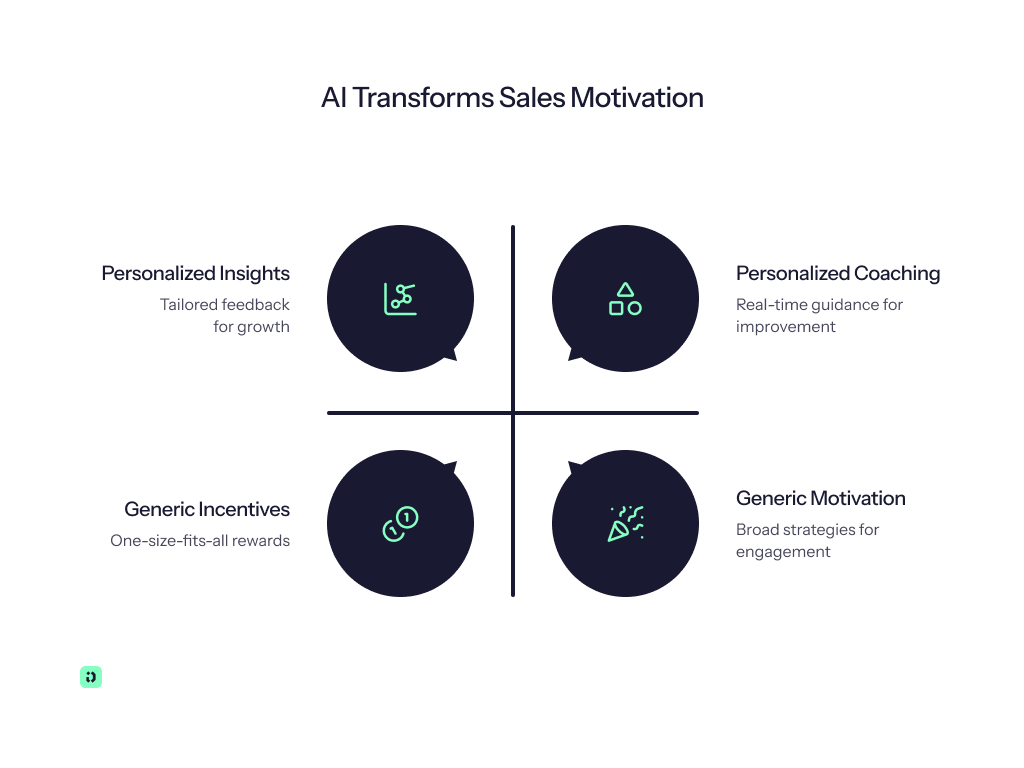
AI is changing how sales teams stay motivated by moving beyond generic approaches to more personalised, data driven strategies. Instead of relying on guesswork, AI provides real time insights, tailored coaching, and smarter incentives that align with individual performance. This shift not only improves productivity but also keeps sales reps more engaged, focused, and driven to achieve better results.
1. Personalized Performance Insights
AI analyzes data across calls, emails, meetings, and conversions to provide tailored insights for each sales representative. Instead of generic feedback, reps receive specific recommendations on:
- Which strategies are working
- Where they are losing deals
- How they can improve performance
This level of personalization creates clarity and empowers salespeople to take ownership of their growth.
2. Real Time Coaching & Feedback
Traditional sales coaching is often delayed and inconsistent. AI changes this by providing real time feedback.
AI powered tools can:
- Analyze sales calls and conversations
- Identify patterns in successful deals
- Suggest improvements instantly
This accelerates the learning curve and helps new hires ramp up faster while enabling experienced reps to continuously refine their approach.
3. Smarter Incentives & Gamification
Motivation in sales is closely tied to incentives, but not all incentives work equally for everyone.
AI helps businesses:
- Identify what drives each sales rep
- Design personalized reward structures
- Align incentives with performance metrics
This approach is explored further in The Future of Sales Compensation: Why AI Is Changing the Game, where the role of AI in creating effective compensation strategies is discussed in depth.
By making incentives more relevant and achievable, organisations can significantly boost engagement and retention.
AI Driven Productivity Leads to Higher Motivation
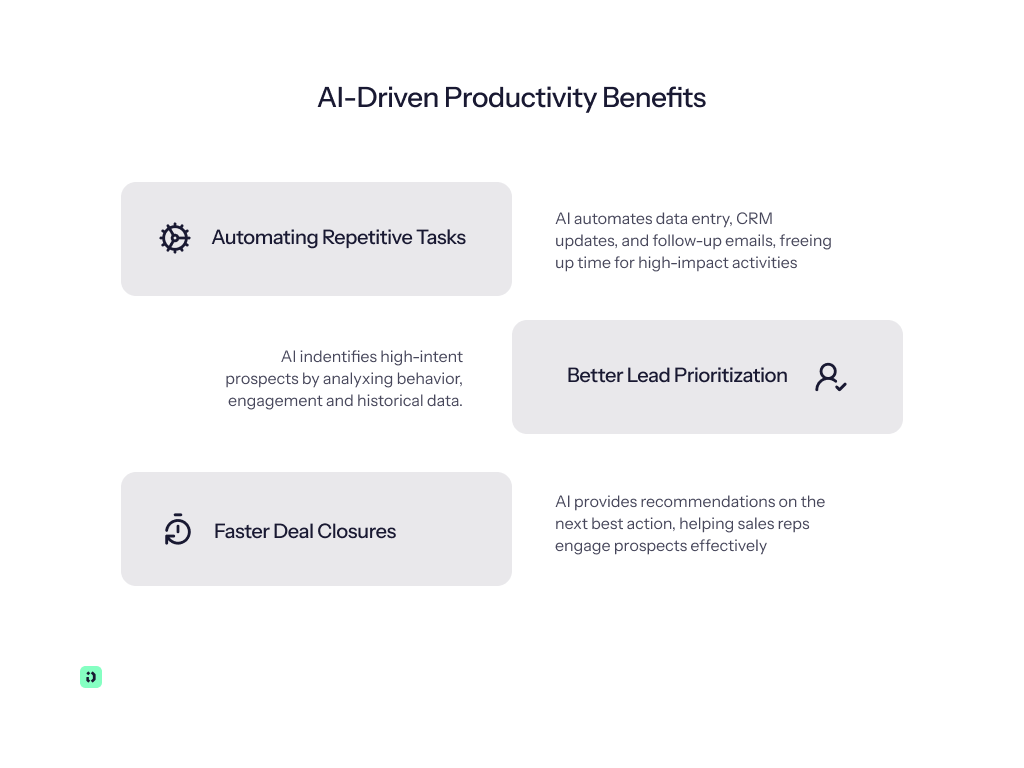
Productivity and motivation in sales are closely connected; when teams work more efficiently, they naturally feel more confident and driven. AI plays a key role here by eliminating time consuming tasks, streamlining workflows, and helping reps focus on high impact activities. As a result, sales professionals can achieve better outcomes with less effort, leading to higher motivation and improved overall performance.
1. Automating Repetitive Tasks
Sales reps often spend hours on the following:
- Data entry
- CRM updates
- Follow up emails
AI automates these processes, freeing up valuable time for high impact activities like building relationships and closing deals. When reps can focus on meaningful work, motivation naturally increases.
2. Better Lead Prioritization
Not all leads are equal. AI helps sales teams identify high intent prospects by analyzing behavior, engagement, and historical data. This means:
- Less time wasted on low quality leads
- Higher chances of conversion
- More consistent wins
Success breeds motivation, and AI helps create more of it.
3. Faster Deal Closures
AI provides recommendations on the next best action, helping sales reps engage prospects at the right time with the right message. This results in:
- Shorter sales cycles
- Improved win rates
- Increased confidence among reps
When teams see tangible results, their motivation and performance go hand in hand.
Enhancing Sales Team Engagement with AI
AI is playing a key role in keeping sales teams engaged by making performance more transparent and goal setting more meaningful. By providing real time insights and continuous support, it helps reps stay focused, motivated, and aligned with business objectives.

1. Data Driven Goal Setting
AI enables organizations to set realistic and achievable goals based on historical performance and market conditions.
This ensures:
- Targets are challenging but attainable
- Reps remain motivated rather than overwhelmed
- Goals are aligned with overall revenue objectives
2. Transparent Performance Tracking
AI powered dashboards provide real time visibility into performance metrics.
Sales reps can:
- Track their progress
- Compare performance with peers
- Identify areas for improvement
This transparency builds accountability and keeps teams engaged.
3. Continuous Learning & Development
AI doesn’t just highlight problems, it also suggests solutions.
Based on performance data, AI can recommend:
- Training modules
- Skill development programs
- Coaching opportunities
This creates a culture of continuous improvement, where learning becomes an ongoing process rather than a one time activity.
The Business Impact of AI on Sales Performance
The benefits of AI extend beyond individual motivation to overall business outcomes:
- Higher productivity: Teams spend more time selling and less time on admin work
- Improved conversion rates: Better targeting leads to more closed deals
- Increased revenue growth: Optimized performance directly impacts the bottom line
- Stronger customer relationships: Personalized interactions improve customer experience
Ultimately, motivated sales teams drive better results, and AI plays a key role in enabling that motivation.
How Driven Helps You Turn AI Insights into Real Sales Motivation
While AI offers powerful capabilities, the real challenge for most organizations is turning insights into action, and that’s where Driven comes in.
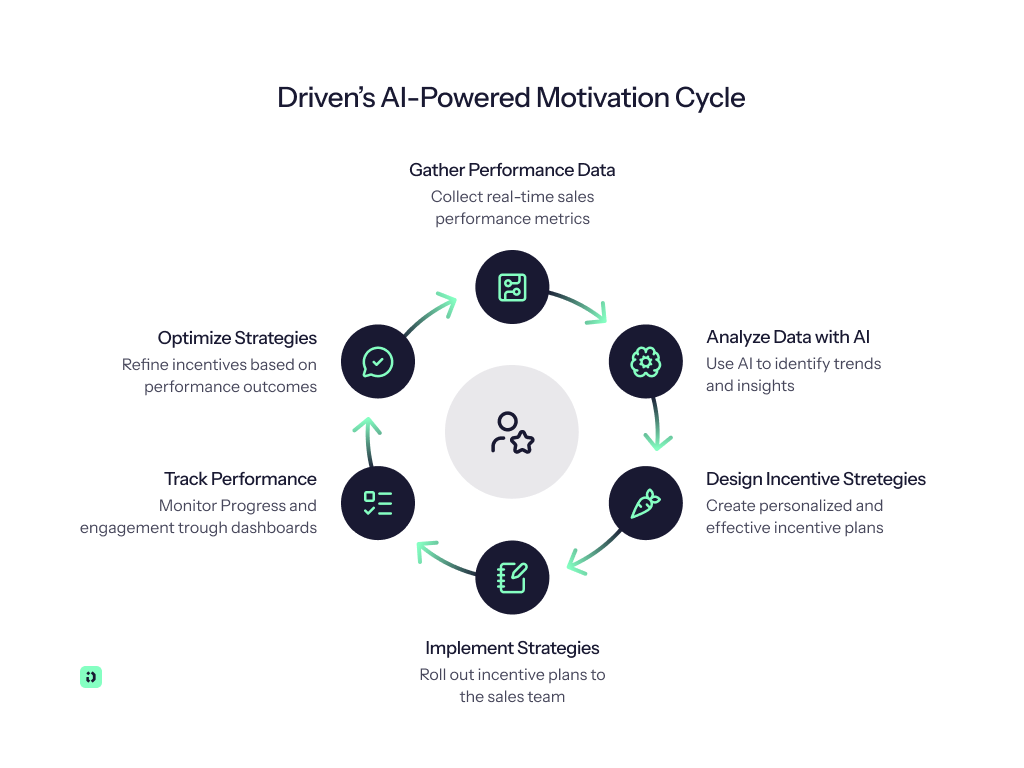
At Driven, we help businesses bridge the gap between performance data and meaningful motivation by using AI to design smarter, more effective incentive strategies.
With Driven, you can:
- Align incentives with real performance metrics: Instead of generic reward systems, Driven helps you create compensation plans that directly reflect individual and team contributions.
- Personalize motivation at scale: Every sales rep is motivated differently. Driven uses AI insights to tailor incentive structures that resonate with each individual, boosting engagement and retention.
- Track performance in real time: Gain complete visibility into sales performance with dynamic dashboards, allowing teams to stay focused, competitive, and goal oriented.
- Optimize compensation strategies continuously: Driven doesn’t just set incentives, it helps you refine them over time based on performance trends and outcomes.
By combining AI driven insights with strategic incentive design, Driven ensures that your sales team is not only productive but also consistently motivated to perform at their best.
The Future of AI in Sales Motivation
AI is evolving rapidly, and its role in sales will only grow stronger. In the future, we can expect:
- AI powered sales copilots guiding reps in real time
- Hyper personalised incentive programs
- Predictive performance management systems
Organisations that embrace these innovations early will gain a significant competitive advantage.
Conclusion
AI is transforming the way sales teams work and, more importantly, how they feel about their work. By reducing repetitive tasks, delivering personalized insights, and enhancing coaching and incentives, AI helps create a more motivated, engaged, and high performing sales force.
At Driven, we go beyond just providing AI insights, we help you turn them into action. By aligning performance with the right incentive strategies, Driven enables businesses to build highly motivated, high performing sales teams that consistently drive revenue growth.



See your comp plan, fully built in minutes

Frequently Asked Questions
About the author





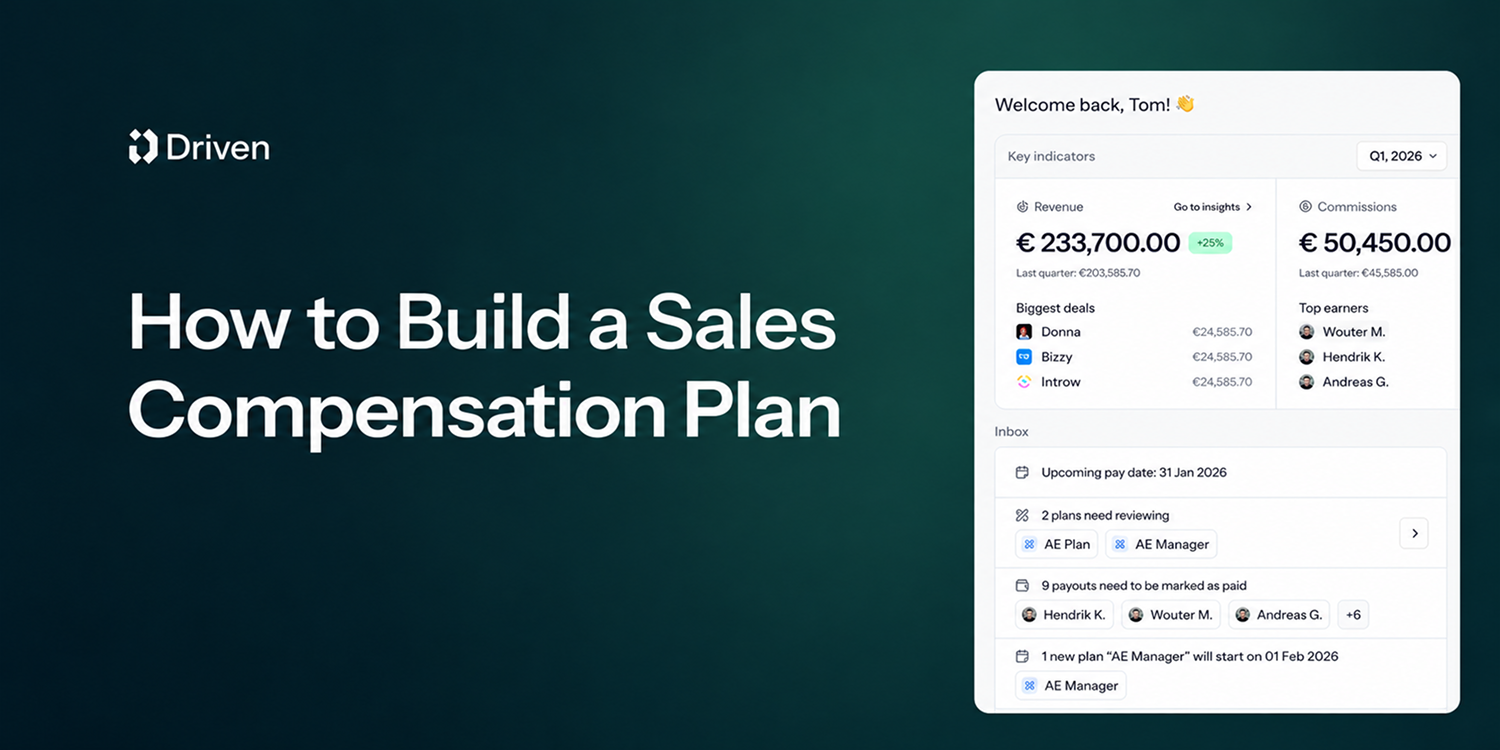
A sales compensation plan defines how your sales team gets paid: a fixed base salary, variable pay like commissions and bonuses, and a quota that decides how much of that variable pay a rep actually earns. Base salary plus target variable pay makes up a rep's on-target earnings (OTE).
Sales compensation plans do more than pay people; they shape behavior, drive revenue, and define culture. Get the plan right, and your team is aligned, motivated, and chasing the numbers that actually matter. Get it wrong, and you'll spend every month-end on disputes, recalculations, and reps who no longer trust their payslip.
This guide covers the core components, the main plan types, and a 10-step process to build your own, followed by three sales compensation plan examples. Jump to the examples. Everything here draws on Driven's work with finance, RevOps, and sales compensation leaders who run these plans every single month.

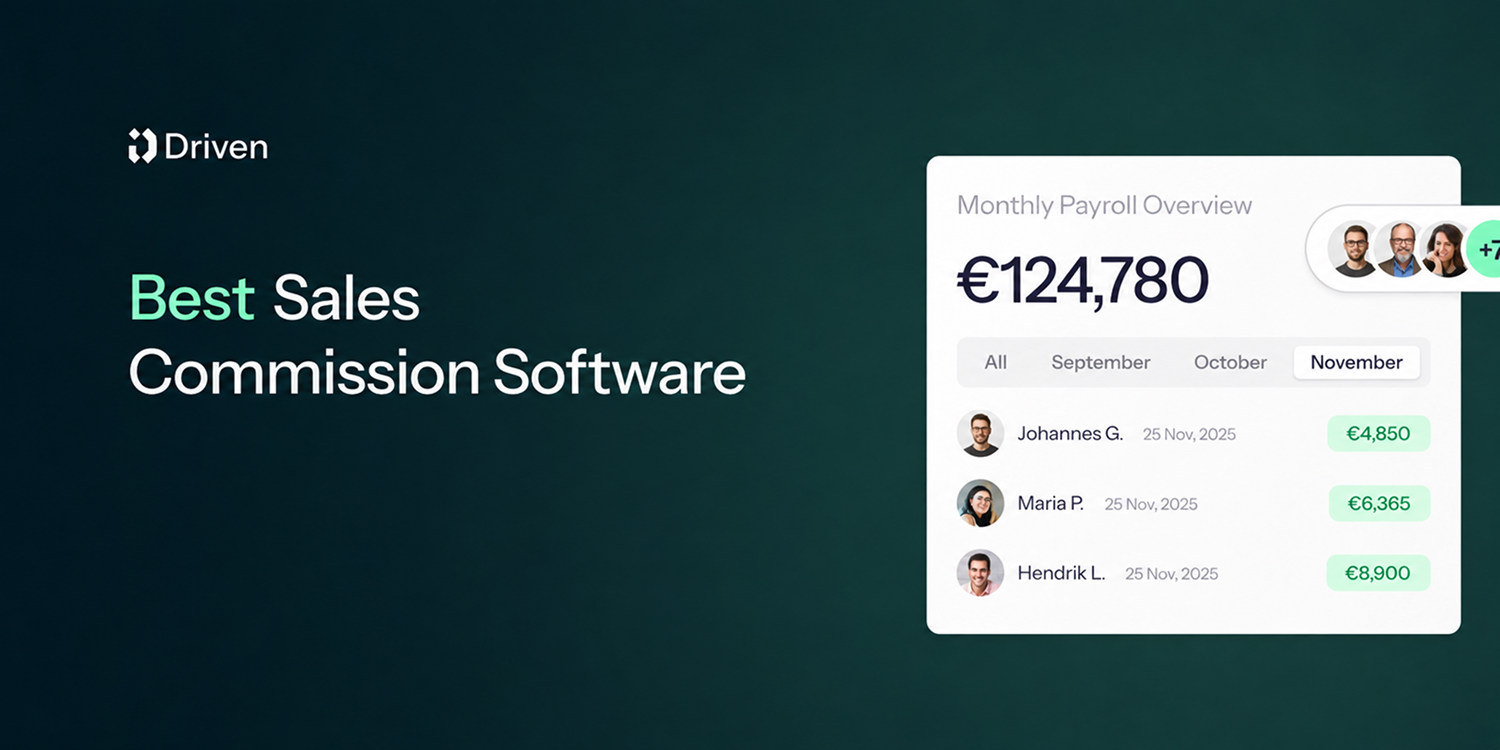
Sales commission software calculates, tracks and explains commissions from your CRM data, so nobody rebuilds a spreadsheet every month. The 9 best tools in 2026:
- Driven: best AI commission agent for HubSpot and Salesforce teams that want to go live in days
- QuotaPath: best for growing teams that want published pricing and broad CRM coverage
- CaptivateIQ: best for mid-market teams with complex, frequently changing plans
- Salesforce Spiff: best for companies that run on Salesforce
- Qobra: best for European RevOps teams that want no-code plans and AI agents
- Xactly Incent: best for large enterprises that also need planning and forecasting
- Performio: best for complex crediting across many data sources and regions
- Sales Cookie: best for small businesses that want month-to-month contracts
- QCommission: best for finance-led teams on QuickBooks or needing on-premise deployment
Choose based on three things: your CRM, how many reps you pay, and how complex your plan is.

TL;DR: Salesforce stores every field commissions depend on, but core Sales Cloud doesn't calculate, explain or protect payouts. Teams close that gap in one of five ways: native formula fields, a custom build, Salesforce's native ICM (Spiff), a vibe-coded tool, or a third-party commission tool. A flat rate and a few reps can stay native. Tiers, accelerators, splits and frequent plan changes point to a dedicated tool, and to an agentic platform like Driven if you want the plan designed, explained and maintained for you.
It's not uncommon for teams in 2026 to still run sales commissions on spreadsheets. The deal data lives in Salesforce, the rates live in a Google Sheet someone built three finance leads ago, and the payouts get reconciled by hand at the end of every quarter. When a rep asks why their number looks different, no one can fully explain it. When finance needs an accrual, someone exports a report and rebuilds it in Excel. The process is time-consuming, error-prone, and actively eroding rep trust. It's hard to keep a sales team motivated when reps can't trust their own paycheck.
Teams that outgrow the spreadsheet usually reach for formula fields, a custom build, or a paid add-on. But tools for managing sales incentives are now moving from rules engines you configure to agents that work alongside you. Gartner predicts that 40% of enterprise applications will feature task-specific AI agents by the end of 2026, up from less than 5% in 2025. They also say that 60% of B2B seller work will be executed through conversational interfaces by 2028.
This guide breaks down five ways to track Salesforce commissions, including what each approach does well, where it breaks, and how to choose.