How to Communicate Compensation Plan Changes to Your Sales Teams in 2026


TL;DR
You can build a highly data driven, strategically aligned compensation plan and still see it fall apart within weeks of rollout. The reason is simple: your sales team may not fully understand it, trust it, or believe they can actually succeed under it. When reps feel uncertain about how they earn, even the best designed plans lose their impact.
In 2026, success in sales compensation isn’t just about plan structure or incentives; it's about how clearly and consistently changes are communicated. Sales teams today are more informed, more analytical, and more sensitive to fairness than ever before something closely tied to trends shaping the future of sales compensation and how AI is changing the game. When communication falls short, confusion grows and motivation drops. This blog breaks down how to communicate compensation plan changes in a way that builds clarity, trust, and adoption rather than resistance.
Why Communication Matters More Than Ever in 2026
Sales compensation is not just another operational update; it directly impacts income, motivation, and job satisfaction. That makes it one of the most emotionally charged topics inside any sales organisation.
When communication is unclear or incomplete, it creates immediate problems:
- Confusion: Reps don’t know how they earn
- Shadow accounting: They start tracking commissions themselves
- Distrust: Leadership decisions are questioned
- Performance drops: Motivation declines when earning potential feels uncertain
On the other hand, when communication is done right, compensation becomes a powerful performance lever. It aligns behaviour, builds confidence, and reinforces trust in leadership.
The Most Common Mistakes Companies Still Make
Even with better tools and increased awareness, many organizations continue to repeat the same communication pitfalls.
- Communicating Too Late: Rolling out a finalised plan without involving reps earlier often leaves them feeling blindsided. It sends a message that their input wasn’t considered in the decision making process.
- Overcomplicating the Message: If a sales rep can’t quickly answer, “What do I need to do to earn more?” then both the plan and how it’s been communicated are already off track.
- Lack of Transparency: When companies avoid sharing clear payout examples or gloss over edge cases, it creates doubt. In the absence of clarity, sales teams tend to assume the worst.
- Treating Communication as a One Time Event: A single kickoff meeting isn’t enough. Without ongoing reinforcement, understanding fades and misinterpretations start to grow.
- Ignoring Manager Enablement: Frontline managers play a critical role in communication. If they’re not fully aligned and equipped, the message quickly becomes inconsistent across teams.
The 2026 Framework for Communicating Compensation Plan Changes
To communicate compensation changes effectively in 2026, organizations need to move beyond one time announcements and adopt a structured, ongoing approach. It is not just about sharing information. It is about building clarity, trust, and alignment over time.
Step 1: Start Early Before Final Decisions Are Made
Most companies wait until plans are finalized before communicating. This often leads to confusion and resistance. A better approach is to involve key stakeholders early, especially sales managers and top performers.
This does not mean opening the entire plan for debate. It means creating space to:
- Share the intent behind upcoming changes
- Gather early feedback from the field
- Identify potential concerns in advance
When people are included early, they feel a sense of ownership. This reduces pushback and makes the final rollout smoother.
Step 2: Lead With the Why, Not the What
Many organizations jump straight into explaining how the plan works. But before reps care about mechanics, they need to understand the reason behind the change.
Start by clearly explaining the business context. For example:
- Expanding into new markets
- Shifting focus from volume to profitability
- Encouraging multi product sales
When the reasoning is clear, acceptance becomes much easier. People are more open to change when they understand the purpose behind it. People support what they understand and believe in.
Step 3: Simplify the Narrative
Compensation plans are often complex, but communication should be simple and clear. The goal is not to explain every detail. The goal is to make the plan easy to understand and act on. Focus your communication on:
- How reps earn money
- What behaviors are rewarded
- What has changed from before
Avoid jargon and overly technical language. Keep the message practical and easy to repeat. A simple test helps here. If a rep cannot explain the plan to a colleague in a few minutes, it needs to be simplified further.
Step 4: Show Real Earning Scenarios
Sales reps think in outcomes, not formulas. That is why real earning scenarios are essential.
Instead of abstract explanations, show what the plan looks like in real situations:
- A high performer exceeding quota
- An average performer meeting expectations
- An underperformer missing targets
These examples help reps quickly understand:
- What happens when they hit quota
- How much more they earn if they exceed it
- What the downside looks like
Clarity at this stage directly improves motivation and confidence.
Step 5: Use a Multi Touch Communication Approach
Effective communication does not happen in a single meeting. It happens through multiple interactions over time. A strong rollout includes:
- An initial announcement with high level context
- Detailed training sessions explaining the plan
- Manager led discussions for team specific clarity
- One on one conversations to address individual concerns
- Ongoing reinforcement through reminders and updates
Each step builds on the previous one. Repetition helps remove confusion and strengthens understanding.
Step 6: Enable Real Time Visibility
In 2026, static documents are no longer enough. Sales teams expect visibility into their performance at all times. This includes:
- Real time earnings tracking
- Clear progress toward quota
- Immediate feedback on performance
Without visibility, reps rely on assumptions. With visibility, they stay informed, aligned, and motivated.
Step 7: Treat Communication as Continuous
Communication should not stop after rollout. It needs to continue throughout the lifecycle of the plan. Strong organizations maintain clarity by:
- Revisiting plans regularly
- Sharing performance insights
- Addressing confusion quickly
This ongoing effort ensures that the plan remains relevant and trusted over time.
What Sales Teams Actually Care About
It is easy to assume reps want every detail, but most focus on a few key questions. If your communication answers these clearly, you are already on the right track.They care about:
- Earning Potential: Sales reps want a clear understanding of how much they can realistically earn based on performance, not just theoretical numbers. Practical examples help them assess if the plan is truly rewarding.
- Fairness: Reps need to feel the plan is balanced and achievable across teams. Clear rules, consistent targets, and transparent payouts build trust and prevent doubts about bias or inequality.
- Control: Reps want confidence that their actions directly impact their earnings. When outcomes feel predictable and tied to effort, motivation increases and they stay more engaged with the plan.
Keeping communication focused on these areas makes it more effective and meaningful.
A Practical Rollout Timeline
An effective compensation rollout does not happen all at once. It follows a structured timeline that builds understanding step by step, allowing teams to absorb information, ask questions, and gain confidence in the plan.
Weeks 1 to 2: Internal Alignment
This phase focuses on getting leadership and managers fully aligned before anything is shared with the broader team. The compensation plan should be finalized, and internal teams should clearly understand how it works.
Key priorities include:
Finalizing the plan structure and logic
Training managers on key details and expected questions
Ensuring consistent messaging across leadership
Strong alignment at this stage prevents confusion later and ensures that managers are prepared to communicate effectively.
Week 3: Early Feedback Loop
Before the official rollout, it is valuable to test the plan with a small group of sales reps. This helps identify gaps in communication and uncover potential concerns.
During this phase:
Share the plan with a select group of reps
Gather feedback on clarity and practicality
Refine messaging based on real input
This step acts as a reality check and helps improve how the plan is presented to the wider team.
Week 4: Official Announcement
This is the first company wide communication about the new compensation plan. The focus here should not be on overwhelming detail, but on setting context and direction.
Communication should cover:
- The overall vision behind the changes
- Key updates and what is different
- What reps should expect next
A clear and confident announcement sets the tone for the rest of the rollout.
Weeks 5 to 6: Training and Enablement
Once the plan is introduced, the focus shifts to helping reps fully understand how it works in practice. This is where deeper learning happens.
Key activities include:
- Conducting training sessions and workshops
- Walking through real earning scenarios
- Answering detailed questions from reps
This phase ensures that reps move from awareness to actual understanding.
Ongoing: Reinforcement
Even after training, communication should continue. Reinforcement helps maintain clarity and prevents misunderstandings over time.
Ongoing efforts include:
- Tracking adoption and engagement
- Addressing new questions as they arise
- Sharing updates and reminders regularly
Consistent reinforcement ensures that the plan remains clear, relevant, and trusted throughout its lifecycle.
How Driven Helps Simplify Compensation Communication
Communicating compensation effectively becomes significantly easier when the right systems are in place.
With a platform like Driven, organizations can:
- Automate complex compensation calculations
- Provide real time earning visibility to reps
- Run simulations before rollout
- Ensure complete transparency across teams
Instead of relying on static spreadsheets and manual explanations, you create a system where reps can see, understand, and trust their earnings at any time.
Final Thought
In 2026, compensation plans rarely fail because of poor design. More often, they fail because they are not communicated clearly or consistently. The organizations that stand out are the ones that communicate early, simplify their messaging, stay transparent, and reinforce understanding over time. When communication is done right, it goes beyond explanation. It builds trust, drives performance, and ensures that sales teams are fully aligned with business goals.
If your sales team clearly understands how to succeed and believes their efforts will lead to meaningful rewards, your compensation plan is already doing its job. To make this easier, platforms like Driven help bring clarity, visibility, and confidence into the process, enabling teams to manage and communicate compensation more effectively.



See your comp plan, fully built in minutes

Frequently Asked Questions
About the author
Andres De Jonge






Understanding SPIFFs, Bonuses, and Commissions
Ask a sales rep what's driving their next paycheck, and you'll often hear all three words used interchangeably: SPIFF, bonus, and commission. They get lumped together as "extra money for selling," but they're not the same thing, and treating them like they are leads to confused reps, inconsistent payouts, and comp plans nobody can actually explain.
A SPIFF is a short-term, targeted incentive. A bonus is a lump-sum reward tied to hitting a broader goal. A commission is the ongoing, formula-based pay tied directly to sales, the core of most sales comp plans, not an add-on to it.
This guide breaks down what each one actually means, when companies use them, how they're calculated, and how they stack together so you can build a comp plan where every payout has a clear reason behind it.
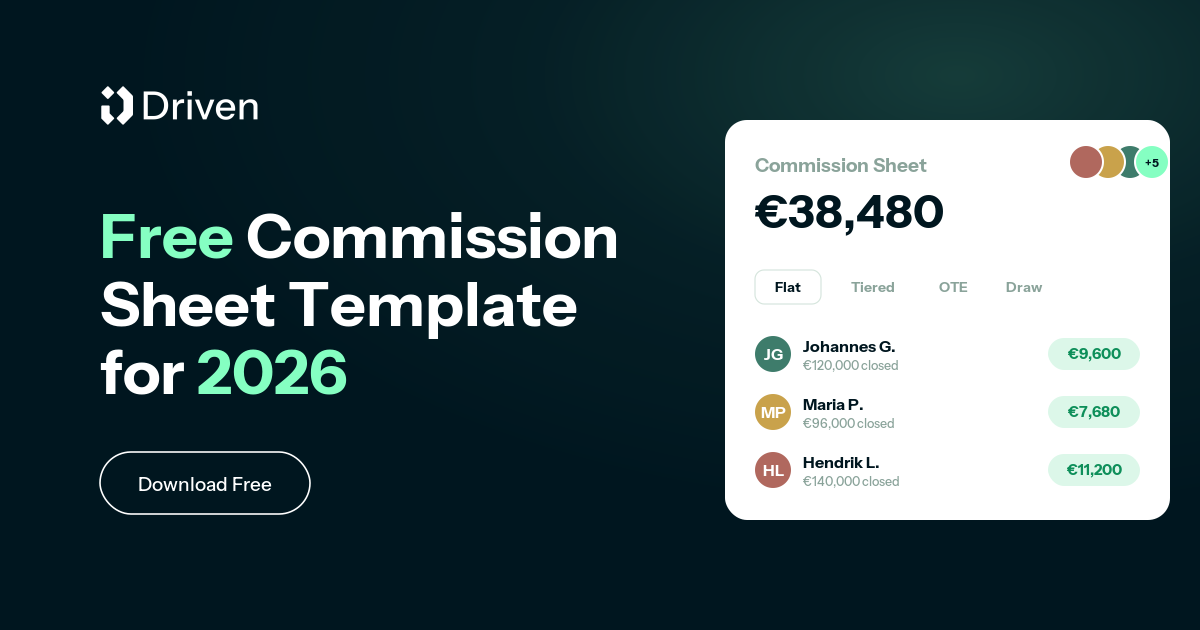
Free Commission Sheet Template: 8 Sales Commission Spreadsheets in One Excel File
Most commission plans don't fail because the idea is wrong. They fail because nobody modelled the numbers before rolling them out. A rate that looks generous on a slide turns into a payout you can't afford at 130% attainment, or an accelerator so flat that your best reps stop pushing the moment they hit quota.
So we built a free commission sheet template to fix that. It's one Excel file with eight ready-to-use sales commission spreadsheets, each structure on its own tab, each with live formulas and a filled-in sample row. Change a rate, a quota, or a revenue number and every payout updates instantly, and because everything lives in one workbook you can compare models side by side without juggling downloads.
Download the commission sheet template, or start for free and let Driven build the plan for you.

New to comp design? Start with our guide to sales compensation structure types, then model your pick here.


Non-Recoverable Draw vs. Recoverable Draw: What's the Difference?
New sales hires often get offered a "draw" against commission, and most sign the offer letter without knowing there are two very different types. That gap in understanding can mean thousands of dollars either staying in a rep's pocket or getting clawed back months later.
A draw is essentially an advance on future commission, designed to give reps steady income while they ramp up pipeline and close their first deals. But whether that advance is recoverable or non-recoverable determines something much bigger: whether it ever has to be paid back.
This guide breaks down what each draw type means, how they're calculated, when companies typically use each one, and the mistakes that turn a helpful ramp tool into a trust problem between reps and the company that hired them.




.svg%201.avif)