Revenue Operations has become the foundation of modern revenue teams in 2026. What once focused mainly on aligning sales and marketing now connects every revenue-related function, workflow, and process across the organisation. However, many companies still struggle with disconnected tools and fragmented systems. Businesses invest in CRMs, forecasting platforms, analytics software, customer success tools, and compensation management systems, but often end up with siloed data and inefficient workflows.
As a result, teams spend more time fixing operational issues than driving growth. A successful RevOps tech stack is not about having more software, it’s about ensuring every tool works together seamlessly. In this guide, we’ll explore how to build a connected RevOps stack that improves visibility, automation, and operational efficiency while reducing complexity. We’ll also look at how platforms like Driven help automate commission operations with AI-powered workflows.
What Is a RevOps Tech Stack?
A RevOps tech stack is the collection of systems, platforms, and tools used to manage revenue operations across your organisation.
It typically includes software for:
CRM management
Marketing automation
Sales engagement
Revenue forecasting
Compensation management
Customer success
Analytics and reporting
The goal of a RevOps stack is not simply to “have tools". The goal is to create a unified operational system where data flows seamlessly across teams. When built correctly, a RevOps stack helps organizations:
Eliminate manual work
Improve forecasting accuracy
Align sales, finance, and customer success
Increase visibility into revenue performance
Reduce operational inefficiencies
Scale revenue processes efficiently
The problem is that many companies build stacks reactively instead of strategically.
Why Most RevOps Tech Stacks Fail
Most RevOps problems are not caused by a lack of software. They are caused by poor system design. Here are the most common reasons RevOps stacks break down.
1. Tool Sprawl
Tool sprawl happens when different departments purchase software independently without considering overall operational alignment. Marketing, sales, finance, and customer success often end up using separate systems that do not communicate properly. This creates disconnected workflows, duplicate work, and fragmented data across the organisation.
2. Poor Integrations
A RevOps stack depends heavily on smooth integrations between tools. When systems fail to sync data correctly, companies face issues like duplicate records, inaccurate forecasts, and manual data handling. Even small integration problems can disrupt revenue operations and reduce reporting accuracy.
3. Siloed Reporting
Siloed reporting occurs when different teams rely on separate data sources and dashboards. Sales, finance, and leadership may all see different revenue numbers, creating confusion and reducing trust in reporting. Without a shared source of truth, decision-making becomes slower and less reliable.
4. Low Team Adoption
A RevOps stack only works if teams actively use the tools. Complex workflows, poor user experience, and disconnected systems often push employees back to spreadsheets and manual processes. Low adoption reduces visibility, weakens automation, and creates operational inefficiencies.
5. Automating Broken Processes
Automation cannot solve poorly structured processes. Many companies automate workflows before clearly defining approvals, ownership, compensation rules, and operational handoffs. This often creates faster inefficiencies instead of improving operations.
The Core Components of a Modern RevOps Stack
While every company’s stack will look slightly different, most high-performing RevOps teams rely on several core categories of tools.
1. CRM (Core System of Record)
The CRM is the foundation of RevOps and acts as the single source of truth for all revenue data.
It stores:
Customer information
Pipeline and deal stages
Revenue activity
Sales performance data
Popular tools include Salesforce, HubSpot, and Pipedrive. If the CRM is not maintained properly, the entire RevOps stack becomes unreliable.
2. Marketing Automation
These tools manage lead generation and nurture prospects through the funnel.
They help with:
Lead scoring
Email nurturing campaigns
Attribution tracking
Funnel performance analysis
Common platforms include Marketo and HubSpot, now closely linked with revenue forecasting systems.
3. Sales Engagement
Sales engagement tools streamline and automate outreach activities for sales teams.
They handle:
Email sequences
Call tracking
Activity logging
Prospect engagement workflows
Tools like Outreach and Salesloft ensure engagement data flows directly into the CRM.
4. Revenue Intelligence & Forecasting
These platforms help improve visibility and accuracy across the pipeline.
They focus on:
Pipeline health analysis
Deal risk detection
Forecast accuracy
Revenue trend monitoring
Clari and Gong are leading tools, increasingly powered by AI-driven insights.
5. Compensation & Incentives
Commission management is a critical part of RevOps as teams scale.
These tools focus on retaining and growing existing customers.
They help with:
Customer health tracking
Churn prediction
Renewal management
Expansion opportunities
Gainsight and ChurnZero are widely used and connect success metrics back to revenue outcomes.
7. Analytics & BI
BI tools provide centralised reporting and visibility across revenue operations.
They enable:
Executive dashboards
Revenue performance analysis
Unified reporting
Operational monitoring
Looker and Tableau help ensure all teams work from consistent, reliable data.
How to Build a RevOps Tech Stack That Actually Works Together
Now that we’ve explored the core components of a RevOps stack, the next step is understanding how to connect them into a system that actually works. A strong RevOps stack isn’t built by collecting tools; it’s built by designing workflows, data flows, and automation in a structured way. The goal is to reduce friction between teams, improve data accuracy, and create a single, reliable revenue engine.
Step 1: Start With Revenue Processes, Not Software
Before choosing any tools, you need a clear understanding of how revenue actually moves through your organisation. This means mapping the full lifecycle from lead generation to closed-won deals and renewals.
Focus on:
How leads move through the funnel
How handoffs happen between teams
Where bottlenecks slow down deals
Which tasks are still manual
What metrics leadership depends on
Once these processes are clear, technology becomes easier to choose and align. The key principle is simple: software should support your revenue process, not define it. When companies start with tools instead of workflows, they often end up redesigning everything later.
Step 2: Establish a Single Source of Truth
One of the biggest challenges in RevOps is inconsistent data across systems. When different tools store different versions of the same information, teams lose trust in reporting and decision-making slows down.
To avoid this, most organisations centralise data in the CRM as the main system of record, while other tools sync around it.
A strong setup ensures the following:
Compensation platforms use verified revenue data
Forecasting tools pull from consistent pipeline information
Analytics dashboards reflect the same numbers across teams
Without a single source of truth, scaling RevOps becomes increasingly complex and unreliable over time.
Step 3: Prioritise Native Integrations
In 2026, how well your tools connect is more important than how many features they offer. A RevOps stack only works efficiently when data moves smoothly between systems without delays or errors.
When evaluating tools, focus on:
Strong API capabilities
Native integrations with core platforms
Minimal reliance on middleware
Real-time or near real-time data sync
The fewer manual touchpoints involved, the more stable and scalable your RevOps operations become. Poor integrations often create hidden operational debt that grows over time
Step 4: Eliminate Redundant Tools
As companies grow, their RevOps stack often becomes cluttered with overlapping tools that serve similar purposes. This leads to higher costs, confusion, and low adoption across teams.
Before adding new software, ask:
Is this already handled by an existing tool?
Are we fully using what we already have?
Does this actually improve revenue efficiency?
Will teams realistically adopt it?
More tools do not automatically mean better performance. In many cases, simplifying the stack leads to better visibility, cleaner data, and faster execution.
Step 5: Automate High-Impact Workflows
Automation is one of the most powerful parts of a modern RevOps stack, but it only works when applied to stable and well-defined processes. The goal is to reduce repetitive manual work, not to automate chaos.
High-impact areas for automation include:
Lead routing and assignment
Forecast updates and pipeline tracking
Commission calculations and payouts
Renewal reminders and alerts
Revenue reporting and dashboards
Pipeline risk notifications
Platforms like Driven.work help RevOps teams automate commission workflows that are often complex, time-consuming, and error-prone. By focusing on structured processes, automation improves accuracy, speed, and operational consistency across the revenue organisation.
Responding to RFPs and security questionnaires is another workflow that drains revenue teams. These requests often pull sales, presales, and subject matter experts away from active deals for days at a time, and the same answers get rewritten from scratch for every new deal. This is where RFP automation fits into a modern RevOps stack. By drawing verified answers from a central knowledge base, these tools help teams produce accurate first drafts in minutes and keep response history connected to the CRM, so win rates and turnaround times stay visible alongside the rest of your revenue reporting.
The Growing Role of AI in RevOps
AI is fundamentally changing how RevOps teams operate. In the past, software mainly focused on reporting and workflow management.
Today, AI systems are actively assisting with:
Forecast analysis
Revenue anomaly detection
Churn prediction
Compensation validation
Operational recommendations
Workflow optimization
The rise of AI commission agents is one example of this shift. Modern platforms are introducing AI-powered compensation operations that reduce admin work while improving accuracy and transparency. In 2026, the future of RevOps is not simply connected software; it’s intelligent operational orchestration.
Common RevOps Stack Mistakes to Avoid
Even mature organizations make costly RevOps mistakes.
Buying Too Many Tools: Complexity creates operational drag.
Ignoring Data Hygiene: Poor CRM data destroys forecasting accuracy.
Delaying Compensation Automation: Manual commission operations become difficult to scale quickly.
Building Around Departments Instead of Revenue: RevOps requires cross-functional alignment.
Overengineering Workflows: Simple systems are often more effective and easier to maintain.
What a High-Performing RevOps Stack Looks Like in 2026
The best RevOps stacks share several characteristics:
Clean integrations
Shared revenue visibility
Real-time reporting
Automated operational workflows
Minimal spreadsheet dependency
AI-assisted insights
Cross-functional alignment
Most importantly, high-performing stacks create trust.
Final Thoughts
Building a RevOps tech stack in 2026 is not about collecting the newest tools. It’s about designing a connected revenue system that helps teams operate efficiently at scale. The companies winning today are not necessarily the ones with the largest software budgets. They are the ones building operational alignment across their revenue organisation. That means cleaner integrations, better automation, shared visibility, reliable data, smarter compensation operations and AI powered workflows.
As RevOps continues to evolve, platforms like Driven.work are helping organizations modernize compensation management and reduce operational complexity with AI-driven commission workflows. If you’re looking to simplify your RevOps stack and automate commission operations with AI-powered workflows, explore how Driven.work can help you build a more connected and efficient revenue system.
Frequently Asked Questions
What is a RevOps tech stack?
A RevOps tech stack is the collection of software tools used to manage revenue operations across sales, marketing, customer success, and finance. It helps organizations align teams, automate workflows, and improve revenue visibility.
Why is an integrated RevOps stack important?
An integrated RevOps stack ensures all systems share accurate data in real time. This reduces manual work, improves reporting accuracy, and helps teams make faster revenue decisions.
A SPIFF (Sales Performance Incentive Fund) is a short-term cash incentive tied to a specific, immediate action, usually selling a particular product, hitting a short-window target, or pushing a specific behavior the company wants right now.
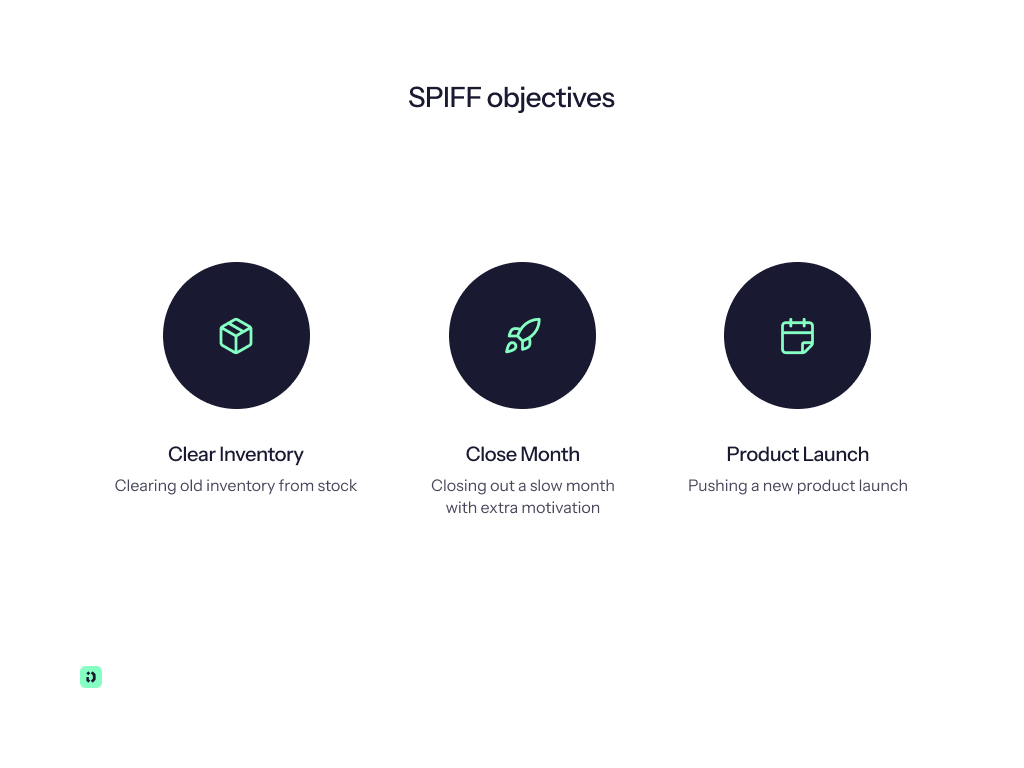
SPIFFs are built for speed. They're announced, run for a defined stretch, usually days or weeks, and paid out fast, sometimes even same-day or same-week, specifically because the immediacy is what makes them effective. A SPIFF isn't meant to replace commission, it's meant to temporarily redirect a rep's attention toward something specific: clearing old inventory, pushing a new product launch, or closing out a slow month with extra motivation.
A draw in sales compensation is a guaranteed advance payment made to a salesperson against their future commissions. This means it is an advance against future commission, paid out on a regular schedule, usually monthly, so reps have predictable income before their pipeline turns into closed deals and actual commission.
Companies use draws to protect new reps' income during ramp. A brand-new AE with a three-month sales cycle isn't going to close anything in week two, but they still need to pay rent. A draw bridges that gap.
For sales professionals, understanding draw type matters because it affects real take-home pay, not just cash flow timing. Two reps can be offered the exact same dollar amount as a "draw" and end up with completely different financial outcomes, depending on which type it actually is.
Before comparing pay, it helps to be clear on what each role is actually on the hook for. They sit on the same team, but they're not doing the same job.
What Does an SDR Do?
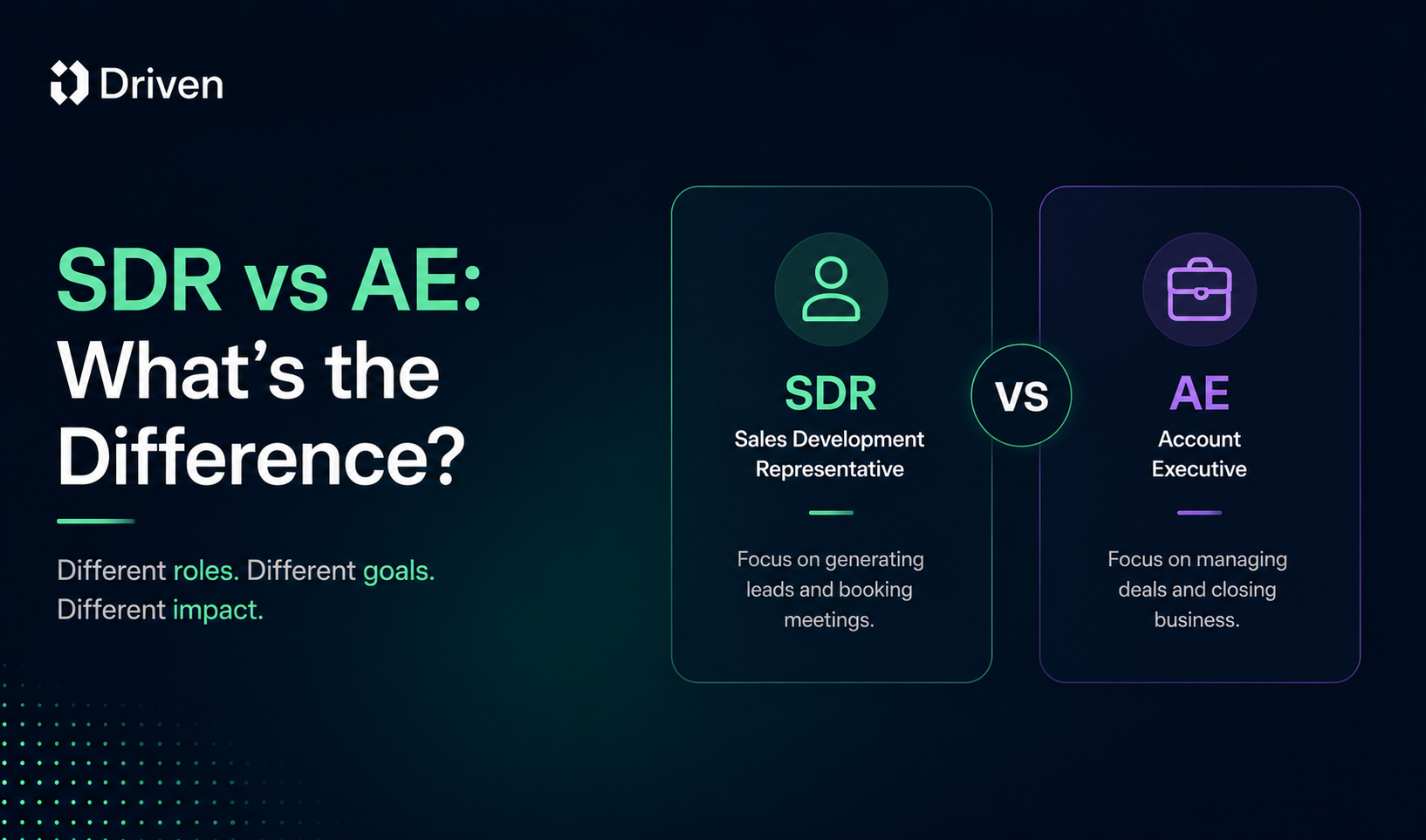
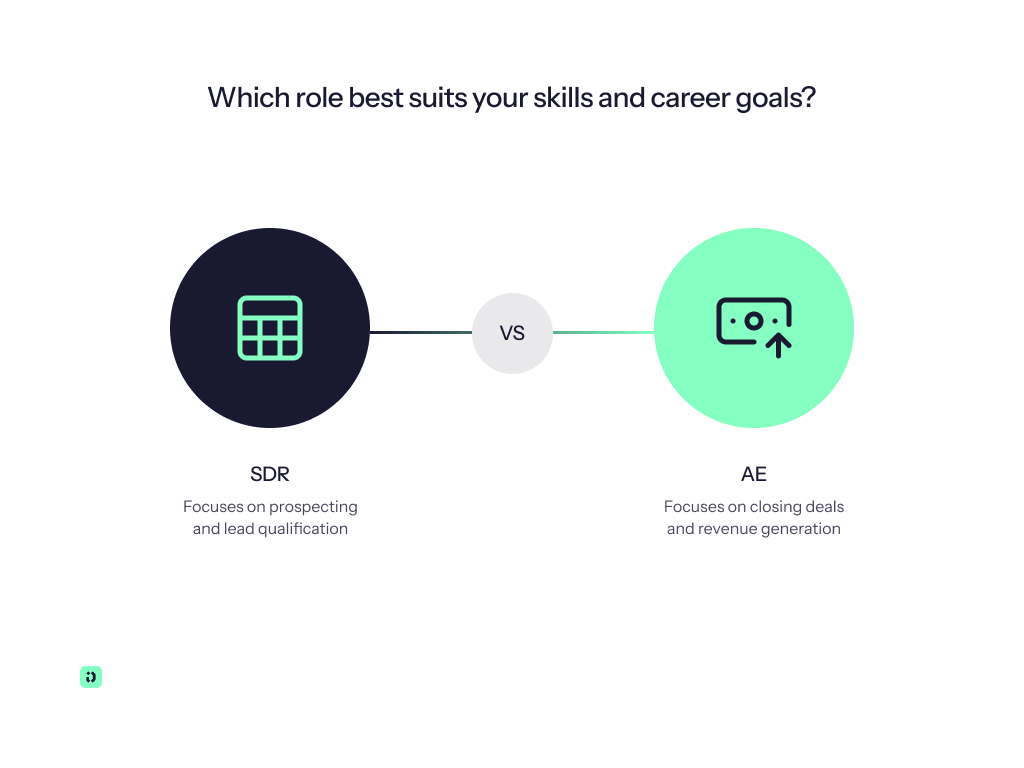
SDRs own the top of the funnel. Their day is built around prospecting, outbound outreach, and lead qualification, all pointed at one outcome: booking meetings and creating a pipeline for AEs to work. SDRs generally aren't responsible for closing deals. Their job ends where the AE's job begins.
What Does an AE Do?
AEs own the deal once it's qualified. That means running discovery calls, delivering product demos, negotiating terms, and closing the deal. AEs carry direct revenue ownership, and in a lot of organizations, they also handle account management once the deal is signed. The pressure sits differently here: an AE's number is measured in dollars closed, not meetings booked.

.png)


.avif)



.png)
.png)







.svg%201.avif)