Driven Raises €1.5M to Reinvent Sales Compensation & Performance with AI

%20Justine%20Wolfs-3%20(1)%20(1).jpg)
TL;DR
We are thrilled to announce a major milestone in our journey. Driven has successfully raised €1.5 million in a pre-seed funding round to scale our AI-powered platform for dynamic sales compensation. This is a huge step forward in our mission to transform how sales teams are motivated and rewarded.
This funding round was led by the venture capital firm Pitchdrive, with significant participation from NewSchool VC. We are also incredibly proud to have the backing of some of Belgium's most respected tech entrepreneurs, including Jeroen De Wit of Teamleader, the Henchman team (Gilles Mattelin, Jorn Vanysacker, and Wouter Van Respaille), and Matthias Geeroms from Lighthouse. Their belief in our vision reinforces our commitment to solving a long-standing industry problem.
The Problem with Traditional Sales Compensation
For decades, sales compensation has been a source of frustration for both managers and their teams. Variable pay is a standard component for about half of all salespeople, yet the methods for managing it are often stuck in the past. Most companies still rely on complex, error-prone spreadsheets that are difficult to maintain and update.
This outdated approach leads to several key challenges:
- Delayed Updates: Commission calculations often happen weeks or even months after a deal closes, creating a disconnect between effort and reward.
- Lack of Transparency: Sales reps are frequently left in the dark about their progress toward goals and what their potential earnings are. This uncertainty can be a powerful demotivator.
- Misaligned Incentives: Static plans struggle to adapt to changing market conditions or business priorities, leading to incentives that don't drive the right behaviors.
- Administrative Burden: Managers spend countless hours manually calculating payouts and resolving disputes, taking time away from coaching and strategy.
These issues don't just affect morale; they directly impact performance and revenue. When motivation wanes and incentives are unclear, sales performance suffers.
How Driven Changes the Game with AI
Driven was founded in early 2025 by Ludovic Diercxsens, Andres De Jonge, and Tom De Kooning to tackle these problems head-on. Our platform moves sales compensation out of static spreadsheets and into a dynamic, intelligent, and transparent system.
By connecting directly to your company's CRM, such as HubSpot or Salesforce, Driven provides a single source of truth for all sales performance and commission data.
Here’s how our solution empowers your entire sales organization:
Real-Time Performance Tracking
With Driven, the days of waiting for end-of-quarter reports are over. Sales representatives get a personal dashboard that shows their progress toward targets in real time. They can see exactly how each activity and closed deal impacts their earnings, providing immediate positive reinforcement and a clear understanding of what they need to do to succeed.
Automated and Smart Commission Plans
Our AI-native platform automates the entire commission process. Managers can set up fair and transparent compensation plans based on historical data, industry benchmarks, and live performance metrics. The AI assistant helps create smart incentive structures that align individual goals with broader company objectives, ensuring everyone is working toward the same outcome.
"Driven is the tool that motivates sales teams through smart incentives," says our CEO, Ludovic Diercxsens. "By making goals visible and dividing them fairly, everyone in the company knows exactly what they’re working toward. That clarity instantly lifts motivation."
Improved CRM Data Quality
A common pain point for sales leaders is poor data quality in the CRM. Inaccurate or incomplete data leads to flawed forecasting and misguided strategies. Driven solves this by directly linking commission payouts to the data logged in the CRM.
As CTO Andres De Jonge explains, "Better data automatically means better sales. When reps know that their pay depends on clean CRM inputs, they become much more disciplined." This creates a virtuous cycle where better data leads to better insights, which in turn drives better performance.
Our Journey and What's Next
Driven is the seventh startup to emerge from the Ghent-based venture builder StarApps, which has a track record of building successful companies like Bizzy and FixForm. We are proud to already be working with early adopters such as the cybersecurity firm Aikido.
With this new €1.5 million in funding, we are ready to accelerate our growth. Our primary focus will be on expanding our team, doubling down on product development, and onboarding more customers across Europe. We have an ambitious goal to reach €1 million in revenue by 2026, and this investment provides the fuel to get us there.
We are building a future where sales compensation is no longer a source of confusion and frustration, but a powerful driver of performance and motivation. We believe that by providing clarity, transparency, and intelligent automation, we can help companies unlock the full potential of their sales teams.
Thank you to our investors, early customers, and the entire Driven team for being part of this incredible journey. The best is yet to come.
Conclusion
Driven is setting a new standard for sales compensation by harnessing the power of AI. Their platform directly addresses some of the most persistent problems in the industry—delayed payouts, lack of transparency, and CRM data challenges—while empowering sales teams and managers to achieve more. As they expand across Europe and continue to innovate, Driven is well-positioned to become a leader in smart sales compensation and help businesses unlock greater motivation and growth within their sales organizations.



See your comp plan, fully built in minutes

FAQ
About the author
Ludovic Diercxsens






Understanding SPIFFs, Bonuses, and Commissions
Ask a sales rep what's driving their next paycheck, and you'll often hear all three words used interchangeably: SPIFF, bonus, and commission. They get lumped together as "extra money for selling," but they're not the same thing, and treating them like they are leads to confused reps, inconsistent payouts, and comp plans nobody can actually explain.
A SPIFF is a short-term, targeted incentive. A bonus is a lump-sum reward tied to hitting a broader goal. A commission is the ongoing, formula-based pay tied directly to sales, the core of most sales comp plans, not an add-on to it.
This guide breaks down what each one actually means, when companies use them, how they're calculated, and how they stack together so you can build a comp plan where every payout has a clear reason behind it.

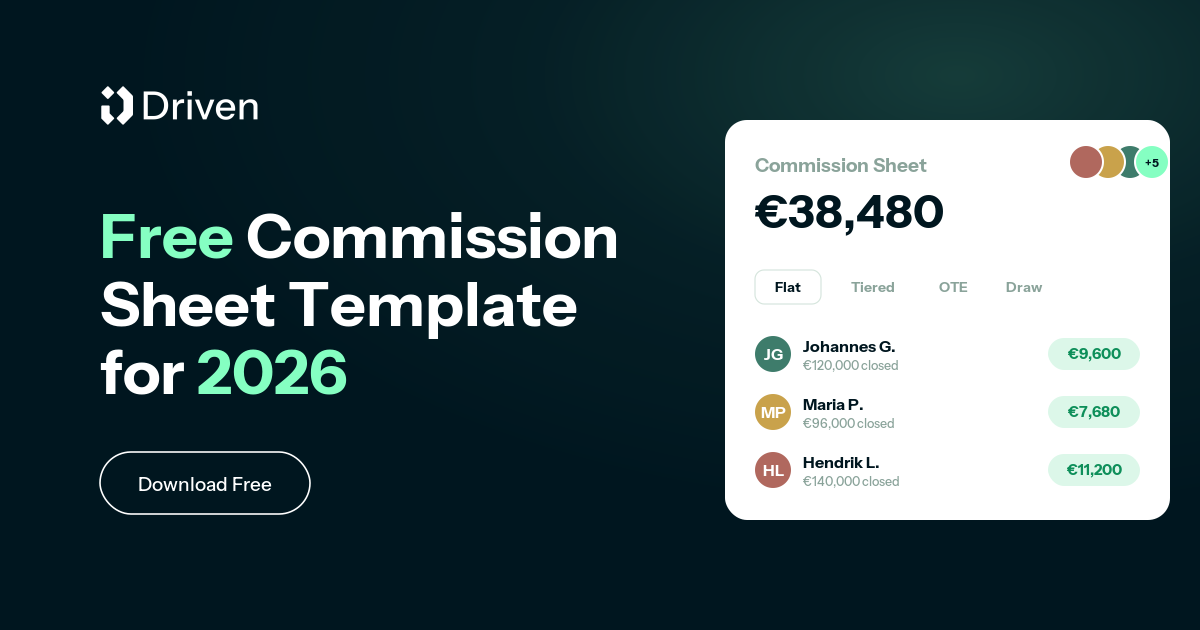
Free Commission Sheet Template: 8 Sales Commission Spreadsheets in One Excel File
Most commission plans don't fail because the idea is wrong. They fail because nobody modelled the numbers before rolling them out. A rate that looks generous on a slide turns into a payout you can't afford at 130% attainment, or an accelerator so flat that your best reps stop pushing the moment they hit quota.
So we built a free commission sheet template to fix that. It's one Excel file with eight ready-to-use sales commission spreadsheets, each structure on its own tab, each with live formulas and a filled-in sample row. Change a rate, a quota, or a revenue number and every payout updates instantly, and because everything lives in one workbook you can compare models side by side without juggling downloads.
Download the commission sheet template, or start for free and let Driven build the plan for you.

New to comp design? Start with our guide to sales compensation structure types, then model your pick here.


Non-Recoverable Draw vs. Recoverable Draw: What's the Difference?
New sales hires often get offered a "draw" against commission, and most sign the offer letter without knowing there are two very different types. That gap in understanding can mean thousands of dollars either staying in a rep's pocket or getting clawed back months later.
A draw is essentially an advance on future commission, designed to give reps steady income while they ramp up pipeline and close their first deals. But whether that advance is recoverable or non-recoverable determines something much bigger: whether it ever has to be paid back.
This guide breaks down what each draw type means, how they're calculated, when companies typically use each one, and the mistakes that turn a helpful ramp tool into a trust problem between reps and the company that hired them.


.svg%201.avif)